


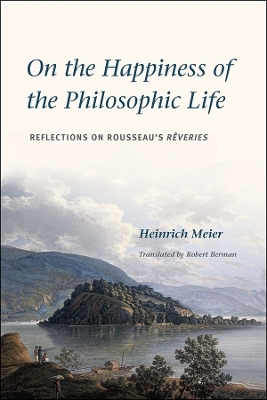
On the Happiness of the Philosophic Life
Reflections on Rousseau's "Rêveries" in Two Books
Seiten
2026
University of Chicago Press (Verlag)
978-0-226-84924-9 (ISBN)
University of Chicago Press (Verlag)
978-0-226-84924-9 (ISBN)
- Noch nicht erschienen (ca. Mai 2026)
- Versandkostenfrei
- Auch auf Rechnung
- Artikel merken
A paradigm-shifting, original examination of Rousseau’s final work, Rêveries.On the Happiness of the Philosophic Life presents Heinrich Meier’s confrontation with Rousseau’s Rêveries, the philosopher’s most beautiful and daring work, as well as his last and least understood. Bringing to bear more than thirty years of study of Rousseau, Meier unfolds his stunningly original interpretation in two parts.
The first part of On the Happiness of the Philosophic Life approaches the Rêveries not as another autobiographical text in the tradition of the Confessions and the Dialogues, but as a reflection on the philosophic life and the distinctive happiness it provides. The second turns to a detailed analysis of a work referred to in the Rêveries, the “Profession of Faith of the Savoyard Vicar,” which triggered Rousseau’s political persecution when it was originally published as part of Émile. In his examination of this most controversial of Rousseau’s writings, which aims to lay the foundations for a successful nonphilosophic life, Meier brings to light the differences between natural religion as expressed by the Vicar and Rousseau’s natural theology. Together, the two reciprocally illuminating parts of this study provide an indispensable guide to Rousseau and to the understanding of the nature of the philosophic life.
The first part of On the Happiness of the Philosophic Life approaches the Rêveries not as another autobiographical text in the tradition of the Confessions and the Dialogues, but as a reflection on the philosophic life and the distinctive happiness it provides. The second turns to a detailed analysis of a work referred to in the Rêveries, the “Profession of Faith of the Savoyard Vicar,” which triggered Rousseau’s political persecution when it was originally published as part of Émile. In his examination of this most controversial of Rousseau’s writings, which aims to lay the foundations for a successful nonphilosophic life, Meier brings to light the differences between natural religion as expressed by the Vicar and Rousseau’s natural theology. Together, the two reciprocally illuminating parts of this study provide an indispensable guide to Rousseau and to the understanding of the nature of the philosophic life.
Heinrich Meier is director of the Carl Friedrich von Siemens Foundation in Munich, professor of philosophy at the University of Munich, and permanent visiting professor in the John U. Nef Committee on Social Thought at the University of Chicago. He is the author of eight books, including Carl Schmitt and Leo Strauss and The Lesson of Carl Schmitt. Robert Berman is professor of philosophy at Xavier University of Louisiana.
| Erscheint lt. Verlag | 20.5.2026 |
|---|---|
| Übersetzer | Robert Berman |
| Zusatzinfo | 2 halftones |
| Sprache | englisch |
| Maße | 152 x 229 mm |
| Gewicht | 454 g |
| Themenwelt | Geisteswissenschaften ► Philosophie |
| Sozialwissenschaften | |
| ISBN-10 | 0-226-84924-4 / 0226849244 |
| ISBN-13 | 978-0-226-84924-9 / 9780226849249 |
| Zustand | Neuware |
| Informationen gemäß Produktsicherheitsverordnung (GPSR) | |
| Haben Sie eine Frage zum Produkt? |
Mehr entdecken
aus dem Bereich



aus dem Bereich
wie Tiere den Tod verstehen
Buch | Hardcover (2025)
Insel Verlag
CHF 42,90
eine Ethik des Verzichts
Buch | Softcover (2025)
Reclam (Verlag)
CHF 9,80
Buch | Softcover (2025)
Wiley-VCH (Verlag)
CHF 30,80


