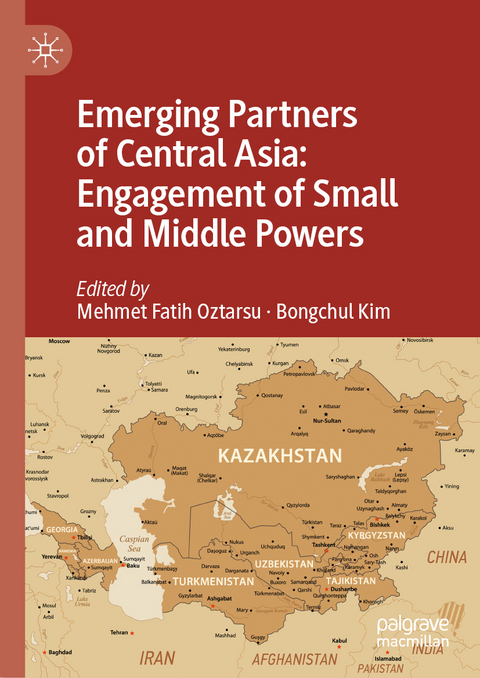
Emerging Partners of Central Asia: Engagement of Small and Middle Powers
Springer International Publishing (Verlag)
978-3-032-10498-4 (ISBN)
- Noch nicht erschienen - erscheint am 21.02.2026
- Versandkostenfrei
- Auch auf Rechnung
- Artikel merken
This book presents a fresh perspective on the geopolitics of Central Asia by shifting attention from great powers such as Russia, China, and the United States to the growing role of small and middle powers. It examines how states including South Korea, Japan, Turkey, Iran, Israel, Azerbaijan, Georgia, Pakistan, India, Brazil, Argentina, Mexico, Gulf countries, and Southeast Asian nations interact with the region through economic cooperation, security ties, and cultural diplomacy. By analyzing these often-overlooked actors, the volume fills a critical gap in international relations and Central Asian studies. It highlights how smaller states shape regional stability, economic growth, and geopolitical competition, while adopting strategies that reflect both opportunity and constraint. Bringing together leading scholars from multiple disciplines, the book offers valuable insights into foreign policy, economic initiatives, and soft power engagement. It will serve as an essential resource for scholars, policymakers, and students seeking to understand Central Asia s evolving dynamics.
Dr. Mehmet Fatih Oztarsu is Assistant Professor at Joongbu University and Senior Researcher at Hankuk University of Foreign Studies. He has worked as a journalist and academic in Baku, Yerevan, Tbilisi, and Seoul, and published extensively on South Caucasus and Central Asian affairs.
Prof. Dr. Bongchul Kim is Professor of Law at Hankuk University of Foreign Studies and Managing Director of the HUFS Jean Monnet EU Centre. He earned his Ph.D. from King s College London, and his research focuses on international legal issues and comparative regional studies.
Chapter 1: Introduction: The Age of Small and Middle Powers in Central Asia.- Chapter 2: From Margins to Influence: The Emerging Voices of Central Asia s Middle Powers.- Chapter 3: The Southeast Asia Vector in Central Asia s Multi-Vector Foreign Policies.- Chapter 4: Iran s Geopolitical Interests in Central Asia: Priorities, Projects and Prospects.- Chapter 5: Central Asia Through Eastern Eyes: Comparing Korea and Japan s Roles.- Chapter 6: Gulf Cooperation Council's Strategic Interests in Central Asia: Pragmatic Partnership and Mutual Benefits.- Chapter 7: Azerbaijan s Pragmatism: Navigating Foreign Policy in a Fragmented World.- Chapter 8: Georgia s Strategic Engagement with Central Asia.- Chapter 9: Israel in Central Asia: A Growing Nexus of Economic and Security Ties.- Chapter 10: India and Pakistan in Central Asia: Competition and Cooperation.- Chapter 11: Multipolarity and the Politics of Emerging Middle Powers: An Examination of Türkiye s Evolving Policy Towards Central Asia.- Chapter 12: Middle Power Bridgework: Latin America and Central Asia Relations.- Chapter 13: Central Asia in the Hierarchy of Powers and Emerging New World Order.
| Erscheint lt. Verlag | 13.4.2026 |
|---|---|
| Zusatzinfo | XV, 339 p. 1 illus. |
| Verlagsort | Cham |
| Sprache | englisch |
| Maße | 148 x 210 mm |
| Themenwelt | Sozialwissenschaften ► Politik / Verwaltung ► Europäische / Internationale Politik |
| Sozialwissenschaften ► Politik / Verwaltung ► Vergleichende Politikwissenschaften | |
| Schlagworte | Central Asia geopolitics • Economic influence in Central Asia • Emerging powers in Central Asia • Geopolitical competition Central Asia • Middle powers foreign policy |
| ISBN-10 | 3-032-10498-X / 303210498X |
| ISBN-13 | 978-3-032-10498-4 / 9783032104984 |
| Zustand | Neuware |
| Informationen gemäß Produktsicherheitsverordnung (GPSR) | |
| Haben Sie eine Frage zum Produkt? |
aus dem Bereich