


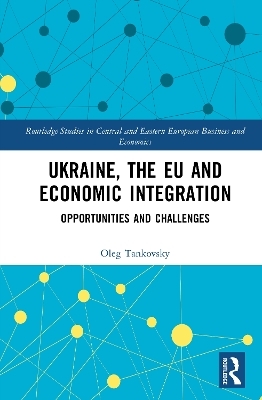
Ukraine, the EU and Economic Integration
Opportunities and Challenges
Seiten
2026
Routledge (Verlag)
978-1-041-14200-3 (ISBN)
Routledge (Verlag)
978-1-041-14200-3 (ISBN)
- Noch nicht erschienen (ca. März 2026)
- Versandkostenfrei
- Auch auf Rechnung
- Artikel merken
Offering a holistic approach and a new comparative framework, this timely resource addresses a central puzzle in the study of European integration: why have some post-communist countries successfully embedded democratic and market institutions after EU accession or candidacy, while others have faltered or regressed?
This book addresses a central puzzle in the study of European integration: why have some post-communist countries successfully embedded democratic and market institutions after EU accession or candidacy, while others have faltered or regressed?
The book utilizes principal component analysis to create a unique composite indicator for EU integration readiness, offering a novel approach to assessing economic and social factors. It provides an extensive comparative study of Ukraine's integration readiness alongside Croatia, Serbia, Montenegro, Albania, Bosnia, and Macedonia. It goes beyond economic indicators, addressing non-economic obstacles such as identity-seeking problems and oligarchic ecosystems, making it a holistic resource for understanding the complexities of EU integration. Introducing the original distinction between self-contained and exported Europeanisation, the book offers a new comparative framework that explains divergent integration outcomes across Central Eastern Europe and the Western Balkans. By combining theory-driven analysis with country case studies, it demonstrates how the balance between domestic political commitment and EU conditionality shapes long-term integration success.
Bridging economics, European studies, comparative politics, and international political economy, this timely book speaks to scholars, students, and policymakers interested in the future of Europe’s eastern frontier.
This book addresses a central puzzle in the study of European integration: why have some post-communist countries successfully embedded democratic and market institutions after EU accession or candidacy, while others have faltered or regressed?
The book utilizes principal component analysis to create a unique composite indicator for EU integration readiness, offering a novel approach to assessing economic and social factors. It provides an extensive comparative study of Ukraine's integration readiness alongside Croatia, Serbia, Montenegro, Albania, Bosnia, and Macedonia. It goes beyond economic indicators, addressing non-economic obstacles such as identity-seeking problems and oligarchic ecosystems, making it a holistic resource for understanding the complexities of EU integration. Introducing the original distinction between self-contained and exported Europeanisation, the book offers a new comparative framework that explains divergent integration outcomes across Central Eastern Europe and the Western Balkans. By combining theory-driven analysis with country case studies, it demonstrates how the balance between domestic political commitment and EU conditionality shapes long-term integration success.
Bridging economics, European studies, comparative politics, and international political economy, this timely book speaks to scholars, students, and policymakers interested in the future of Europe’s eastern frontier.
Oleg Tankovsky is an Assistant Professor in the Department of Economics and International Economics, University of Public Service, Budapest, Hungary.
1. Introduction 2. International Integrations in general 3. International Political Economy, Regimes, and Path Dependence in Ukraine 4. Methodology 5. Ukraine’s Macroeconomic Foundations Before and After the War 6. Economic Reforms Since 2014: Mapping the Transformation 7. Comparative Assessment of EU Candidate Countries 8. Foreign Policy Analysis 9. Conflict, Identity, and EU Accession Obstacles in the framework of case studies 10. Discussion and Conclusions
| Erscheint lt. Verlag | 24.3.2026 |
|---|---|
| Reihe/Serie | Routledge Studies in Central and Eastern European Business and Economics |
| Zusatzinfo | 9 Tables, black and white; 11 Line drawings, black and white; 11 Illustrations, black and white |
| Verlagsort | London |
| Sprache | englisch |
| Maße | 156 x 234 mm |
| Themenwelt | Sozialwissenschaften ► Soziologie ► Spezielle Soziologien |
| Wirtschaft ► Volkswirtschaftslehre ► Makroökonomie | |
| ISBN-10 | 1-041-14200-5 / 1041142005 |
| ISBN-13 | 978-1-041-14200-3 / 9781041142003 |
| Zustand | Neuware |
| Informationen gemäß Produktsicherheitsverordnung (GPSR) | |
| Haben Sie eine Frage zum Produkt? |
Mehr entdecken
aus dem Bereich



aus dem Bereich
Bullshit als politische Strategie
Buch | Softcover (2025)
Kohlhammer (Verlag)
CHF 33,55
eine Einführung
Buch | Softcover (2024)
De Gruyter Oldenbourg (Verlag)
CHF 41,90
Antisemitismus und postkoloniale Debatte auf der documenta fifteen
Buch | Softcover (2025)
Campus (Verlag)
CHF 41,95


