


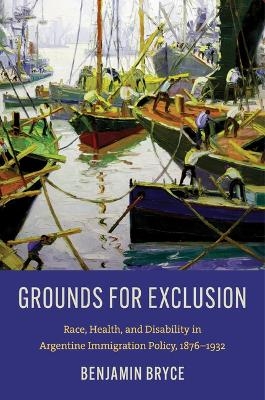
Grounds for Exclusion
Race, Health, and Disability in Argentine Immigration Policy, 1876–1932
Seiten
2026
The University of North Carolina Press (Verlag)
978-1-4696-9535-8 (ISBN)
The University of North Carolina Press (Verlag)
978-1-4696-9535-8 (ISBN)
- Noch nicht erschienen (ca. Mai 2026)
- Versandkostenfrei
- Auch auf Rechnung
- Artikel merken
Argentina has been one the most important destinations for international labor migrants in the modern world. But while it was long imagined as a nation of immigrants, a closer look at its history and policies reveals that the country’s doors were only open to certain people. In the late nineteenth and early twentieth centuries, officials developed a long list of grounds for exclusion that deterred many people from ever boarding a ship to the country. Travelers who did come to Argentina were frequently barred at ports of entry on account of race, health, or disability.
Tracing the attempts of European, Asian, and Middle Eastern migrants to enter Argentina, Benjamin Bryce shows how the modern state worked to privilege white supremacy and expansion over diversity and magnanimity. As Argentine officials, politicians, and influential thinkers envisioned their country’s future, they tried to define the ideal citizens who would live, work, vote, and reproduce in Argentina—and the characteristics of those who would not. Anyone deemed unhealthy or disabled was labeled unproductive or a potential burden on the state. Race often shaped notions of health and productivity and therefore determined who was welcome. Bryce’s thorough analysis of immigration exclusions reconceptualizes Argentina’s long-accepted reputation as a haven for newcomers.
Tracing the attempts of European, Asian, and Middle Eastern migrants to enter Argentina, Benjamin Bryce shows how the modern state worked to privilege white supremacy and expansion over diversity and magnanimity. As Argentine officials, politicians, and influential thinkers envisioned their country’s future, they tried to define the ideal citizens who would live, work, vote, and reproduce in Argentina—and the characteristics of those who would not. Anyone deemed unhealthy or disabled was labeled unproductive or a potential burden on the state. Race often shaped notions of health and productivity and therefore determined who was welcome. Bryce’s thorough analysis of immigration exclusions reconceptualizes Argentina’s long-accepted reputation as a haven for newcomers.
Benjamin Bryce is associate professor of history at the University of British Columbia.
| Erscheint lt. Verlag | 19.5.2026 |
|---|---|
| Reihe/Serie | InterConnections: the Global Twentieth Century |
| Zusatzinfo | 9 illustrations - 9 halftones, 9 tables - 9 Tables, unspecified - 9 Halftones, unspecified |
| Verlagsort | Chapel Hill |
| Sprache | englisch |
| Maße | 25 x 235 mm |
| Themenwelt | Sozialwissenschaften ► Ethnologie |
| Sozialwissenschaften ► Soziologie | |
| ISBN-10 | 1-4696-9535-9 / 1469695359 |
| ISBN-13 | 978-1-4696-9535-8 / 9781469695358 |
| Zustand | Neuware |
| Informationen gemäß Produktsicherheitsverordnung (GPSR) | |
| Haben Sie eine Frage zum Produkt? |
Mehr entdecken
aus dem Bereich


aus dem Bereich
Prolegomena zu einer Geschichte der Magie
Buch | Hardcover (2025)
Matthes & Seitz Berlin (Verlag)
CHF 53,20
ethnographische Texte
Buch | Hardcover (2025)
Konstanz University Press (Verlag)
CHF 36,40
Buch | Hardcover (2021)
Konstanz University Press (Verlag)
CHF 39,20


