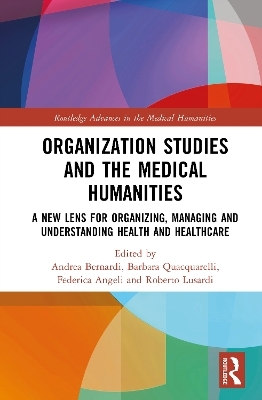
Organization Studies and the Medical Humanities
Routledge (Verlag)
978-1-032-94669-6 (ISBN)
- Noch nicht erschienen (ca. März 2026)
- Versandkostenfrei
- Auch auf Rechnung
- Artikel merken
Showcasing an emerging sub-field, this book begins by developing an original definition of the medical humanities and problematizing the relationship between it and organization studies. Looking at hospitals, national health services, pharmaceutical firms and professional healthcare bodies, this book explores constructs, variables and categories such as autonomy, centralization, efficiency, power, politics, conflict, subcultures, employment relations, quality improvement, participation, and managerialism.
Making a case for the important role that organization studies can play in the medical and health humanities, this book is a valuable contribution to students and scholars with an interest in both fields and healthcare management more generally.
Andrea Bernardi is Associate Professor of Organization Studies at the School of Advanced Defence Studies (CASD) in Rome. Previously he was Senior Lecturer in Employment and Organization Studies at Oxford Brookes University, UK. His previous positions include Manchester Metropolitan University, University of Nottingham Ningbo China, University of Rome, Roma Tre. In 2019 in Oxford, with Beijing University, he convened the conference ‘Healthcare in China, a medical humanities perspective’. He is associate editor for the Review of Evolutionary Political Economy. With Federica Angeli, Barbara Quacquarelli and Roberto Lusardi, he convened a sub-theme devoted to the Medical Humanities at the 2022 and 2024 editions of the European Group for Organizational Studies (EGOS) colloquia. Barbara Quacquarelli is Associate Professor in Organisation Studies at the University of Milano Bicocca and Professor of Public Management at Scuola Nazionale dell’Amministrazione in Rome, Italy, a government institution for the selection and training of top managers of the Italian civil service. She is a faculty member of MIP, business school of Politecnico di Milano. She was founder of a research centre, BTDC, focused on emerging trends in organizational development. She is responsible of a summer school on Global Diversity Management with Caledonian University in Scotland. Barbara has been attending EGOS for about 15 years. She was the chair of the 2024 edition of EGOS Colloquium in Milan. Federica Angeli is Professor of Management at the University of York Management School, York, UK. She obtained her PhD in Management from the University of Bologna and held positions at Tilburg University (School of Social and Behavioural Sciences), Maastricht University (Care and Public Health Research Institute) and at the Indian Institute of Management, Bangalore. Federica has served as Associate Editor for BMC Health Services Research and is currently an Academic Editor for PLOS One. She is also a Fellow of The Royal Society for Arts, Manufactures and Commerce. Federica has been an EGOS member since 2007. She has organized and co-convened four EGOS sub-themes between 2014-2019, all examining opportunities and challenges facing contemporary healthcare organisational and systems. Roberto Lusardi is associate professor of Sociology at the Department of Management of the University of Bergamo. He obtained his PhD in Sociology and social research from the University of Trento. His main research interests concern the relation between knowledge, work and innovation in organizations, especially in the fields of healthcare and biomedicine. He is member of several scientific communities (European Group for Organizational Studies (EGOS), European Sociological Association (ESA); Italian Sociological Association (AIS), Italian Society of Sociology of Health (SISS)) and is in the scientific board of the Italian Society of Sociology of Health and senior editor for the scientific journal Tecnoscienza. In the last years he published monographs, essay and articles in Italian and international journals such as Current Sociology, Forum - Qualitative Sociological Research, Frontiers in Sociology, Rassegna Italiana di Sociologia, Salute e Società and Studi organizzativi. He is the chair of the 2026 edition of EGOS Colloquium in Bergamo
Part 1: Introduction
1. What are Medical Humanities? A Necessary Interplay with Organization Studies Andrea Bernardi, Federica Angeli and Barbara Quacquarelli
2. Medical Humanities: Historical and Current Perspectives and Concepts Brenda Bogaert
3. Developing Moral Imagination in Professional Education: Critical Medical Humanities and Critical Management Studies Stephen Linstead
Part 2: New Understandings of the Healthcare Professional: Narratives, Identities and Legacies
4. Training the Professionals, Transforming the Environment: A Project of Narrative Medicine at the Hospital Christian Delorenzo and Jean-Marc Baleyte
5. Peering Through the Glass Door: Unobtrusively Accessing Employee Voice to Derive Sociological Insights that Inform Organizational Learning in the National Health Service Sai Kalvapalle and Tom Reader
6. Antecedents and Consequences of Hospital Senior Manager Burnout Alexander Peever
7. Reshaping Physician Identity: Medical legitimacy and the Rise of Integrative and Lifestyle Medicine Deborah de Fauconberg, Kevin Volkan and Âriel de Fauconberg
Part 3: Re-Conceptualising Collaboration and Patient Involvement: Empathy and Meaning-Making across Multiple Stakeholders
8. Patient and Public Involvement in Finnish Context Caterina Bettin, Tero Montonen, Pasi Hirvonen and Päivi Eriksson
9. The Shaping of Palliative Care through the Collaboration between Practitioners and Caregivers: Resources, Ambivalences, and Tensions Matteo Crippa and Paolo Rossi
10. Health Systems Innovation. A Quadruple Helix Approach Lorenzo Mercurio, Andrea Tomo and Lucio Todisco
Part 4: Revisiting Medical Decision-making: Personal Medicine, Moral Orders and Dilemmas
11. Organizing Novel Medicine: Storylines, Positions, and Moral Orders of Personalized Medicine Nina Lunkka, Pasi Hirvonen, Eeva Aromaa, Outi-Maaria Palo-oja, Esa Hiltunen and Van Langenhove Luk
12. Conceptualizing and Understanding Dilemmas of Therapeutic Action in Digitally Mediatized Hospital Work Situations Christopher Schlembach and Michaela Pfadenhauer
13. Adoption in the Shadow of the Profession: Medical Innovation Revisited M. Lourdes Sosa, Louise Mors and Roberto M. Fernandez
14. Technical, Medical and Organizational Innovations in Neonatal Intensive Care in French Public Hospitals and the Transformation of Ethical Decision-Making Lionel Honoré and Laure Gillot
Part 5: Reconsidering Evidence in the Workplace and Professional Training
15. Using Evidence in Workplaces to Invest in Mental Health and Wellbeing Initiatives Camille Allard and Hareth Al-Janabi
16. Anthropology and Simulation Education in Nursing Silvia Musci
17. Conclusions Andrea Bernardi, Federica Angeli and Barbara Quacquarelli
| Erscheint lt. Verlag | 9.3.2026 |
|---|---|
| Reihe/Serie | Routledge Advances in the Medical Humanities |
| Zusatzinfo | 14 Tables, black and white; 5 Line drawings, black and white; 5 Illustrations, black and white |
| Verlagsort | London |
| Sprache | englisch |
| Maße | 156 x 234 mm |
| Themenwelt | Medizin / Pharmazie ► Gesundheitswesen |
| Studium ► 1. Studienabschnitt (Vorklinik) ► Med. Psychologie / Soziologie | |
| Naturwissenschaften ► Biologie ► Humanbiologie | |
| Sozialwissenschaften ► Ethnologie | |
| Wirtschaft ► Betriebswirtschaft / Management ► Planung / Organisation | |
| ISBN-10 | 1-032-94669-5 / 1032946695 |
| ISBN-13 | 978-1-032-94669-6 / 9781032946696 |
| Zustand | Neuware |
| Informationen gemäß Produktsicherheitsverordnung (GPSR) | |
| Haben Sie eine Frage zum Produkt? |
aus dem Bereich