


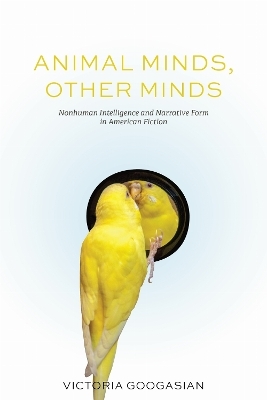
Animal Minds, Other Minds
Nonhuman Intelligence and Narrative Form in American Fiction
Seiten
2026
University of Virginia Press (Verlag)
978-0-8139-5514-8 (ISBN)
University of Virginia Press (Verlag)
978-0-8139-5514-8 (ISBN)
- Noch nicht erschienen (ca. Juni 2026)
- Versandkostenfrei
- Auch auf Rechnung
- Artikel merken
How a fascination with animal consciousness, perception, and intelligence shaped American fiction in the twentieth century
Animal Minds, Other Minds upends a common assumption: that the minds encountered in fiction are always in some sense fundamentally human. Readers, writers, critics, and narrative theorists have surmised that when fiction turns its attention to the inner lives of its characters, it does so with the aim of revealing their recognizable humanity. This book tells a different story. The narrative styles of American fiction show a growing awareness that human subjectivity exists within a multispecies ecology of minds. The science of animal minds, argues Victoria Googasian, has played a central role in building fiction's capacity to imagine cognitive diversity, both within our own species and in the wider world of sentience.
The multispecies world of twentieth-century American literature exhibits a clear recognition that intelligence can take more than one form. From the fragmented personhood of Jack London's canine heroes, to the associative intelligence of William Faulkner's Compson family, to the rabid opacity of Zora Neale Hurston's Tea Cake, to the sociobiological play of Octavia Butler's shapeshifters, American fiction abounds with characters whose animalized minds structure the narrative techniques that unfold their behaviors.
Animal Minds, Other Minds upends a common assumption: that the minds encountered in fiction are always in some sense fundamentally human. Readers, writers, critics, and narrative theorists have surmised that when fiction turns its attention to the inner lives of its characters, it does so with the aim of revealing their recognizable humanity. This book tells a different story. The narrative styles of American fiction show a growing awareness that human subjectivity exists within a multispecies ecology of minds. The science of animal minds, argues Victoria Googasian, has played a central role in building fiction's capacity to imagine cognitive diversity, both within our own species and in the wider world of sentience.
The multispecies world of twentieth-century American literature exhibits a clear recognition that intelligence can take more than one form. From the fragmented personhood of Jack London's canine heroes, to the associative intelligence of William Faulkner's Compson family, to the rabid opacity of Zora Neale Hurston's Tea Cake, to the sociobiological play of Octavia Butler's shapeshifters, American fiction abounds with characters whose animalized minds structure the narrative techniques that unfold their behaviors.
Victoria Googasian is Assistant Professor of American Literature at Georgetown University in Qatar.
| Erscheint lt. Verlag | 18.6.2026 |
|---|---|
| Reihe/Serie | Cultural Frames, Framing Culture |
| Zusatzinfo | 4 b&w illus. |
| Verlagsort | Charlottesville |
| Sprache | englisch |
| Maße | 152 x 229 mm |
| Themenwelt | Geisteswissenschaften ► Psychologie |
| Geisteswissenschaften ► Sprach- / Literaturwissenschaft ► Anglistik / Amerikanistik | |
| Geisteswissenschaften ► Sprach- / Literaturwissenschaft ► Literaturwissenschaft | |
| Sozialwissenschaften ► Ethnologie | |
| Sozialwissenschaften ► Soziologie | |
| ISBN-10 | 0-8139-5514-9 / 0813955149 |
| ISBN-13 | 978-0-8139-5514-8 / 9780813955148 |
| Zustand | Neuware |
| Informationen gemäß Produktsicherheitsverordnung (GPSR) | |
| Haben Sie eine Frage zum Produkt? |
Mehr entdecken
aus dem Bereich


aus dem Bereich
Poetik eines sozialen Urteils
Buch | Hardcover (2023)
De Gruyter (Verlag)
CHF 83,90


