


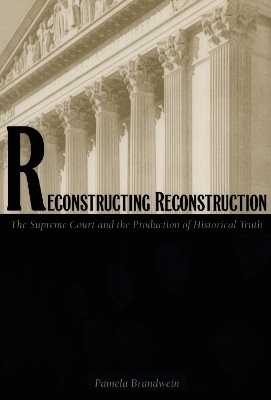
Reconstructing Reconstruction
The Supreme Court and the Production of Historical Truth
Seiten
1999
Duke University Press (Verlag)
978-0-8223-2284-9 (ISBN)
Duke University Press (Verlag)
978-0-8223-2284-9 (ISBN)
- Titel z.Zt. nicht lieferbar
- Versandkostenfrei
- Auch auf Rechnung
- Artikel merken
Examines the post-Civil War struggle between competing political and legal interpretations of slavery and Reconstruction to reveal how accepted historical truth was established. Offering an approach to the subject of original intent, this book will interest legal historians and scholars of constitutional law and the sociology of law.
Was slavery over when slaves gained formal emancipation? Was it over when the social, economic, and political situation for African Americans no longer mimicked the conditions of slavery? If the Thirteenth Amendment abolished it in 1865, why did most of the disputed points during the Reconstruction debates of 1866–75 concern issues of slavery? In this book Pamela Brandwein examines the post–Civil War struggle between competing political and legal interpretations of slavery and Reconstruction to reveal how accepted historical truth was established.
Delving into the circumstances, assumptions, and rhetoric that shaped the “official” story of Reconstruction, Brandwein describes precisely how a dominant interpretation of events ultimately emerged and what its implications have been for twentieth-century judicial decisions, particularly for Supreme Court rulings on civil rights. While analyzing interpretive disputes about slavery, Brandwein offers a detailed rescoring of post–Civil War legislative and constitutional history, including analysis of the original understanding of the Fourteenth Amendment. She identifies the perspectives on Reconstruction that were endorsed or rejected by the Supreme Court. Explaining what it meant-theoretically and practically-to resolve Reconstruction debates with a particular definition of slavery, Brandwein recounts how the Northern Democratic definition of “ending” slavery was not the only definition, just the one that prevailed. Using a familiar historical moment to do new interpretive work, she outlines a sociology of constitutional law, showing how subjective narrative construction can solidify into opaque institutional memory.
Was slavery over when slaves gained formal emancipation? Was it over when the social, economic, and political situation for African Americans no longer mimicked the conditions of slavery? If the Thirteenth Amendment abolished it in 1865, why did most of the disputed points during the Reconstruction debates of 1866–75 concern issues of slavery? In this book Pamela Brandwein examines the post–Civil War struggle between competing political and legal interpretations of slavery and Reconstruction to reveal how accepted historical truth was established.
Delving into the circumstances, assumptions, and rhetoric that shaped the “official” story of Reconstruction, Brandwein describes precisely how a dominant interpretation of events ultimately emerged and what its implications have been for twentieth-century judicial decisions, particularly for Supreme Court rulings on civil rights. While analyzing interpretive disputes about slavery, Brandwein offers a detailed rescoring of post–Civil War legislative and constitutional history, including analysis of the original understanding of the Fourteenth Amendment. She identifies the perspectives on Reconstruction that were endorsed or rejected by the Supreme Court. Explaining what it meant-theoretically and practically-to resolve Reconstruction debates with a particular definition of slavery, Brandwein recounts how the Northern Democratic definition of “ending” slavery was not the only definition, just the one that prevailed. Using a familiar historical moment to do new interpretive work, she outlines a sociology of constitutional law, showing how subjective narrative construction can solidify into opaque institutional memory.
Pamela Brandwein is Assistant Professor of Sociology and Political Economy at the University of Texas at Dallas.
Acknowledgments
1. Introduction
2. Slavery as an Interpretive Issue in the 39th Reconstruction Congress: The Northern Democrats
3. Republican Slavery Criticism
4. The Supreme Court’s Official History
5. Dueling Histories: Charles Fairman and William Crosskey Reconstruct “Original Understanding”
6. Recipes for “Acceptable” History
7. History as an Institutional Resource: Warren Court Debates over Legislative Apportionment
8. Constitutional Law as a “Culture of Argument”: Toward a Sociology of Constitutional Law
9. Conclusion
Notes
Bibliography
Index
| Erscheint lt. Verlag | 13.7.1999 |
|---|---|
| Verlagsort | North Carolina |
| Sprache | englisch |
| Gewicht | 848 g |
| Themenwelt | Geisteswissenschaften ► Geschichte |
| Recht / Steuern ► EU / Internationales Recht | |
| Recht / Steuern ► Öffentliches Recht | |
| Sozialwissenschaften ► Politik / Verwaltung ► Staat / Verwaltung | |
| ISBN-10 | 0-8223-2284-6 / 0822322846 |
| ISBN-13 | 978-0-8223-2284-9 / 9780822322849 |
| Zustand | Neuware |
| Informationen gemäß Produktsicherheitsverordnung (GPSR) | |
| Haben Sie eine Frage zum Produkt? |
Mehr entdecken
aus dem Bereich

aus dem Bereich
Organisationen steuern, Strukturen schaffen, Prozesse gestalten
Buch | Softcover (2024)
Rehm Verlag
CHF 53,20
über 1000 Stichworte mit Fundstellenhinweisen
Buch (2025)
NWB Verlag
CHF 36,90


