


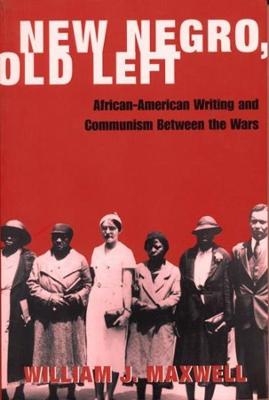
New Negro, Old Left
African-American Writing and Communism Between the Wars
Seiten
1999
Columbia University Press (Verlag)
978-0-231-11425-7 (ISBN)
Columbia University Press (Verlag)
978-0-231-11425-7 (ISBN)
- Lieferbar (Termin unbekannt)
- Versandkostenfrei
- Auch auf Rechnung
- Artikel merken
Maxwell uncovers both black literature's debt to Communism and Communism's debt to black literature, reciprocal obligations first incurred during the Harlem Renaissance.
Howard "Stretch" Johnson, a charismatic Harlemite who graduated from Cotton Club dancer to Communist Party youth leader, once claimed that in late 1930s New York "75% of black cultural figures had Party membership or maintained regular meaningful contact with the Party." He stretched the truth, but barely. In a broad-ranging, revisionary account of the extensive relationship between African-American literary culture and Communism in the 1920s and 1930s, William J. Maxwell uncovers both black literature's debt to Communism and Communism's debt to black literature-reciprocal obligations first incurred during the Harlem Renaissance. Juxtaposing well-known and newly rediscovered works by Claude McKay, Andy Razaf, Mike Gold, Langston Hughes, Louise Thompson, Richard Wright, Zora Neale Hurston, and Nelson Algren, Maxwell maintains that the "Old," Soviet-allied Left promoted a spectrum of exchanges between black and white authors, genres, theories, and cultural institutions. Channels opened between radical Harlem and Bolshevik Moscow, between the New Negro renaissance and proletarian literature.
Claude McKay's 1922-23 pilgrimage to the Soviet Union, for example, usually recalled as a lighthearted adventure in radical tourism, actually jumpstarted the Comintern's controversial nation-centered program for Afro America. Breaking from studies governed by Cold War investments and pivoting on the Great Depression, Maxwell argues that Communism's rare sustenance for African-American initiative-not a seduction of Depression-scarred innocents-brought scores of literary "New Negroes" to the Old Left.
Howard "Stretch" Johnson, a charismatic Harlemite who graduated from Cotton Club dancer to Communist Party youth leader, once claimed that in late 1930s New York "75% of black cultural figures had Party membership or maintained regular meaningful contact with the Party." He stretched the truth, but barely. In a broad-ranging, revisionary account of the extensive relationship between African-American literary culture and Communism in the 1920s and 1930s, William J. Maxwell uncovers both black literature's debt to Communism and Communism's debt to black literature-reciprocal obligations first incurred during the Harlem Renaissance. Juxtaposing well-known and newly rediscovered works by Claude McKay, Andy Razaf, Mike Gold, Langston Hughes, Louise Thompson, Richard Wright, Zora Neale Hurston, and Nelson Algren, Maxwell maintains that the "Old," Soviet-allied Left promoted a spectrum of exchanges between black and white authors, genres, theories, and cultural institutions. Channels opened between radical Harlem and Bolshevik Moscow, between the New Negro renaissance and proletarian literature.
Claude McKay's 1922-23 pilgrimage to the Soviet Union, for example, usually recalled as a lighthearted adventure in radical tourism, actually jumpstarted the Comintern's controversial nation-centered program for Afro America. Breaking from studies governed by Cold War investments and pivoting on the Great Depression, Maxwell argues that Communism's rare sustenance for African-American initiative-not a seduction of Depression-scarred innocents-brought scores of literary "New Negroes" to the Old Left.
William J. Maxwell is assistant professor of English and an affiliate of the Afro-American Studies and Research Program at the University of Illinois at Urbana-Champaign.
Introduction: Black and Red All Over? 1. Kitchen Mechanics and Parlor Nationalists: Andy Razaf Black Bolshevism, and Harlem's Renaissance 2. Home to Moscow: Claude McKay's The Negroes in America and the Race of Marxist Theory 3. The Proletarian as New Negro; the New Negro as Proletarian: Mike Gold Meets Claude McKay 4. Scottsboro Delimited: White Bait Red Triangles, and Interracialism Between Men 5. Black Belt/Black Folk: The End(s) of the Richard Wright--Zora Neale Hurston Debate 6. Native Sons Divorce: A Conclusion Notes Bibliography Index
| Erscheint lt. Verlag | 17.6.1999 |
|---|---|
| Zusatzinfo | 10 illus |
| Verlagsort | New York |
| Sprache | englisch |
| Themenwelt | Geisteswissenschaften ► Sprach- / Literaturwissenschaft ► Anglistik / Amerikanistik |
| Geisteswissenschaften ► Sprach- / Literaturwissenschaft ► Literaturwissenschaft | |
| Sozialwissenschaften ► Ethnologie | |
| Sozialwissenschaften ► Politik / Verwaltung ► Politische Systeme | |
| Sozialwissenschaften ► Politik / Verwaltung ► Politische Theorie | |
| Sozialwissenschaften ► Soziologie | |
| ISBN-10 | 0-231-11425-7 / 0231114257 |
| ISBN-13 | 978-0-231-11425-7 / 9780231114257 |
| Zustand | Neuware |
| Informationen gemäß Produktsicherheitsverordnung (GPSR) | |
| Haben Sie eine Frage zum Produkt? |
Mehr entdecken
aus dem Bereich

aus dem Bereich
Poetik eines sozialen Urteils
Buch | Hardcover (2023)
De Gruyter (Verlag)
CHF 83,90


