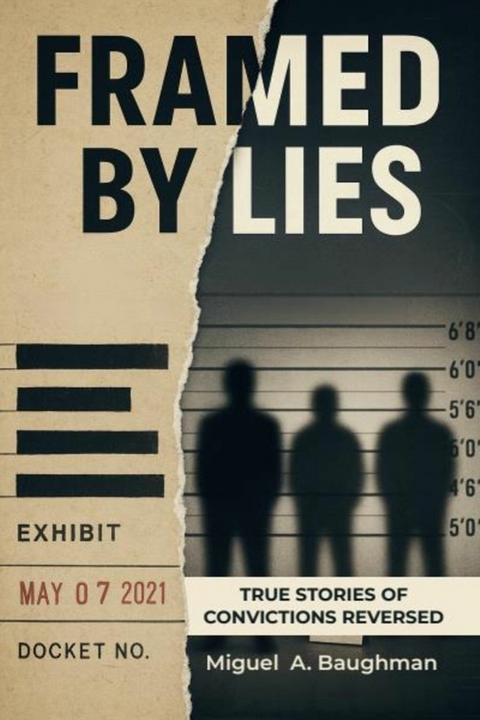
Framed by Lies (eBook)
244 Seiten
Seahorse Pub (Verlag)
978-0-00-105367-0 (ISBN)
Framed by Lies uncovers the harrowing real-life nightmares of innocent individuals trapped in a flawed justice system. Author Miguel A. Baughman, an investigative journalist with over two decades exposing criminal injustices, delves into seven shocking cases spanning four decades-from mistaken eyewitness identifications and coerced confessions to prosecutorial misconduct and junk forensic science that sent the wrong people to prison for years, even decades.
Drawing from court transcripts, DNA evidence, and exclusive interviews with exonerees, families, and legal experts, Baughman reveals the systemic failures driving over 3,400 documented exonerations since 1989, where the innocent collectively lost more than 30,000 years behind bars. Meet Jorge de los Santos, freed after three years on faulty lineup testimony; Kerry Kotler, whose life was upended by a victim's sincere but wrong memory; and Ron Williamson, who endured eleven years on death row amid fabricated evidence and perjured informants. These true stories expose how racial bias, official corruption, and cognitive errors create 'perfect storms' of injustice, leaving real criminals free to strike again.
But Framed by Lies isn't just a catalog of horrors-it's a call to action. Baughman spotlights reform successes, like double-blind lineups reducing misidentifications by 42% and mandatory interrogation recordings preventing false admissions. With a foreword by innocence pioneer Jim McCloskey and insights from the National Registry of Exonerations, this book equips readers to demand change: support innocence organizations, vote for accountable prosecutors, and engage in jury duty with eyes wide open.
Discover why conservative estimates suggest 20,000-100,000 innocents remain imprisoned today-and how we can end this epidemic. A must-read for anyone who believes in truth over expedience, Framed by Lies will leave you outraged, inspired, and ready to fight for a fairer system.
Chapter 1
How Innocent People Get Convicted
The National Registry of Exonerations reveals that 57% of wrongful convictions involve perjury or false accusations, making deliberate falsehoods the single most common factor in sending innocent people to prison. This staggering statistic encompasses three primary categories: jailhouse informants seeking reduced sentences, false accusations in domestic disputes, and deliberate false testimony from supposed witnesses. The incentive structure within the criminal justice system creates powerful motivations for individuals to lie under oath, often with devastating consequences for the accused. Jailhouse informants represent the most problematic category, as incarcerated individuals facing lengthy sentences possess overwhelming incentives to fabricate testimony against fellow inmates.
Dr. Alexandra Natapoff, a leading expert on informant use, notes through her research that "the reliability of jailhouse informant testimony approaches zero, yet prosecutors continue using these witnesses because juries find their testimony compelling." Consider the case of Jeffrey Deskovic, convicted of rape and murder in 1990 based primarily on a jailhouse informant's claim that Deskovic had confessed. DNA evidence eventually proved Deskovic's innocence after sixteen years of wrongful imprisonment, while the actual perpetrator committed additional crimes during those years. The systematic use of unreliable informant testimony reflects institutional pressures that prioritize conviction rates over truth-seeking. False accusations in domestic situations often emerge from custody disputes, divorce proceedings, or personal vendettas where accusers possess clear motivations for fabrication beyond truth-telling.
…
Official misconduct appears in 54% of exonerations, encompassing prosecutorial misconduct, police misconduct, and forensic analyst errors that violate professional standards and legal requirements. Brady violations, where prosecutors suppress exculpatory evidence, represent the most common form of prosecutorial misconduct, occurring when evidence favorable to the defense is deliberately withheld from attorneys and courts. Police misconduct includes coerced confessions through improper interrogation techniques, planted evidence, investigative shortcuts that ignore contradictory evidence, and failure to pursue obvious alternative suspects. Forensic fraud involves analysts who manipulate test results, provide false testimony about scientific evidence, or claim expertise in techniques lacking scientific validation.
Research conducted by the University of California Irvine demonstrates that official misconduct isn't composed of isolated incidents by rogue actors but represents systematic institutional failures driven by career pressures and inadequate oversight mechanisms. Professor Megan Quattlebaum's analysis of misconduct patterns reveals that "prosecutors facing election pressures show statistically significant increases in Brady violations during campaign years, while police departments with lower clearance rates demonstrate higher rates of evidence manipulation." The convergence of career incentives with inadequate accountability creates environments where misconduct becomes normalized rather than exceptional. Internal affairs investigations rarely result in meaningful sanctions, while prosecutorial immunity shields district attorneys from civil liability even when their actions directly cause wrongful convictions that destroy innocent lives.
…
Mistaken eyewitness identification contributes to 28% of wrongful convictions, despite extensive psychological research demonstrating the unreliability of human memory under stress and traumatic circumstances. Cross-racial identification presents particular challenges, as studies consistently show that individuals struggle to accurately identify faces from different racial backgrounds due to reduced familiarity and processing differences. Dr. Jennifer Dysart's research at John Jay College of Criminal Justice reveals that "cross-racial identification errors occur at rates approaching 50% in laboratory settings, yet these identifications carry equal weight in courtrooms regardless of scientific evidence about their unreliability." Memory accuracy deteriorates rapidly under stress, with adrenaline and fear significantly impairing the brain's ability to encode and retrieve facial features accurately.
Suggestion effects in lineup procedures compound these natural limitations, as subtle cues from investigators can influence witness selections toward particular suspects rather than accurate identifications. The sequential presentation of suspects, double-blind administration where officers conducting lineups don't know suspect identity, and proper instructions about perpetrator absence possibilities can dramatically improve identification accuracy. However, many jurisdictions continue using simultaneous lineups where witnesses compare options rather than matching memory to reality. Dr. Gary Wells, whose research established modern identification science, explains that "traditional lineup procedures essentially ask witnesses to pick the person who looks most like the perpetrator, rather than determining whether the perpetrator is actually present." Scientific reforms in identification procedures could eliminate thousands of wrongful convictions, yet implementation remains inconsistent across American jurisdictions despite decades of available research.
…
False confessions occur in 12% of wrongful conviction cases, representing one of the most counterintuitive phenomena in criminal justice that challenges common assumptions about human behavior under interrogation. Psychological research identifies specific vulnerability factors including youth, intellectual disability, mental illness, substance abuse, and prolonged interrogation that dramatically increase false confession likelihood among innocent suspects. The Reid Technique, widely used in police interrogations throughout the United States, employs psychological pressure specifically designed to break down resistance and extract confessions regardless of actual guilt or innocence. Interrogators present fabricated evidence, suggest reduced consequences for cooperation, isolate suspects from support systems, and maintain relentless pressure until suspects capitulate to end psychological torture.
Dr. Saul Kassin's groundbreaking research on interrogation psychology demonstrates that "innocent suspects often confess because they believe cooperation will lead to lenient treatment, while lengthy interrogations produce exhaustion that impairs decision-making capacity and reality testing." The Central Park Five case exemplifies how psychological manipulation can produce detailed false confessions from multiple innocent suspects who provided extensive, corroborated details about a crime they didn't commit. These teenagers described specific acts, locations, and sequences that demonstrated how interrogation techniques can actually implant false memories that feel real to suspects. Recording requirements for interrogations have increased in many jurisdictions, providing transparency that reveals problematic techniques, but the fundamental interrogation methods remain largely unchanged. Expert analysis reveals that certain interrogation approaches virtually guarantee false confessions from vulnerable populations, yet these methods continue in widespread use throughout American law enforcement agencies.
…
Wrongful convictions rarely result from single system failures but emerge from convergent combinations of multiple factors that create overwhelming circumstantial cases against innocent defendants who become trapped by accumulating unreliable evidence. Statistical analysis by the National Registry of Exonerations demonstrates that cases involving three or more contributing factors show conviction rates approaching 90%, even when individual factors would prove insufficient for prosecution under careful scrutiny. The combination of weak physical evidence, eyewitness misidentification, prosecutorial pressure, and inadequate defense representation creates what researchers term "the perfect storm" of wrongful conviction that overwhelms traditional safeguards.
Professor Samuel Gross's longitudinal research reveals that "factor combinations don't simply add wrongful conviction risk—they multiply it exponentially, creating prosecutorial confidence that overrides normal skepticism about case strength and evidence quality." Consider how jailhouse informant testimony gains credibility when combined with mistaken eyewitness identification, despite both factors being individually unreliable according to extensive scientific research. Defense attorneys facing multiple unreliable sources often struggle to effectively challenge each component while maintaining coherent alternative theories, while juries interpret multiple accusations as confirmation rather than recognizing systematic unreliability patterns. The convergence effect explains why obviously weak cases proceed to trial and result in convictions that later appear inexplicable to outside observers who examine evidence without prosecution framing.
…
Systematic pressures within criminal justice institutions create environments where wrongful convictions become inevitable outcomes rather than tragic accidents, as performance metrics reward speed and conviction rates while providing minimal incentives for accuracy or truth-seeking. Police departments face constant pressure to maintain high clearance rates that satisfy political leaders and community demands for public safety, with detective promotions and department funding often tied to successfully closed cases regardless of actual guilt determination....
| Erscheint lt. Verlag | 12.9.2025 |
|---|---|
| Sprache | englisch |
| Themenwelt | Sozialwissenschaften ► Politik / Verwaltung |
| ISBN-10 | 0-00-105367-1 / 0001053671 |
| ISBN-13 | 978-0-00-105367-0 / 9780001053670 |
| Informationen gemäß Produktsicherheitsverordnung (GPSR) | |
| Haben Sie eine Frage zum Produkt? |
 EPUB (Adobe DRM)
Größe: 944 KB
Kopierschutz: Adobe-DRM
Adobe-DRM ist ein Kopierschutz, der das eBook vor Mißbrauch schützen soll. Dabei wird das eBook bereits beim Download auf Ihre persönliche Adobe-ID autorisiert. Lesen können Sie das eBook dann nur auf den Geräten, welche ebenfalls auf Ihre Adobe-ID registriert sind.
Details zum Adobe-DRM
Dateiformat: EPUB (Electronic Publication)
EPUB ist ein offener Standard für eBooks und eignet sich besonders zur Darstellung von Belletristik und Sachbüchern. Der Fließtext wird dynamisch an die Display- und Schriftgröße angepasst. Auch für mobile Lesegeräte ist EPUB daher gut geeignet.
Systemvoraussetzungen:
PC/Mac: Mit einem PC oder Mac können Sie dieses eBook lesen. Sie benötigen eine
eReader: Dieses eBook kann mit (fast) allen eBook-Readern gelesen werden. Mit dem amazon-Kindle ist es aber nicht kompatibel.
Smartphone/Tablet: Egal ob Apple oder Android, dieses eBook können Sie lesen. Sie benötigen eine
Geräteliste und zusätzliche Hinweise
Buying eBooks from abroad
For tax law reasons we can sell eBooks just within Germany and Switzerland. Regrettably we cannot fulfill eBook-orders from other countries.
aus dem Bereich