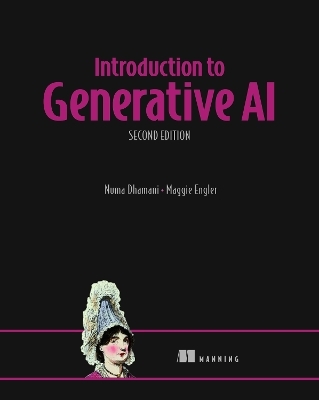
Introduction to Generative AI, Second Edition
Manning Publications (Verlag)
978-1-63343-488-2 (ISBN)
- Noch nicht erschienen (ca. März 2026)
- Versandkostenfrei
- Auch auf Rechnung
- Artikel merken
Core concepts demystified: Grasp LLM architecture, training, and prompting without needing coding experience.
Real-world case studies: See how businesses, education, and creativity already extract measurable AI value.
Risk and ethics primer: Navigate privacy, bias, and regulation to implement AI responsibly.
Practical toolkits: Apply step-by-step checklists for evaluating, testing, and integrating generative systems.
Foresight on trends: Anticipate reasoning models and vibe coding to future-proof your strategy.
Accessible format: Short chapters, visuals, and summaries enable quick learning and reference on demand.
Introduction to Generative AI, Second Edition by NLP expert Numa Dhamani and LLM safety researcher Maggie Engler delivers a timely, hype-free field guide.
You start with the simplest question, what is generative AI, then build to policy and economic impacts. Clear diagrams, chapter checklists, and myth-busting sidebars keep learning engaging and grounded in reality. Finish with the confidence to explore ChatGPT prompts, evaluate vendor claims, and brief stakeholders on risks. You will know when to trust AI, when to question it, and how to progress responsibly.
Perfect for managers, educators, students, and curious professionals seeking a practical, nontechnical AI starting point.
Numa Dhamani is a natural-language-processing researcher known for translating complex language science into actionable insight. With years at the intersection of technology and society, Numa brings clarity, curiosity, and social awareness to every page. She distills her expertise into practical guidance that empowers readers to explore AI responsibly. Maggie Engler is an engineer and safety researcher working on large language models at a pioneering AI lab. With deep experience in measuring harms and building safeguards, Maggie offers balanced, evidence-based advice wrapped in an empathetic voice. She turns cutting-edge research into usable frameworks that help readers champion trustworthy AI systems.
1 LARGE LANGUAGE MODELS: THE POWER OF AI
2 TRAINING LARGE LANGUAGE MODELS
3 DATA PRIVACY AND SAFETY WITH LLMS
4 THE EVOLUTION OF CREATED CONTENT
5 MISUSE AND ADVERSARIAL ATTACKS
6 ACCELERATING PRODUCTIVITY: MACHINE-AUGMENTED WORK
7 MAKING SOCIAL CONNECTIONS WITH CHATBOTS
8 WHAT'S NEXT FOR AI AND LLMS
9 BROADENING THE HORIZON: EXPLORATORY TOPICS IN AI
APPENDIXES
APPENDIX A: REFERENCES
| Erscheint lt. Verlag | 4.3.2026 |
|---|---|
| Verlagsort | New York |
| Sprache | englisch |
| Themenwelt | Geisteswissenschaften ► Sprach- / Literaturwissenschaft ► Literaturwissenschaft |
| Mathematik / Informatik ► Informatik ► Netzwerke | |
| Informatik ► Software Entwicklung ► UML | |
| Informatik ► Theorie / Studium ► Künstliche Intelligenz / Robotik | |
| Informatik ► Weitere Themen ► Zertifizierung | |
| Sozialwissenschaften ► Pädagogik ► Erwachsenenbildung | |
| ISBN-10 | 1-63343-488-5 / 1633434885 |
| ISBN-13 | 978-1-63343-488-2 / 9781633434882 |
| Zustand | Neuware |
| Informationen gemäß Produktsicherheitsverordnung (GPSR) | |
| Haben Sie eine Frage zum Produkt? |
aus dem Bereich