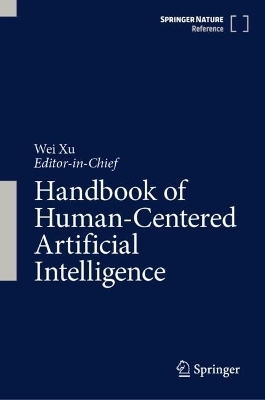
Handbook of Human-Centered Artificial Intelligence
Springer Verlag, Singapore
978-981-95-3657-3 (ISBN)
- Titel nicht im Sortiment
- Artikel merken
Explore the transformative world of Human-Centered Artificial Intelligence (HCAI) with the Handbook of Human-Centered Artificial Intelligence. This authoritative resource bridges cutting-edge AI technologies with core human-centered principles, such as human needs, values, controllability, and experiences, offering a holistic approach for designing, developing, deploying, and using AI systems that put humans first.
Written by leading experts, the handbook serves as an indispensable reference for researchers, practitioners, and policymakers dedicated to creating AI solutions that are reliable, safe, controllable, usable, valuable, and trustworthy. It covers the foundational principles of HCAI, from core concepts, methodology, design and development strategies, risk management and governance, to real-world applications across diverse domains, demonstrating how AI can enhance human capabilities and improve the quality of work and life.
Empower your knowledge and be at the forefront of AI innovation, a future where AI benefits humans rather than harming or replacing them. This is your definitive guide to understanding and shaping the future of AI through a human-centered lens.
This handbook comprises ten sections, encompassing approximately sixty chapters in total. (Note: In the current living version, individual chapters are published in alphabetical order as they become available.)
Fundamentals
Human-AI interaction
Human-centered AI design
Human-centered AI in computing
Human controllability over AI
Dr. Wei Xu is Chief Scientist at HCAI Labs, California, USA. He previously worked as a Senior Research Scientist and served as Principal Engineer in Human Factors/Human-Computer Interaction (HCI) at Intel (USA), where he also chaired the IT HCI Technical Committee, and as Senior Research Scientist at Boeing (USA). He is currently an adjunct professor. Dr. Xu earned his Ph.D. in Human Factors/HCI and M.S. in Computer Science, both from Miami University, USA, in 1997. An internationally recognized expert in human factors and HCI, Dr. Xu is an elected Fellow of the International Ergonomics Association (IEA), the Human Factors and Ergonomics Society (HFES), and the Association for Psychological Science (APS). He serves as Senior Editor of IEEE Transactions on Technology and Society, Associate Editor of IEEE Transactions on Human-Machine Systems. He also sits on the editorial boards of the International Journal of Human-Computer Interaction, Theoretical Issues in Ergonomics Science, and the Journal of Applied Psychology. He is a member of the International Organization for Standardization (ISO) Technical Committee on Human-System Interaction (TC159/SC4) and its Standards Drafting Working Group (TC159/SC4/WG6). With over 35 years of experience spanning academia and leading global IT and aviation companies, Dr. Xu has contributed extensively to research, design, development, and standards development in human factors and HCI. His work has received numerous research and design awards, with applications across multiple aircraft models and computing systems. He has co-drafted over 20 human factors/HCI design standards for ISO, ANSI, Boeing, and Intel, and authored three books—Engineering Psychology, User Experience: Theory and Practice, Human-AI Interaction: Multidisciplinary Collaboration for Enabling Human-Centered AI, and a forthcoming book, Human-Centered AI: Advancing Research and Applications in Human-AI Interaction. His papers have been published in core journals of human factors/ergonomics, HCI, psychology, aviation, computer science, and AI. Since 2018, Dr. Xu has focused on the emerging field of Human-Centered Artificial Intelligence (HCAI). As one of its pioneers, he proposed the early “human factors–technology–ethics triangle” framework (2019) and advanced the emerging domain of “human-AI interaction” (2020). He co-authored the influential paper titled “Six Human-Centered AI Grand Challenges” (2022) with Professors Ben Shneiderman, Gavriel Salvendy, and 24 other scholars. In recent years, he has introduced multiple frameworks in the HCAI field, including Human-AI Joint Cognitive Systems (2021), Human-AI Joint Cognitive Ecosystems (2022), Intelligent Sociotechnical Systems (iSTS) (2022), the HCAI Methodological Framework (HCAI-MF) (2024), the Hierarchical HCAI (hHCAI) approach (2024), the “User Experience 3.0” paradigm framework for HCAI (2024), and the HCAI Maturity Model (HCAI-MM) (2025). He participated in the development of two ISO standards for AI systems: Ergonomics Issues of Robotic, Intelligent, and Autonomous Systems (ISO 9241-810) (2020) and Ergonomics of Human-Intelligent Systems Interaction (ISO 9241-812) (2024).
Chapter 1. Human-centered AI: Concepts and approaches.Chapter.- 2. Human-AI interaction: Enabling HCAI.- Chapter 3. Computational modeling of human cognition and behavior.- Chapter 4. Human-AI integrated hybrid intelligence.- Chapter 5. Engineering psychology issues and methodologies.- Chapter 6. Human state recognition in human-AI interaction.- Chapter 7. Neuroergonomics approach to human-AI interaction.- Chapter 8. Human performance modeling: Driving behavior in autonomous vehicles.- Chapter 9. Theory of mind in human-AI interaction.- Chapter 10. Embodied intelligence.
| Erscheinungsdatum | 13.09.2025 |
|---|---|
| Mitarbeit |
Chef-Herausgeber: Wei Xu |
| Zusatzinfo | Approx. 1200 p. |
| Verlagsort | Singapore |
| Sprache | englisch |
| Maße | 155 x 235 mm |
| Themenwelt | Mathematik / Informatik ► Informatik ► Betriebssysteme / Server |
| Informatik ► Software Entwicklung ► User Interfaces (HCI) | |
| Informatik ► Theorie / Studium ► Künstliche Intelligenz / Robotik | |
| Sozialwissenschaften | |
| Schlagworte | Artificial Intelligence • Human-AI interaction • Human-Centered Artificial Intelligence • Human-Computer interaction • Human Factors |
| ISBN-10 | 981-95-3657-X / 981953657X |
| ISBN-13 | 978-981-95-3657-3 / 9789819536573 |
| Zustand | Neuware |
| Informationen gemäß Produktsicherheitsverordnung (GPSR) | |
| Haben Sie eine Frage zum Produkt? |
aus dem Bereich