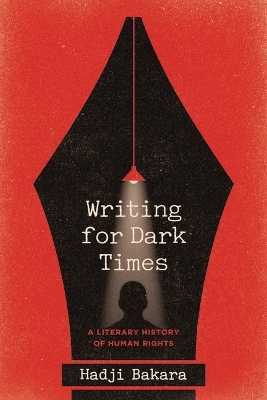
Writing for Dark Times
University of Chicago Press (Verlag)
978-0-226-84782-5 (ISBN)
- Noch nicht erschienen (ca. Mai 2026)
- Versandkostenfrei
- Auch auf Rechnung
- Artikel merken
At Amnesty International’s headquarters in London hangs a large copy of Seamus Heaney’s “From the Republic of Conscience,” a poem that touches on neither imprisonment nor torture but instead suggests that acts of literary creation are themselves a form of human rights work, important for bringing new things into the world rather than removing evil from it. Why does a poem about the power of creation stand at the center of an organization known for publicizing atrocity? What can it tell us about human rights?
Hadji Bakara’s Writing for Dark Times tells the story of the writer’s distinct place in the history of human rights. It argues that the relationship between the creative work of writing and the pursuit of universal rights is an important but misunderstood dimension of both literary and human rights history over the past century. Following a diverse cast of characters from the First World War through the end of the Cold War, including Bertolt Brecht, H.G. Wells, Archibald MacLeish, Albert Camus, Czeslaw Milosz, Ngũgĩ wa Thiong’O, Muriel Rukeyser, Nadine Gordimer, and J.M. Coetzee, Bakara shows how many writers took up questions about human rights, from refugees in the early century to a poet-statesman who helped draft the United Nations declarations of human rights to imprisoned writers and writer-activists who became integral parts of the global human rights movement. But the book also shows that these writers’ efforts to theorize and support human rights were bound up with changing ideas about the place of their own work in the world––the work of writing.
For those who study human rights, Writing for Dark Times offers both an archive and a method for better understanding the influence of writers on the historical development of the concept. For those in literary studies, the book provides a new account of how human rights shaped the politics of twentieth-century literature. Few books have made as vivid a case for literature’s relevance to our most exalted ideals and institutions.
Hadji Bakara is assistant professor of English at the University of Michigan. His articles and essays on human rights and migration have appeared in such publications as Journal of Narrative Theory, PMLA, German Quarterly, American Literary History, the Los Angeles Review of Books. He is the coeditor of The Oxford Handbook to Literature and Migration.
List of Figures
Introduction: On Writing and Human Rights History
Part I: The Refugee
1. Stateless Writing
2. The Problem of the Refugee Writer
Part II: The Legislator
3. Poetry in the Shadow of Human Rights
Part III: The Prisoner
4. The Writer’s Freedom
5. The Prisoner’s Pressure
Part IV: The Witness
6. Suffering and the Fate of Utopia
Conclusion: The Writer’s Imagination and the Imagination of the State
Acknowledgments
Notes
Index
| Erscheint lt. Verlag | 15.5.2026 |
|---|---|
| Zusatzinfo | 29 halftones |
| Sprache | englisch |
| Maße | 152 x 229 mm |
| Gewicht | 454 g |
| Themenwelt | Geisteswissenschaften ► Geschichte |
| Geisteswissenschaften ► Sprach- / Literaturwissenschaft ► Anglistik / Amerikanistik | |
| Geisteswissenschaften ► Sprach- / Literaturwissenschaft ► Literaturwissenschaft | |
| Sozialwissenschaften ► Politik / Verwaltung | |
| ISBN-10 | 0-226-84782-9 / 0226847829 |
| ISBN-13 | 978-0-226-84782-5 / 9780226847825 |
| Zustand | Neuware |
| Informationen gemäß Produktsicherheitsverordnung (GPSR) | |
| Haben Sie eine Frage zum Produkt? |
aus dem Bereich