


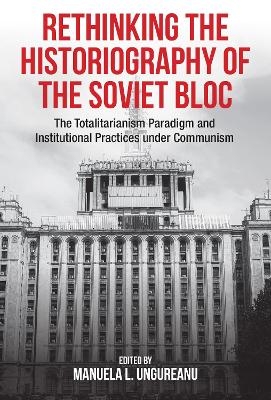
Rethinking the Historiography of the Soviet Bloc
Berghahn Books (Verlag)
978-1-83695-352-4 (ISBN)
- Noch nicht erschienen (ca. März 2026)
- Versandkostenfrei
- Auch auf Rechnung
- Artikel merken
Highlights the reasons why totalitarianism is still an attractive model in political science born out of the cold war.
Revisits ideas about totalitarianism and knowledge production under communism.
Addressing polarized narratives of authoritarian control and societal resistance, this volume reconsiders the totalitarianism paradigm in the study of the Soviet Bloc. Historians, philosophers, and literary scholars explore both its enduring explanatory power and its conceptual limits, drawing on insights from social epistemology and the history of social sciences. Case studies on Czechoslovakia, Romania, Poland, Hungary, the former GDR, Ukraine and the Soviet Union reveal how education, publishing, and cultural production shaped institutional life and intra-bloc interactions. The contributions develop new historiographical standards for understanding the complex interplay between imperial influence and local agency across the diverse societies of the former socialist world, while exploring the potential of various social-theoretical frameworks.
Manuela Ungureanu is associate professor of philosophy at the University of British Columbia, Okanagan. She has published on Donald Davidson’s interpretation theory and has examined issues in the philosophy of language following Chomsky’s universal grammar. Her work, which is at the interface between cognitive psychology and social epistemology, has appeared in journals such as Dialogue and AVANT as well as edited volumes including Romanian Studies in the Philosophy of Science (2015) and From an Analytical Point of View (2025).
List of Illustrations
Acknowledgments
Introduction: Historians Reassess Totalitarianism Theory
Manuela L. Ungureanu
Part I: Main Paradigms and their Evolving Fortunes
Chapter 1. Remarks on the Historiography of Rapid Political and Social Change
Daniel Little
Chapter 2. Carl Friedrich’s Path to “Totalitarianism”
Stephen Turner
Chapter 3. Soviet Society, Social Structure, and Everyday Life: Major Frameworks Reconsidered
Mark Edele
Chapter 4. The GDR: A Special Kind of Modern Dictatorship
Jürgen Kocka
Chapter 5. Totalitarian Syndrome as a Case of an Essentially Contested Concept: An Overview of Discussions Held in the Humanities and Social Sciences in Poland
Krzysztof Brzechczyn
Chapter 6. Framing the Rising Discontent with Totalitarianism Theory: The View from Social Ontology
Manuela L. Ungureanu
Chapter 7. Totalitarianism and the Historians
Charles Turner
Chapter 8. Why I say “Totalitarian Regimes”: A Response to Totalitarianism Denial
Aviezer Tucker
Part II: Approaches to Control, Legitimation of Power and Forms of Resistance
Chapter 9. Beyond Totalitarianism: Rethinking Approaches to the GDR and the Nazi Past
Mary Fulbrook
Chapter 10. The Soviets Abroad: The NKVD, Intelligence, and State Building in East-Central Europe after World War II
Molly Pucci
Chapter 11. Postwar Show Trials: The Apogee of Totalitarianism or Political Processes?
Barbara J. Falk
Chapter 12. The Communist Public Sphere: A Sociolegal Analysis
Mihaela Şerban
Chapter 13. Industrialization, Independence, Identity: Legitimation of Power in Communist Romania, 1965–1971
Dragoş Petrescu
Chapter 14. Homo Sovieticus and the Greengrocer: On Varieties of Dissident Critique of Post-Totalitarian Political Culture
Piotr Wciślik
Chapter 15. On the Origins of “Totalita”: A Social Epistemology of a Non-Concept
Muriel Blaive
Part III: Soviet-Style Institutions for Higher-Education and Research and the Powers of the New Elites
Chapter 16. The Counterintuitive Effects of Soviet Totalitarianism: Soviet Universities during Late Stalinism, 1945-1953
Benjamin Tromly
Chapter 17. Sergei Vavilov and the Soviet Modes of Science Production
Alexei Kojevnikov
Chapter 18. A Friendship Inside Romanian Academia under Cultural Stalinism: Mihai Ralea and Tudor Vianu
Cristian Vasile
Chapter 19. Gatekeeping Institutions of Literary Translation in Soviet Ukraine
Valentyna Savchyn
Chapter 20. Intellectual Autonomy in Socialist Romania: Theories, Methods, and the Case Study of Sociology after 1966
Adela Hîncu
Chapter 21. Writing Contemporary History in Late Socialist Hungary: Dissecting Institutional Legacies
Réka Krizmanics
Chapter 22. “The Tale of Two Cities”: The Historical Multicultural Bucharest Vs. the Communist Capital of Romania
Cristina Petrescu
Afterword: The Makings of Rethinking the Historiography of the Soviet Bloc or How to Take Stock of an Elephant, and Still Keep Your Bearings
Manuela L. Ungureanu
Index
| Erscheint lt. Verlag | 1.3.2026 |
|---|---|
| Zusatzinfo | Bibliography; Index |
| Verlagsort | Oxford |
| Sprache | englisch |
| Themenwelt | Geisteswissenschaften ► Geschichte |
| Sozialwissenschaften ► Politik / Verwaltung ► Politische Systeme | |
| ISBN-10 | 1-83695-352-6 / 1836953526 |
| ISBN-13 | 978-1-83695-352-4 / 9781836953524 |
| Zustand | Neuware |
| Informationen gemäß Produktsicherheitsverordnung (GPSR) | |
| Haben Sie eine Frage zum Produkt? |
aus dem Bereich


