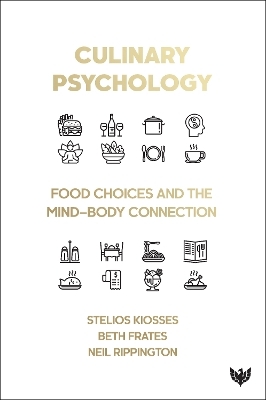
Culinary Psychology
Phoenix Publishing House (Verlag)
978-1-80013-232-0 (ISBN)
- Noch nicht erschienen (ca. März 2026)
- Versandkostenfrei
- Auch auf Rechnung
- Artikel merken
Food is entwined in all of our lives. As a topic, it belongs simultaneously to many diverse fields, including economics, ecology, agriculture, and sociology. Culinary psychology incorporates many of these outlooks to understand and interpret the meaning of food and to investigate experiential as well as sensory perceptions. Healthy thinking and lifestyle patterns are an integral part of nutrition. Exercise, sleep, friendships, attitude, and alcohol all have a significant impact on the choice, the timing, and our enjoyment of the food we consume. What we eat impacts our mental health and even our libidos – with many comestibles feted for their aphrodisiac power. Added to all of this is the cultural and historical significance of food in our lives and the part it plays in celebrations and commemorations. Outside influences, such as societal expectations, market forces, and government legislation, also affect what and how we eat, as we can see from the rise of processed foods, snacking, and the use (or not) of cutlery and dining tables.
This superb resource brings together accessible expertise from these wide-ranging perspectives to demonstrate the importance of culinary psychology in our lives. As our understanding of the impact of what and how we eat continues to grow, this book’s comprehensive overview of culinary psychology will prove invaluable to students, academics, and the general reader.
Beth Frates, MD, is a trained physiatrist (a medical doctor specializing in physical medicine and rehabilitation) and a health and wellness coach, with expertise in lifestyle medicine. She has received several teaching accolades from Harvard Extension School and Harvard Medical School, where she is an associate professor, part-time. Dr. Frates is one of the first fellows of the American College of Lifestyle Medicine and a pioneer in lifestyle medicine. In 2008, Dr. Frates created the first Lifestyle Medicine Interest Group at Harvard Medical School. In 2014, she developed and taught a college lifestyle medicine curriculum at Harvard Extension School, and it is still one of the most well-received courses offered at the school. In 2017, Dr. Frates was selected to be one of four item writers for the American Board of Lifestyle Medicine’s inaugural exam for certification in this specialty. She was voted president of the American College of Lifestyle Medicine in August 2020. Dr. Frates served as president until November 2024, and now serves two years as immediate past president. Dedicated to mentoring, she won the Women in Medicine I Stand With Her annual mentoring award for women mentoring women in 2024. Dr. Frates coauthored The Lifestyle Medicine Handbook: An Introduction to the Power of Healthy Habits, which was ranked in the top 20 by Book Authority for medical books released in 2018. To accompany the syllabus and handbook, she also cocreated Lifestyle Medicine 101, a full college curriculum with twelve weeks of PowerPoints and a teacher’s manual, which is free and accessible through the ACLM website. In addition, Dr. Frates coauthored The Teen Lifestyle Medicine Handbook (2020) which, when paired with the Teen Curriculum consisting of a teacher’s manual and twelve PowerPoint decks, can be used to teach and empower middle school and high school students to adopt and sustain healthy habits. In 2023, Dr. Frates coauthored The Lifestyle Medicine Pocket Guide and coedited Empowering Behavior Change in Patients. Most recently, in June 2024, she coedited the book Essentials of Clinical Nutrition in Healthcare. Dr. Frates has created and implemented a twelve-step wellness program, PAVING the Path to Wellness™ for patients and providers. Most recently, she coauthored the book PAVING the Path to Wellness Workbook: A Guide to Thriving with a Healthy Body, Peaceful Mind and Joyful Heart. In addition, Dr. Frates has her own lifestyle medicine consulting/coaching practice where she sees patients one to one and in groups. Stelios Kiosses is a psychotherapist, course director, and tutor at the University of Oxford, where he leads the pioneering programme in culinary psychology. He studied psychodynamic counselling and clinical supervision at the University of Oxford, following earlier training in psychotherapy and experimental psychology at the University of Sussex. He is a member of the British Association for Counselling and Psychotherapy, the British Psychological Society, and an associate member of the American Psychological Association. Stelios has developed and co-taught the innovative culinary psychology course at Harvard University Extension School and is currently a featured guest faculty member at Harvard Medical School, contributing to the nutrition and wellness coaching programme. His previous academic appointments include visiting senior research associate at King’s College London, visiting lecturer at Goldsmiths, University of London, and honorary senior lecturer in the department of psychiatry at the University of Birmingham. In the public sphere, Stelios presented Channel 4’s acclaimed series The Hoarder Next Door, narrated by Olivia Colman. He is the author of The Power of Talking: Stories from the Therapy Room (Phoenix, 2022). Through his clinical practice, academic leadership, and public engagement, Stelios continues to explore the links between psychology, food, and emotional well-being, championing innovative approaches to mental health and resilience. Neil Rippington trained as a chef at the Bournemouth and Poole College, before going on to work in Michelin-starred restaurants in France, London, and the New Forest, and other roles in the culinary industry in the U.S.A., Canada, and the Caribbean. In 1999, Neil returned to work in education and, in 2003, he joined Colchester Institute as head of the Centre for Hospitality and Food Studies. In 2010, Neil took up the position as dean of the College of Food at University College Birmingham, where he worked for more than ten years. Neil’s writing career started in 2007 with the publication of Professional Chef, produced as a resource for students following the newly developed City & Guilds diplomas in professional cookery (now in its second edition and translated into many languages). He has since written and cowritten several other practical books for students, has developed many educational programs, and teaches subjects across the culinary arts and gastronomy. His research led to the development of degree programs offered at the Edge Hotel School, University of Essex, and he codeveloped a program in culinary psychology at Harvard University, U.S.A. Neil is a senior fellow of Advance HE. He is also an examiner for City & Guilds of London Institute and an academician of the Royal Academy of Culinary Arts, and chair of its Education Committee. Neil sits on various other committees and steering groups, is a subject expert for hospitality and catering for the Office of Qualifications and Examinations Regulation (Ofqual), and has acted as an external university advisor/examiner in the U.K. and internationally. In recognition of his work, Neil has received many accolades, including Disciple of Escoffier, honorary member of City & Guilds, and is lead judge for the development of skills at the Salon Culinaire, U.K. Neil is currently the program director for the college community program for the Royal Academy of Culinary Arts, U.K. and the international director for global education with the International Institute of Hotel Management, India.
About the authors and contributors
Foreword
Irini Tzortzoglou
Introduction
Chef Andreas Antona
1. Neurogastronomy: The study of how the brain processes sensory information relating to flavor
Stelios Kiosses
2. The psychology of sex and food: Do food aphrodisiacs really work?
Stelios Kiosses
3. The link between diet, crime, and mental health
Stelios Kiosses
4. The relationship between religion and food
Stelios Kiosses
5. Unconscious influences on dietary intake: Why we eat more than we think
Stelios Kiosses
6. Stress and its impact on food intake
Beth Frates
7. How mindset and positive psychology influence food preferences and consumption
Beth Frates
8. The influence of social connections on dietary patterns
Beth Frates
9. Physical activity and its impact on food choices
Beth Frates
10. Substance use and its impact on food choices
Beth Frates
11. Sleep and food choices: What we eat when we are sleepy
Beth Frates
12. Empowering healthy eating patterns
Beth Frates
13. The psychology of product branding
Stelios Kiosses
14. Gastrophysics: An introduction
Charles Spence
15. Practical gastronomy and developing taste and flavor in cooking
Neil Rippington
16. Cutlery: The science and sensory experience
Neil Rippington
17. Food sustainability and ethical eating: How to feed the world without breaking it!
Neil Rippington
18. The restaurant journey: From booking to departure
Neil Rippington
19. The importance of chefs and their influence on eating patterns
Neil Rippington
20. Reign of the fat heads: The evolutionary advantage of human brain development
Kimberly Wilson
Conclusion: Culinary psychology—uniting food, mind, and health
References
Index
| Erscheint lt. Verlag | 26.3.2026 |
|---|---|
| Sprache | englisch |
| Maße | 152 x 229 mm |
| Themenwelt | Geisteswissenschaften ► Psychologie ► Biopsychologie / Neurowissenschaften |
| Geisteswissenschaften ► Psychologie ► Verhaltenstherapie | |
| Sozialwissenschaften | |
| ISBN-10 | 1-80013-232-8 / 1800132328 |
| ISBN-13 | 978-1-80013-232-0 / 9781800132320 |
| Zustand | Neuware |
| Informationen gemäß Produktsicherheitsverordnung (GPSR) | |
| Haben Sie eine Frage zum Produkt? |
aus dem Bereich