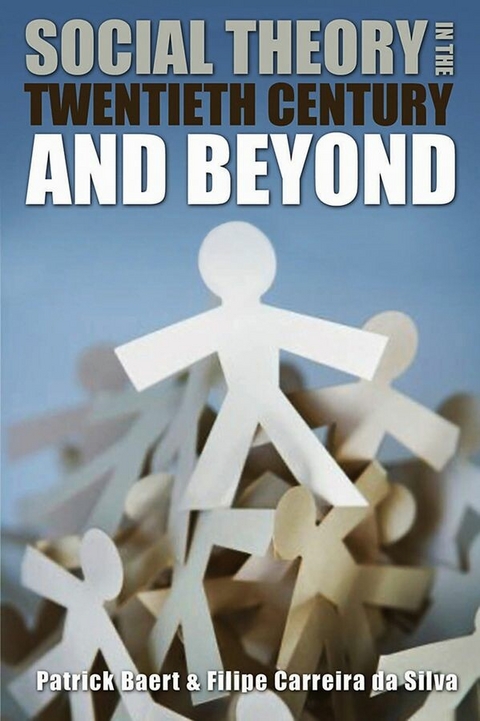
Social Theory in the Twentieth Century and Beyond (eBook)
497 Seiten
Polity (Verlag)
978-1-5095-0004-8 (ISBN)

The revised edition includes new material on French pragmatist sociology and cultural sociology, and on contemporary social thinkers such as Zygmunt Bauman, Ulrich Beck, Manuel Castells, Randall Collins, Michael Mann, Saskia Sassen and Theda Skocpol. The authors conclude with a bold, new pragmatist agenda for social theory and the social sciences.
Written in a lively style, and avoiding jargon, Social Theory in the Twentieth Century and Beyond is aimed at students who wish to gain an understanding of the main debates and dilemmas driving social theory. Like its predecessor, it will be a standard introduction to modern social theory for students in sociology, politics and anthropology.
This revised edition of Patrick Baert's widely acclaimed Social Theory in the Twentieth Century, now benefitting from the collaboration of Filipe Carreira da Silva has been brought right up-to-date with cutting-edge developments in social theory today. It offers an easy-to-read but provocative account of the development of social theory, covering a range of key figures and classic schools of thought. The authors bridge the gap between philosophy and social theory, locating the theoretical views of individuals such as Michel Foucault, Anthony Giddens and J rgen Habermas within wider historical traditions. The revised edition includes new material on French pragmatist sociology and cultural sociology, and on contemporary social thinkers such as Zygmunt Bauman, Ulrich Beck, Manuel Castells, Randall Collins, Michael Mann, Saskia Sassen and Theda Skocpol. The authors conclude with a bold, new pragmatist agenda for social theory and the social sciences. Written in a lively style, and avoiding jargon, Social Theory in the Twentieth Century and Beyond is aimed at students who wish to gain an understanding of the main debates and dilemmas driving social theory. Like its predecessor, it will be a standard introduction to modern social theory for students in sociology, politics and anthropology.
Introduction
What this book is about
We take social theory to be a relatively systematic, abstract and general reflection on the workings of the social world. However elementary this definition might be, a number of consequences follow from it. First, we will only discuss theories which reach a high level of abstraction. This is certainly not to say that social theories are necessarily independent of the empirical study of society. Of course, some theories have hardly any bearing on empirical research, while others very much rely upon or inform empirical sociology. But whether they are empirically grounded or not, the main purpose of social theorists is obviously to theorize, and there is thus a clear distinction between the abstract nature of social theory and the practical orientations of empirical sociology. Second (and relatedly), we will explore theories which reach a high level of generality. That is, they aim to cover various aspects of the social realm, across different periods and across different societies. Third, there is the systematic nature of social theories. Compared to mere opinions and beliefs, they exhibit a high level of internal consistency and coherence. Even recent attempts to move away from grand theory-building are systematic endeavours; they are not mere amalgams of opinions.
Our starting point is the early twentieth century, but this is not to suggest that social theory was created in this period. The tradition of social theory goes a long way back. From the classic Greek thinkers to the eighteenth-century philosophes, the social realm has long been a motif for theoretical reflection. Furthermore, social theory was central to the emergence of sociology as a separate discipline in the course of the nineteenth century. Auguste Comte, Émile Durkheim, Max Weber and Karl Marx (to name only a few) developed extremely elaborate views about the mechanisms of the social world. Nevertheless, contemporary social theory is, at least in some respects, quite distinct from its nineteenth-century predecessor. Three main differences can be pointed out.
First, although Comte, Durkheim and others made great efforts to establish sociology as a separate discipline, theory-building and empirical research were far from being institutionalized specialisms. By contrast, in many countries, social theory has increasingly become a separate academic field – clearly distinct from empirical sociology. Second, social theory has become professionalized. In the nineteenth century it was practised by people who were educated in aligned fields (namely philosophy). Few occupied academic positions which would have allowed them to train others. Most classic social theorists (Tocqueville, Comte, Marx, Spencer and Simmel, for example), never occupied permanent posts in universities at all. Nowadays, formal training in social theory has become a massive industry enrolling tens of thousands each year in graduate schools around the world. Third, social theories are now less clearly tied to political action and social reform than they used to be. Sociology, one should not forget, emerged as the scientific answer to the so-called ‘social question’ afflicting nineteenth-century European societies – i.e., the social and political upheavals created by the Industrial Revolution. Social theories were then tools for dealing with social and political problems. For example, Comte (and to some extent Durkheim) wondered how social order could be reinstated following the political and economic turmoil of the time. Tocqueville tried to ascertain how equality of opportunity and freedom could be reconciled, and Marx aimed to develop a more equal and less alienating type of society. For all of them, social theory was not an aim in itself; it was considered to be a necessary medium for dealing with current social and political issues. Today there is a much more pronounced consciousness that social reform and political activism are not internally linked to social theory. When contemporary thinkers like Jürgen Habermas intervene in the public sphere, they do so as public intellectuals, i.e., as citizens concerned with the public good. Habermas’s social theory, however, is not at stake. Its validity comes from its intellectual depth and internal consistency, characteristics to be established through academic procedures like anonymous peer review or empirical verification, not from its ability to ‘solve’ political problems. Today, social theory and political life are highly differentiated professional domains, with separate organizational principles and goals.
Social theory has undergone profound changes in the past four decades. In the 1960s, events like the student revolts of May 1968 in Paris and the civil rights movement in the US contributed decisively to a sea change in the intellectual landscape. As a result, the intellectual edifice that Talcott Parsons had been carefully building since the 1930s was spectacularly ruined. In less than a decade, Parsonian structural-functionalism passed from being the dominant paradigm in sociology to being the consensual target of an entire generation of social theorists. The 1970s were devoted to the working out of feasible alternatives to structural-functionalism: symbolic interactionism, ethnomethodology, conflict theory and exchange theory were among the paradigms presented as the solution for the crisis generated by the demise of Parsons’s project. In the early 1980s, the tradition of grand social theorizing returned. In a few years, sociology bookshelves were invaded by multivolume attempts at grand theoretical synthesis. Jeffrey Alexander’s neo-functionalism, Pierre Bourdieu’s genetic structuralism, Anthony Giddens’s structuration theory and Habermas’s critical theory came to the forefront in this period.
These theories have two features in common. First, they all attempt to integrate opposing philosophical and theoretical traditions. For example, they aim to integrate structuralist notions and insights from interpretative sociology, and they seek to transcend the opposition between determinism and voluntarism. Second, they all wish to overcome previously held dualisms. For example, they try to move beyond the opposition between the individual and society. Besides these two features, genetic structuralism and structuration theory have other characteristics in common. Both reject mechanistic views of the social world in which structures are seen as imposed upon people. Instead, people are portrayed as active agents – their behaviour being constrained, but not determined. Both Bourdieu and Giddens argue that people’s daily routines are rooted in a taken-for-granted world. In general, people know how to act in accordance with the implicit, shared rules which make up that world. They draw upon these rules and, in so doing, they unintentionally reproduce them.
Fin-de-siècle social theory differs from the recent past in three important respects. First, there is what we call the ‘empirical turn’ in contemporary social theory. We refer to the trend of contemporary theorists to abandon universal ambitions and instead to reflect on the transition towards modernity and towards society today. This intellectual enterprise is ‘empirical’ in that it provides a diagnosis of the empirical nature of modernity and contemporary society. Those who follow the empirical turn do not abandon theory as such. Rather, they develop a theoretical frame of reference that facilitates the understanding of the distinctiveness and problems of modern contemporary society. The epochal sociologies of authors like Richard Sennett, Ulrich Beck or Zygmunt Bauman exemplify this empirical turn (see chapter 8).
Second, there is a ‘normative turn’. Until recently, issues of justice, equality and democracy were considered off-limits to objective social theorizing. From the 1990s onwards, however, social theorists have enthusiastically included these moral and political topics in their agendas. From Habermas’s discourse ethics to Bauman’s postmodern ethics and Judith Butler’s writings on the performative nature of gender identity, normative social theorizing has firmly established itself as a legitimate mode of social thinking. Third, globalization has become a major topic of interest to social theorists. If modernization was the central preoccupation for the post-war generation and the new social movements were the chief interest for social theorists in the 1970s and early 1980s, today there is hardly any major social theorist who does not address globalization. There are, however, noticeable differences in the treatment of this topic. There are those who try to develop a general new social theory about global networks, such as Manuel Castells; there are those who, like Habermas or Axel Honneth, try to explore the democratic and emancipatory potential of this process of growing cosmopolitanism; and there are those who try to develop global, intercivilizational comparisons in order to advance non-ethnocentric modes of social theorizing (Shmuel Eisenstadt is one such example).
The structure of this book can be described as follows. Most contemporary perspectives are influenced by some nineteenth-century precursors. Both structuralism (see chapter 1) and functionalism (see chapter 2) have a lot in common in that they adopt Durkheim’s holistic picture of society. According to the doctrine of holism, society is to be studied as a whole, and this whole cannot be reduced to a mere sum of its components. Like Comte, Durkheim emphasized that society is an entity sui...
| Erscheint lt. Verlag | 4.9.2025 |
|---|---|
| Sprache | englisch |
| Themenwelt | Sozialwissenschaften ► Soziologie ► Allgemeine Soziologie |
| Schlagworte | Account • baerts • Between • Carreira • Century • Collaboration • da • Development • Developments • easytoread • Edition • Filipe • GAP • Key • Patrick • Provocative • Range • schools • Silva • Social • theory • Thought • twentieth • uptodate |
| ISBN-10 | 1-5095-0004-9 / 1509500049 |
| ISBN-13 | 978-1-5095-0004-8 / 9781509500048 |
| Informationen gemäß Produktsicherheitsverordnung (GPSR) | |
| Haben Sie eine Frage zum Produkt? |
 EPUB (Adobe DRM)
Kopierschutz: Adobe-DRM
Adobe-DRM ist ein Kopierschutz, der das eBook vor Mißbrauch schützen soll. Dabei wird das eBook bereits beim Download auf Ihre persönliche Adobe-ID autorisiert. Lesen können Sie das eBook dann nur auf den Geräten, welche ebenfalls auf Ihre Adobe-ID registriert sind.
Details zum Adobe-DRM
Dateiformat: EPUB (Electronic Publication)
EPUB ist ein offener Standard für eBooks und eignet sich besonders zur Darstellung von Belletristik und Sachbüchern. Der Fließtext wird dynamisch an die Display- und Schriftgröße angepasst. Auch für mobile Lesegeräte ist EPUB daher gut geeignet.
Systemvoraussetzungen:
PC/Mac: Mit einem PC oder Mac können Sie dieses eBook lesen. Sie benötigen eine
eReader: Dieses eBook kann mit (fast) allen eBook-Readern gelesen werden. Mit dem amazon-Kindle ist es aber nicht kompatibel.
Smartphone/Tablet: Egal ob Apple oder Android, dieses eBook können Sie lesen. Sie benötigen eine
Geräteliste und zusätzliche Hinweise
Buying eBooks from abroad
For tax law reasons we can sell eBooks just within Germany and Switzerland. Regrettably we cannot fulfill eBook-orders from other countries.
aus dem Bereich