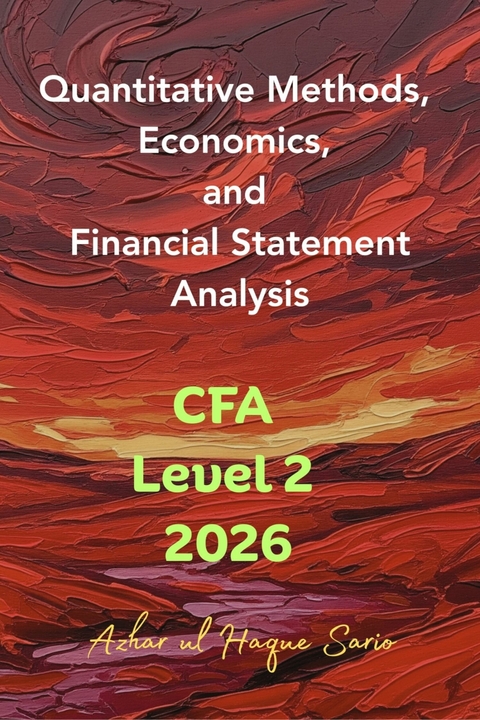
Quantitative Methods, Economics, and Financial Statement Analysis (eBook)
240 Seiten
Azhar Sario Hungary (Verlag)
978-3-384-69428-7 (ISBN)
This book is your roadmap through three of the toughest subjects on the exam. We start with Quantitative Methods. You'll build a strong foundation in multiple regression and its assumptions. We show you how to evaluate a model's fit and interpret its results. You'll learn to spot and correct model misspecification. The book also covers extensions of multiple regression. From there, we transition into the complexities of Time-Series Analysis. We then bring you into the modern era of finance with clear introductions to Machine Learning and Big Data Projects. Next, we simplify the world of Economics. You'll gain a thorough understanding of currency exchange rates and their equilibrium value. We also unpack the theories and drivers of economic growth. Finally, we tackle Financial Statement Analysis. You will master intercorporate investments and employee compensation, including post-employment and share-based plans. We clarify the accounting for multinational operations and teach you the unique aspects of analyzing financial institutions. You'll develop a critical eye for evaluating the quality of financial reports and learn to integrate all these techniques for a holistic analysis.
What sets this book apart from other prep materials? It's our commitment to clarity and practical application. We know other guides can be dense and academic, burying key concepts in jargon. This book is different. It's written in a simple, conversational tone, like a mentor guiding you through each topic. We bridge the gap between abstract theory and the real world by using intuitive examples. We focus on the 'why' behind the formulas, not just memorization. This approach ensures you're building a deep, lasting understanding that will serve you throughout your career. While other books tell you the rules, we show you how to think like a charterholder. This focus on intuition and application is our unique advantage, designed to give you the confidence and competence needed to excel on the exam and beyond.
Disclaimer: The author of this book is not affiliated with the CFA Institute. This publication is independently produced and is not endorsed, sponsored, or approved by the CFA Institute. CFA® is a trademark owned by the CFA Institute. This book is intended for educational purposes and is sold under the principle of nominative fair use.
Currency Exchange Rates: Understanding Equilibrium Value
Bid-Offer Spreads in Currency Markets
Imagine walking into a currency exchange booth at an airport. You'll notice two different prices listed for any currency pair: one price at which they will buy a currency from you and another, higher price at which they will sell that same currency to you. This difference is the heart of the bid-offer spread, and it’s how currency dealers, from that small booth to massive international banks, make their money. It's essentially their fee for providing the service of immediate currency exchange.
The bid price is the price at which a dealer is willing to buy the base currency. The base currency is the first currency listed in a pair (e.g., in EUR/USD, the Euro is the base currency). So, if you are selling Euros, the dealer will buy them from you at the bid price. Think of it as the dealer "bidding" for your currency.
The offer price (also known as the ask price) is the price at which a dealer is willing to sell the base currency. If you want to buy Euros, you'll have to pay the dealer's offer price. It's what the dealer is "asking" for the currency. The offer is always higher than the bid.
Calculating and Interpreting the Spread
Calculating the spread is straightforward. You simply subtract the bid price from the offer price.
Spread = Offer Price – Bid Price
Let's look at an example. Suppose a bank quotes the British Pound against the US Dollar (GBP/USD) as 1.2550/1.2555.
Bid Price: 1.2550 (The bank will buy 1 GBP from you for $1.2550)
Offer Price: 1.2555 (The bank will sell 1 GBP to you for $1.2555)
The spread is calculated as: 1.2555−1.2550=0.0005. This difference of 5 "pips" (price interest points) is the dealer's profit margin.
The spread can also be expressed as a percentage, which helps in comparing spreads across different currency pairs.
Percentage Spread = ( (Offer Price - Bid Price) / Offer Price ) * 100
Using our example: ((1.2555−1.2550)/1.2555)∗100≈0.04%.
This percentage tells you the transaction cost relative to the price. A trader immediately loses this small percentage the moment they enter a trade. To make a profit, the currency's value must move in their favor by an amount greater than the spread.
This applies to both spot (for immediate delivery) and forward (for future delivery) contracts. A forward quotation like EUR/USD for 90 days at 1.0820/1.0830 works the same way; the spread is 0.0010, representing the dealer's profit on that future transaction.
What Affects the Bid-Offer Spread?
The size of the spread isn't random; it's a dynamic reflection of risk and market conditions. Several key factors influence it:
Liquidity of the Currency: This is the most significant factor. Currencies that are traded in massive volumes, like the US dollar, Euro, and Japanese Yen, are highly liquid. This means there are always tons of buyers and sellers, making it easy for dealers to complete transactions. High liquidity leads to very narrow (tight) spreads. In contrast, exotic currencies from smaller or less stable economies have low liquidity, making them riskier to trade. This results in much wider spreads to compensate the dealer for the risk of not being able to offload the currency easily.
Market Volatility: When the market is choppy and uncertain—perhaps due to a major political announcement or unexpected economic data—prices can swing wildly. This increases the risk for dealers. They don't want to buy a currency only to see its value plummet moments later. To protect themselves, they widen the spread. In calm, stable market conditions, spreads tend to be narrower.
Time of Day: The foreign exchange market operates 24 hours a day, but activity peaks when major financial centers overlap, like when both London and New York are open. During these high-volume periods, liquidity is at its maximum, and spreads are at their tightest. Conversely, during quiet periods, like late in the Asian session, liquidity thins out, and spreads can widen.
Size of the Transaction: Large institutional traders dealing in huge volumes often get tighter spreads than a retail investor trading a small amount. Banks are more willing to offer a better price on a large, single transaction.
The Hunt for Triangular Arbitrage Profit
In a perfectly efficient market, all currency exchange rates would be perfectly aligned. If you could buy Euros with Dollars, then sell those Euros for Yen, and finally sell those Yen back for Dollars, you should end up with exactly the amount of money you started with. Triangular arbitrage is a strategy that exploits temporary glitches in these cross-exchange rates, allowing a trader to make a risk-free profit.
This opportunity arises when the exchange rate quoted by a bank between two currencies (say, A and B) is not in sync with the implied cross-rate calculated through a third currency (C). It’s like finding a pricing error where you can buy a product from one store, sell it to another, and pocket the difference. These opportunities are rare and fleeting in today's electronic markets, as algorithms spot and correct them in fractions of a second. However, understanding the mechanics is a classic lesson in finance.
Identifying and Calculating the Profit
Let's walk through an example to see how to spot and profit from such an opportunity. Suppose you are a trader with 1,000,000 and you see the following real-time bid-offer quotes from three different banks:
Bank A (USD/CHF): 0.9110/0.9115 (Dollars vs. Swiss Francs)
Bank B (GBP/USD): 1.2640/1.2645 (Pounds vs. Dollars)
Bank C (GBP/CHF): 1.1525/1.1530 (Pounds vs. Swiss Francs)
Step 1: Calculate the Implied Cross-Rate
First, we need to check if the direct quote for GBP/CHF from Bank C aligns with the rate we can create by going through the US Dollar using the quotes from Bank A and Bank B. This is the implied cross-rate.
To find the implied GBP/CHF rate, we need to see how many Swiss Francs we can get for one British Pound by using the dollar as a middleman.
To buy GBP (the base currency), we must use the offer rate from Bank B: 1.2645. This means 1 GBP costs $1.2645.
To sell those USD for CHF, we must use the bid rate from Bank A: 0.9110. This means for every dollar, we get $0.9110 CHF.
So, the implied cross-rate to sell GBP for CHF is: 1.2645 USD/GBP∗0.9110 CHF/USD=1.1520 CHF/GBP.
Step 2: Compare the Implied Rate with the Actual Market Rate
Now, we compare our calculated rate with the direct quote from Bank C.
Our Implied Rate (to sell GBP): 1.1520
Bank C's Bid Rate (they will buy GBP at): 1.1525
Here's the opportunity! Bank C is willing to buy Pounds from us at a higher price (1.1525) than the rate we can effectively create in the market (1.1520). This means the actual rate is mispriced relative to the cross-rate, and we can profit.
Step 3: Execute the Trades and Calculate the Profit
To capitalize on this, we need to perform a three-step trade that starts and ends with our initial currency (USD). The goal is to "buy low" and "sell high."
Sell USD, Buy GBP: We start with our $1,000,000. We need to buy pounds. Bank B sells pounds at its offer price of 1.2645.
Amount of GBP bought = 1,000,000/1.2645 USD/GBP=£790,826.41
Sell GBP, Buy CHF: Now, we take our pounds and sell them for Swiss Francs. We go to Bank C, which has the favorable rate. Bank C buys pounds at its bid price of 1.1525.
Amount of CHF bought = £790,826.41∗1.1525 CHF/GBP=CHF 911,427.95
Sell CHF, Buy USD: Finally, we convert our Swiss Francs back to our original currency, US Dollars. We go to Bank A, which buys Swiss Francs at its offer price of 0.9115 (remember, since USD is the base currency, their bid is for USD and their offer is for CHF).
Amount of USD received = CHF 911,427.95/0.9115 CHF/USD=$1,000,000− a slight rounding difference, lets re-verify the logic of bid/offer on the last step
Let's re-think the last step. The quote is USD/CHF. The base is USD. The bank buys USD at 0.9110 and sells USD at 0.9115. We are selling CHF to buy USD. This means we must accept the bank's rate for selling us USD, which is the offer price of 0.9115. But this is the price in terms of CHF per USD. So, we divide our CHF by this rate.
Final USD = CHF 911,427.95/0.9115 CHF/USD=$999,920.95.
Wait, this resulted in a loss. Let's re-examine the arbitrage path. The implied bid rate was 1.1520, and the market bid was 1.1525. We should sell GBP at the higher rate. The path taken was correct. Let's check the other side.
What if we calculate the implied offer rate?
To sell GBP, we would get USD at the GBP/USD bid: 1.2640.
To use those USD to buy CHF, we would pay the USD/CHF offer: 0.9115.
Implied Offer Rate (CHF/GBP) = 1.2640∗0.9115=1.152056. The market offer...
| Erscheint lt. Verlag | 31.8.2025 |
|---|---|
| Sprache | englisch |
| Themenwelt | Sachbuch/Ratgeber ► Beruf / Finanzen / Recht / Wirtschaft ► Bewerbung / Karriere |
| Sozialwissenschaften ► Pädagogik ► Bildungstheorie | |
| Schlagworte | CFA Exam Prep 2026 • CFA Level 2 Study Guide • Financial Economics • Financial Statement Analysis • Investment Valuation • Quantitative Methods • Time-series analysis |
| ISBN-10 | 3-384-69428-7 / 3384694287 |
| ISBN-13 | 978-3-384-69428-7 / 9783384694287 |
| Informationen gemäß Produktsicherheitsverordnung (GPSR) | |
| Haben Sie eine Frage zum Produkt? |
 EPUB (Ohne DRM)
Digital Rights Management: ohne DRM
Dieses eBook enthält kein DRM oder Kopierschutz. Eine Weitergabe an Dritte ist jedoch rechtlich nicht zulässig, weil Sie beim Kauf nur die Rechte an der persönlichen Nutzung erwerben.
Dateiformat: EPUB (Electronic Publication)
EPUB ist ein offener Standard für eBooks und eignet sich besonders zur Darstellung von Belletristik und Sachbüchern. Der Fließtext wird dynamisch an die Display- und Schriftgröße angepasst. Auch für mobile Lesegeräte ist EPUB daher gut geeignet.
Systemvoraussetzungen:
PC/Mac: Mit einem PC oder Mac können Sie dieses eBook lesen. Sie benötigen dafür die kostenlose Software Adobe Digital Editions.
eReader: Dieses eBook kann mit (fast) allen eBook-Readern gelesen werden. Mit dem amazon-Kindle ist es aber nicht kompatibel.
Smartphone/Tablet: Egal ob Apple oder Android, dieses eBook können Sie lesen. Sie benötigen dafür eine kostenlose App.
Geräteliste und zusätzliche Hinweise
Buying eBooks from abroad
For tax law reasons we can sell eBooks just within Germany and Switzerland. Regrettably we cannot fulfill eBook-orders from other countries.
aus dem Bereich