


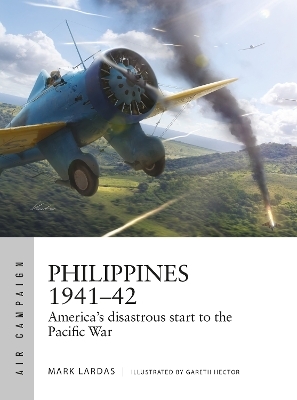
Philippines 1941–42
America's disastrous start to the Pacific War
Seiten
2026
Osprey Publishing (Verlag)
978-1-4728-7086-5 (ISBN)
Osprey Publishing (Verlag)
978-1-4728-7086-5 (ISBN)
- Noch nicht erschienen (ca. Juli 2026)
- Portofrei ab CHF 40
- Auch auf Rechnung
- Artikel merken
The weeks after Pearl Harbor saw Japan destroy the well-prepared US air forces in the Philippines. Fully illustrated, this studies the Pacific War’s little-known first major air campaign.
On December 7, 1941, the Japanese not only attacked Pearl Harbor,but also struck at US and allied bases throughout the Pacific, including the USA’s biggest overseas territory, the Philippines. However, that was an air battle the US was expecting. The USAAF had beefed up its assets in the Philippines, sending nearly a quarter of its available B-17s to the Far Eastern Air Force (FEAF).It could also call on the Philippine Army Air Corps (PAAC).
Aviation historian Mark Lardas explains how despite that, in a campaign that lasted barely a month, Japan’s air forces routed both the FEAF and the PAAC, gaining air superiority and permitting Imperial Army troops undisturbed access to the Philippine coast. Within a week Japan ruled the skies over Luzon. Two weeks later it had air superiority over all the Philippines. After a month, its control was so complete the Imperial Army felt confident to move its 5th Air Group back out of the Philippines. While desultory air combat would continue off and on for the next three months, the issue was decided by 5 January 1942.
Packed with original artwork, 3D diagrams, maps and photos, this is the history of how the first air campaign of the Pacific War turned into a humiliating defeat for the United States.
On December 7, 1941, the Japanese not only attacked Pearl Harbor,but also struck at US and allied bases throughout the Pacific, including the USA’s biggest overseas territory, the Philippines. However, that was an air battle the US was expecting. The USAAF had beefed up its assets in the Philippines, sending nearly a quarter of its available B-17s to the Far Eastern Air Force (FEAF).It could also call on the Philippine Army Air Corps (PAAC).
Aviation historian Mark Lardas explains how despite that, in a campaign that lasted barely a month, Japan’s air forces routed both the FEAF and the PAAC, gaining air superiority and permitting Imperial Army troops undisturbed access to the Philippine coast. Within a week Japan ruled the skies over Luzon. Two weeks later it had air superiority over all the Philippines. After a month, its control was so complete the Imperial Army felt confident to move its 5th Air Group back out of the Philippines. While desultory air combat would continue off and on for the next three months, the issue was decided by 5 January 1942.
Packed with original artwork, 3D diagrams, maps and photos, this is the history of how the first air campaign of the Pacific War turned into a humiliating defeat for the United States.
Mark Lardas has always been fascinated by things related to the sea and sky. From building models of ships and aircraft as a teen, he then studied Naval Architecture and Marine Engineering, but his interest in aviation led him to take a job on the then-new Space Shuttle program, where he worked for the next 30 years as a navigation engineer. He has written numerous books on military, naval or maritime history. Gareth Hector is an internationally renowned aviation artist who lives in Scotland.
(Subject to confirmation)
Introduction
Chronology
Attacker's Capabilities
Defender's Capabilities
Campaign Objectives
The Campaign
Aftermath and Analysis
Conclusion
Bibliography
Index
| Erscheint lt. Verlag | 30.7.2026 |
|---|---|
| Reihe/Serie | Air Campaign |
| Illustrationen | Gareth Hector |
| Zusatzinfo | Illustrated throughout with 65 photos and 16 pages of colour illustrations |
| Sprache | englisch |
| Maße | 184 x 248 mm |
| Themenwelt | Geschichte ► Allgemeine Geschichte ► 1918 bis 1945 |
| Geschichte ► Teilgebiete der Geschichte ► Militärgeschichte | |
| Sozialwissenschaften ► Politik / Verwaltung | |
| ISBN-10 | 1-4728-7086-7 / 1472870867 |
| ISBN-13 | 978-1-4728-7086-5 / 9781472870865 |
| Zustand | Neuware |
| Informationen gemäß Produktsicherheitsverordnung (GPSR) | |
| Haben Sie eine Frage zum Produkt? |
Mehr entdecken
aus dem Bereich

aus dem Bereich
Deutschland 1933 bis 1945
Buch | Hardcover (2025)
S. Fischer (Verlag)
CHF 47,60
ein Psychologe erlebt das Konzentrationslager
Buch | Hardcover (2024)
Kösel (Verlag)
CHF 30,80


