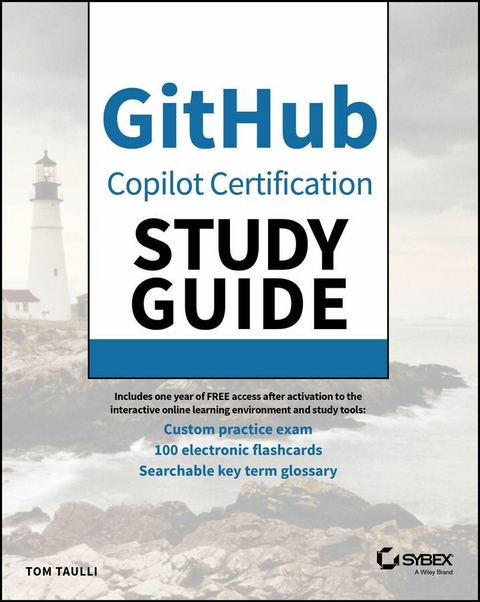
GitHub Copilot Certification Study Guide (eBook)
373 Seiten
Sybex (Verlag)
978-1-394-35000-1 (ISBN)

The fastest, most effective way to prepare for the GitHub Copilot certification exam and hone your skills with the popular AI-powered programming tool
In the GitHub Copilot Certification Study Guide, tech entrepreneur and Pluralsight trainer, Tom Taulli, delivers a concise and accurate walkthrough of the AI-powered programming tool. Perfect for everyone preparing to take the new GitHub Copilot Certification exam, as well as programmers who regularly use the tool in their day-to-day work, this Study Guide helps you optimize your software development workflows, understand the structure of the test, and learn the material covered by it.
This book explains every topic covered by the GitHub Copilot Certification exam, including:
- Responsible AI
- GitHub Copilot plans and features
- The inner workings of GitHub Copilot and how it handles data
- Prompt crafting and prompt engineering
- Developer use cases
- Testing workflows with GitHub Copilot
- Privacy fundamentals and context exclusions
From step-by-step tutorials of the GitHub Copilot installation process to proven exam-taking techniques from the experts at Sybex, the GitHub Copilot Certification Guide explores everything you need to understand to succeed on the test and improve your on-the-job coding performance. It offers:
- Job-ready strategies and techniques for avoiding common generative AI-enhanced programming pitfalls and making use of its many benefits
- Up-to-date descriptions of the most useful features and functions of GitHub Copilot, including Copilot Edits
- Complimentary access to a practice Assessment Test, a Practice Exam, 100 digital flashcards, and a glossary of key terms on the Sybex online learning environment
Generative AI tools, like GitHub Copilot, have transformed the software engineering and programming landscapes. If you're preparing for the certification exam, or you wish to expand your AI coding skillset, grab a copy of the GitHub Copilot Certification Study Guide today.
ABOUT THE AUTHOR
TOM TAULLI is an author, speaker, Pluralsight trainer, and startup advisor. He is the author of AI-Assisted Programming: Better Planning, Coding, Testing, and Deployment, as well as other AI-focused technology books.
The fastest, most effective way to prepare for the GitHub Copilot certification exam and hone your skills with the popular AI-powered programming tool In the GitHub Copilot Certification Study Guide, tech entrepreneur and Pluralsight trainer, Tom Taulli, delivers a concise and accurate walkthrough of the AI-powered programming tool. Perfect for everyone preparing to take the new GitHub Copilot Certification exam, as well as programmers who regularly use the tool in their day-to-day work, this Study Guide helps you optimize your software development workflows, understand the structure of the test, and learn the material covered by it. This book explains every topic covered by the GitHub Copilot Certification exam, including: Responsible AI GitHub Copilot plans and features The inner workings of GitHub Copilot and how it handles data Prompt crafting and prompt engineering Developer use cases Testing workflows with GitHub Copilot Privacy fundamentals and context exclusions From step-by-step tutorials of the GitHub Copilot installation process to proven exam-taking techniques from the experts at Sybex, the GitHub Copilot Certification Guide explores everything you need to understand to succeed on the test and improve your on-the-job coding performance. It offers: Job-ready strategies and techniques for avoiding common generative AI-enhanced programming pitfalls and making use of its many benefits Up-to-date descriptions of the most useful features and functions of GitHub Copilot, including Copilot Edits Complimentary access to a practice Assessment Test, a Practice Exam, 100 digital flashcards, and a glossary of key terms on the Sybex online learning environment Generative AI tools, like GitHub Copilot, have transformed the software engineering and programming landscapes. If you're preparing for the certification exam, or you wish to expand your AI coding skillset, grab a copy of the GitHub Copilot Certification Study Guide today.
Chapter 1
The Fundamentals of AI and Its Responsible Use
The GitHub Copilot exam objectives covered in this chapter include, but are not limited to, the following:
- Domain 1: Responsible AI
- Explain responsible usage of AI
- Describe the risks associated with using AI
- Explain the limitations of using generative AI tools (dept of the source data for the model, bias in the data, etc.)
- Explain the need to validate the output of AI tools
- Identify how to operate a responsible AI
- Identify the potential harms of generative AI (bias, secure code, fairness, privacy, transparency)
- Explain how to mitigate the occurrence of potential harms
- Explain ethical AI
- Explain responsible usage of AI
The goal of this chapter is to give you a broad overview of artificial intelligence (AI) and to set a solid foundation.
The first few sections of the book, though, are not covered on the exam. They include the principles of AI coding, the abstraction of programming languages, and the basics of AI. Yet these are important to cover since they make some of the exam-focused topics easier to understand.
The chapter also covers areas that are relevant to the exam, such as the risks of generative AI—including topics like hallucinations and bias—and responsible AI. It also looks at how AI coding systems can use different models.
Finally, the chapter covers a few other topics that are not on the exam but are still helpful in learning about some of the powerful features of GitHub Copilot, such as using different AI models. The chapter talks about how AI coding is reshaping traditional development and evaluates some of the alternatives to GitHub Copilot.
AI Coding and GitHub Copilot
AI coding is about using AI for writing, testing, and debugging code. It’s one of the most dynamic areas of technology, as it seems like every day there is a new innovation. It can be difficult to keep up with everything.
Regardless, AI coding is quickly becoming mainstream. Here’s what Hadi Partovi, CEO of Code.org, had to say about it1:
“At this point, software engineering without AI is a little bit like writing without a word processor.”
Or consider this tweet from Paul Graham, cofounder of Y Combinator2:
“I met a 19 year old yesterday who’d been using AI to write code since he was 16. It was not an advance to him. It was just how programming is done. He took it for granted that AI will eventually write most code.”
To get a sense of the pervasiveness of AI coding, look at Google. The company, which has about 60,000 developers, generates more than a quarter of its code using AI.3 This was according to a statement from CEO Sundar Pichai in late 2024.4 It seems like a good bet that this percentage will continue to grow.
One of the leading AI coding tools is GitHub Copilot, which was launched in June 2021.5 This came about 17 months before the introduction of ChatGPT. GitHub used a specialized AI model, called Codex, that was customized for coding tasks. The system was essentially a derivative of OpenAI’s GPT-3 model.
While this was an early generation of the model, GitHub Copilot was still quite powerful. Andrej Karpathy, founding member of OpenAI and entrepreneur, tweeted this about it6:
“Copilot has dramatically accelerated my coding; it’s hard to imagine going back to ‘manual coding.’ Still learning to use it but it already writes ~80 percent of my code, ~80 percent accuracy. I don’t even really code, I prompt and edit.”
Soon after, other AI-coding tools sprang up. Some were from startups like Cursor, others from mega-tech companies, such as Amazon and Google. But GitHub has remained the top player.
There are many reasons for this. The system is a first mover. GitHub also has a massive userbase, many talented developers, a strong AI team, and a willingness to focus on innovation.
All in all, learning GitHub Copilot is a smart decision, and getting the certification is a way to help you stand out.
Programming Languages and Abstraction
Abstraction is about simplifying complex systems, which is critical for software development. You do not want a project to get bogged down in unnecessary technical details. A developer should also not have to understand the inner workings of every component. As much as possible, a developer should be able to focus on higher-level concepts, which helps speed up development and improve quality. Abstraction also makes it easier to maintain and adapt codebases.
As should be no surprise, abstraction is a major driver for the evolution of programming languages. For example, the first ones were highly cryptic and prone to error. They used machine language, which consisted of long strings of binary digits or 0s and 1s.
But there would quickly emerge abstractions, such as assembly language. True, this was still complex. Then again, assembly language did use characters!
It would not be until the 1950s that we saw the emergence of high-level languages, which used human-readable syntax. Some examples included Fortran and COBOL. In fact, COBOL was written in a way that allowed nontechnical people to understand the workflows. This was important since this language was mostly about business applications that were often audited by accountants and business analysts.
After this, languages started to adopt more structured approaches. They involved using functions and subroutines. This would eventually be followed by object-oriented programming. With these approaches, software code became more modular and reusable.
However, the leveraging of AI for software development has represented perhaps the most transformative level of abstraction. You no longer write code. Instead, you write prompts—that is, natural language instructions. As Karpathy has tweeted7:
“The hottest new programming language is English.”
This is not to imply you do not have to understand software languages. You still do. The main reason is that AI coding systems sometimes generate code that has bugs.
You’ll also need to understand how to craft effective prompts—known as prompt engineering. They will allow you to get the most from an AI coding system.
The Basics of AI
Defining AI can be a challenge. It’s a complicated technology and is constantly undergoing change. The industry also has much hype and marketing exaggerations.
But a helpful way of understanding AI is to use a diagram, which you can see in Figure 1.1.
FIGURE 1.1 The different forms of AI.
Basically, AI is a general term that includes various types of technologies like machine learning (ML), deep learning (DL) and generative AI (GenAI). For the most part, they allow machines to engage in learning, reasoning, problem solving, and decision-making.
Machine Learning (ML)
Machine learning (ML) is one of the earliest approaches to AI. In 1959, IBM researcher Arthur Samuel published a paper that set forth the elements of this technology.8 The basic idea was that ML allows a computer to learn without being explicitly programmed. In the paper, Samuel noted:
“Programming computers to learn from experience should eventually eliminate the need for much of this detailed programming effort.”
To understand ML, let’s take an example of a spam filtering application. To create one, you need large amounts of data. This includes emails that are labeled either “spam” or “not spam.” You then train this model using an available ML algorithm, like linear regression, decision trees, or k-nearest neighbors. A popular one for spam detection is the Naive Bayes Classifier. This uses probability analysis to determine the likelihood of an email being spam.
Once the ML model is trained, it will be fed emails in a person’s email program. Any spam will then be sent to a separate folder.
But an effective ML model needs monitoring and updates. For example, Gmail will improve its models by using user feedback, such as when a person marks emails as spam or not.
This process is known as labeling data. When an ML model uses this approach, it is called supervised learning. This is usually for classification, which divides data into classes or categories. Besides spam filtering applications, other examples of this include image recognition and fraud detection.
But supervised learning is also used with regression. This where labeled data predicts numerical values, such as temperatures or home prices.
Besides supervised learning, there are two other ways ML can help a computer learn:
- Unsupervised learning: This uses unlabeled data. For this, an ML algorithm will find patterns in groups or clusters. A scenario for this is a product recommendation system. For example, if a customer buys a book about cooking, the system might predict that they are likely to buy kitchen gadgets or other cookbooks.
- Reinforcement learning: This trains a model based on rewards and punishments when there is interaction with an environment. An example is game playing. Reinforcement learning can improve performance by going through many moves and seeing which ones result in the highest scores.
Deep Learning...
| Erscheint lt. Verlag | 27.8.2025 |
|---|---|
| Reihe/Serie | Sybex Study Guide |
| Sprache | englisch |
| Themenwelt | Mathematik / Informatik ► Informatik |
| Sozialwissenschaften ► Pädagogik | |
| Schlagworte | github copilot certification exam • github copilot certification exam guide • github copilot certification practice exams • github copilot certification practice tests • Github copilot certification test • github copilot certification test guide • Microsoft |
| ISBN-10 | 1-394-35000-7 / 1394350007 |
| ISBN-13 | 978-1-394-35000-1 / 9781394350001 |
| Informationen gemäß Produktsicherheitsverordnung (GPSR) | |
| Haben Sie eine Frage zum Produkt? |
 EPUB (Adobe DRM)
Kopierschutz: Adobe-DRM
Adobe-DRM ist ein Kopierschutz, der das eBook vor Mißbrauch schützen soll. Dabei wird das eBook bereits beim Download auf Ihre persönliche Adobe-ID autorisiert. Lesen können Sie das eBook dann nur auf den Geräten, welche ebenfalls auf Ihre Adobe-ID registriert sind.
Details zum Adobe-DRM
Dateiformat: EPUB (Electronic Publication)
EPUB ist ein offener Standard für eBooks und eignet sich besonders zur Darstellung von Belletristik und Sachbüchern. Der Fließtext wird dynamisch an die Display- und Schriftgröße angepasst. Auch für mobile Lesegeräte ist EPUB daher gut geeignet.
Systemvoraussetzungen:
PC/Mac: Mit einem PC oder Mac können Sie dieses eBook lesen. Sie benötigen eine
eReader: Dieses eBook kann mit (fast) allen eBook-Readern gelesen werden. Mit dem amazon-Kindle ist es aber nicht kompatibel.
Smartphone/Tablet: Egal ob Apple oder Android, dieses eBook können Sie lesen. Sie benötigen eine
Geräteliste und zusätzliche Hinweise
Buying eBooks from abroad
For tax law reasons we can sell eBooks just within Germany and Switzerland. Regrettably we cannot fulfill eBook-orders from other countries.
aus dem Bereich