


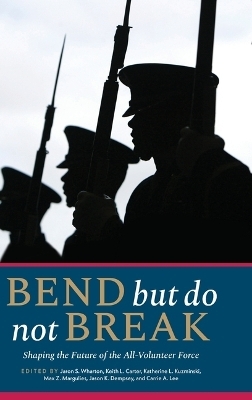
Bend But Do Not Break
Oxford University Press Inc (Verlag)
978-0-19-782111-4 (ISBN)
- Noch nicht erschienen (ca. April 2026)
- Versandkostenfrei
- Auch auf Rechnung
- Artikel merken
Jaron S. Wharton is an infantry officer who commanded a brigade in the US Army. He previously served on the National Security Council staff as a deputy executive secretary and later as the chief of staff to the deputy national security advisor for strategy. He is a former White House Fellow, research Fellow at West Point's Modern War Institute (MWI), and military Fellow at both the Center for a New American Security and the Center for Strategic and International Studies. Keith L. Carter is an Associate Professor in the United States Naval War College at the Naval Postgraduate School and a Senior non-resident Fellow at the Cornell Tech Policy Institute. He served for over twenty years in the Army, where he last served as an Assistant Professor and Director of the United States Military Academy's (USMA) Defense and Strategic Studies Program. Katherine L. Kuzminski is the Deputy Director of Studies and Director of the Military, Veterans, and Society Program at the Center for a New American Security (CNAS). Before CNAS, she was a political scientist at the RAND Corporation where she led research teams examining officer personnel management, reserve component transition issues, senior officer selection and development, military culture, and ground force capability development. Max Z. Margulies is an Associate Professor in the Department of Social Sciences and Chief Research Officer at the Modern War Institute at West Point. He is also a Security Fellow with the Truman National Security Project and a 2023 Non-Resident Fellow with the Institute for Global Affairs. From 2018 - 2020, he served as Executive Director of the Rupert H. Johnson Grand Strategy Program at West Point. Jason Dempsey is the Executive Director of the Center for Veteran Transition and Integration at Columbia University. He has written on Army efforts toward gender integration, the experiences of Hispanics in the military, and the failure of our counterinsurgency efforts in Afghanistan. He is the author of Our Army: Soldiers, Politics and Civil-Military Relations, a former White House Fellow, and an adjunct Senior Fellow at CNAS. He served for over twenty years as an infantry officer in the Army. Carrie A. Lee is an Associate Professor at the US Army War College, where she serves as the chair of the Department of National Security and Strategy and director of the Civil-Military Relations Center. She is a term member of the Council on Foreign Relations, contributing editor for War on the Rocks, and a fellow with the Center for a New American Security and the Truman National Security Project. She has previously held academic positions at the US Air War College, Notre Dame International Security Center, and the RAND Corporation.
Foreword: AVF Debates and the Historical Significance of the Moment
-Eliot A. Cohen
Introduction: An Inflection Point
-Jaron S. Wharton and Jason Dempsey
Chapter 1: The Civil-Military Gap and the Future of Recruiting and Mobilization
-Marybeth Ulrich
Chapter 2: Population Demographics and Recruiting Considerations from a Macro Perspective
-Dennis Laich
Chapter 3: Polarization, Politicization, and the Future of Democratic Civil-Military Relations
-Ronald R. Krebs and Robert Ralston
Chapter 4: Can Our Military Be Political Without Becoming Partisan?
-Bishop Garrison and Kori Schake
Chapter 5: Norm Deterioration in U.S. Civil-Military Relations
-Risa A. Brooks and Heidi A. Urben
Chapter 6: The Future of the "All-Volunteer Family"
-Miriam Krieger
Chapter 7: Money Matters: Modernizing the Military Compensation System
-Brandon J. Archuleta
Chapter 8: Displaced not Replaced: People, Technology, and the Future of the All-Volunteer Force
-Cole Livieratos
Chapter 9: Balancing Military Influence in National Security
-Todd Schmidt and Ambassador David Miller
Chapter 10: Diminishing Legislative Oversight: Congress and the AVF
-Danielle L. Lupton
Chapter 11: The Future Adventures of the All-Volunteer Force
-Keith L. Carter, Max Z. Margulies, and Isaiah Wilson III
Chapter 12: The Future of the Total Force: What Will It Mean to Be a Citizen-Soldier?
-Jessica D. Blankshain and Lindsay P. Cohn
Chapter 13 What Should We Owe Our Veterans?
-Michael Meese
Conclusion: Sustaining the All-Volunteer Force
-Carrie A. Lee
Afterword: Trust in the Military and the Legitimacy of the All-Volunteer Force
-Peter D. Feaver
Bibliography
Index
| Erscheint lt. Verlag | 16.4.2026 |
|---|---|
| Verlagsort | New York |
| Sprache | englisch |
| Maße | 156 x 235 mm |
| Themenwelt | Sozialwissenschaften ► Politik / Verwaltung ► Politische Systeme |
| Sozialwissenschaften ► Politik / Verwaltung ► Staat / Verwaltung | |
| Sozialwissenschaften ► Politik / Verwaltung ► Vergleichende Politikwissenschaften | |
| ISBN-10 | 0-19-782111-1 / 0197821111 |
| ISBN-13 | 978-0-19-782111-4 / 9780197821114 |
| Zustand | Neuware |
| Informationen gemäß Produktsicherheitsverordnung (GPSR) | |
| Haben Sie eine Frage zum Produkt? |
aus dem Bereich


