


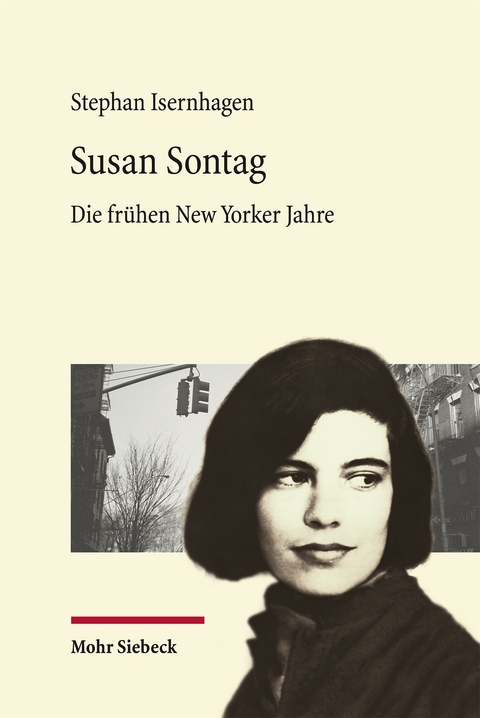
Susan Sontag
Die frühen New Yorker Jahre
2016
Mohr Siebeck (Hersteller)
978-3-16-154234-3 (ISBN)
Mohr Siebeck (Hersteller)
978-3-16-154234-3 (ISBN)
Die US-Amerikanerin Susan Sontag (1933-2004) gilt als streitbare Intellektuelle in der Tradition Zolas und Voltaires, die immer wieder in die Politik intervenierte. Doch wie wurde sie in den 1960er Jahren zur schillernden Figur des New Yorker Kulturbetriebs? Was trieb sie an und welche Kämpfe musste sie als alleinerziehende Frau, die Frauen liebte, austragen?
Susan Sontag was an icon who went on the intellectual warpath with Zolas and Voltaire, intervening time and again in politics. But how did Susan Lee Rosenblatt, as she was born in January 1933, come to be the colourful figure of New York's cultural scene that she was? As a woman who loved other women and had arrived virtually penniless with her son in late 1950s New York, how did she manage to establish herself in its largely heterosexual male-dominated literary scene of the 60s? Stephan Isernhagen locates Sontag in the cultural field of the east coast city and argues that the issues she was occupied with, the stances she adopted and the channels she directed her art criticism along had influenced New York's cultural scene long before her arrival. He works out the connection between Sontag's homosexual self-awareness, art criticism and how strongly her work as one of history's most important female intellectuals was influenced by the powers-of-society's repeated declaration of homosexual experience's inferiority.
Susan Sontag was an icon who went on the intellectual warpath with Zolas and Voltaire, intervening time and again in politics. But how did Susan Lee Rosenblatt, as she was born in January 1933, come to be the colourful figure of New York's cultural scene that she was? As a woman who loved other women and had arrived virtually penniless with her son in late 1950s New York, how did she manage to establish herself in its largely heterosexual male-dominated literary scene of the 60s? Stephan Isernhagen locates Sontag in the cultural field of the east coast city and argues that the issues she was occupied with, the stances she adopted and the channels she directed her art criticism along had influenced New York's cultural scene long before her arrival. He works out the connection between Sontag's homosexual self-awareness, art criticism and how strongly her work as one of history's most important female intellectuals was influenced by the powers-of-society's repeated declaration of homosexual experience's inferiority.
Geboren 1980; Studium der Allgemeinen Geschichte unter besonderer Berücksichtigung der Zeitgeschichte in Bielefeld, Paris, Baltimore und Durham, NC; 2013 Promotion an der Universität Bielefeld; arbeitet im Wissenschaftsmanagement.
| Erscheint lt. Verlag | 19.2.2016 |
|---|---|
| Verlagsort | Tübingen |
| Sprache | deutsch |
| Themenwelt | Geisteswissenschaften ► Geschichte ► Allgemeines / Lexika |
| Sozialwissenschaften ► Ethnologie | |
| Schlagworte | Neoavantgarde • Neue Sensibilität • New Yorker Intellektuelle • weibliche Intelektuelle |
| ISBN-10 | 3-16-154234-7 / 3161542347 |
| ISBN-13 | 978-3-16-154234-3 / 9783161542343 |
| Zustand | Neuware |
| Informationen gemäß Produktsicherheitsverordnung (GPSR) | |
| Haben Sie eine Frage zum Produkt? |


