


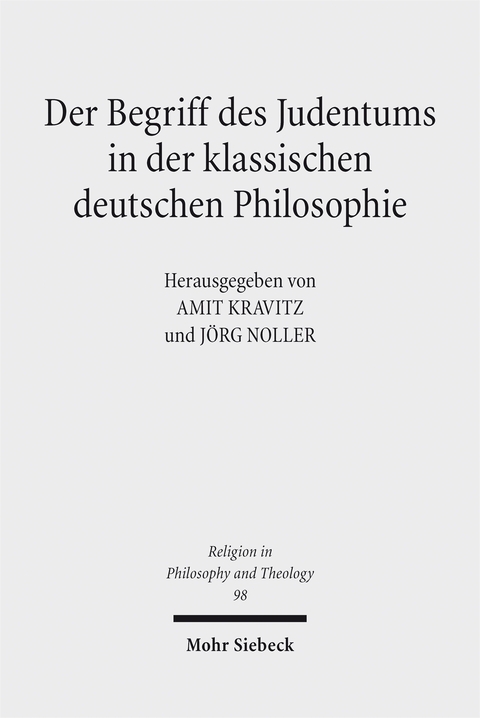
Der Begriff des Judentums in der klassischen deutschen Philosophie
2018
Mohr Siebeck (Hersteller)
978-3-16-155420-9 (ISBN)
Mohr Siebeck (Hersteller)
978-3-16-155420-9 (ISBN)
Der vorliegende Sammelband untersucht und problematisiert das Verhältnis der klassischen deutschen Philosophie zum Judentum. Behandelte Themen sind u.a. der Monotheismus, das Verhältnis von Judentum und Christentum, die Bedeutung der Offenbarung sowie die mystische Tradition der Kabbala.
Der vorliegende Sammelband setzt sich zum Ziel, das spezifisch Philosophische am Verhältnis der klassischen deutschen Philosophie zum Judentum herauszuarbeiten: Wie wird "das Judentum" im Ausgang von Kant in die philosophische Theoriebildung affirmativ, kritisch oder gar diffamierend einbezogen? Wie wird die eigene Philosophie in Abgrenzung vom Judentum konstituiert? Wie wird das Bild des Judentums philosophisch konstruiert, und wie wird es für die eigene philosophische Theorie instrumentalisiert, modifiziert und transformiert? Im Zentrum der Betrachtung stehen der Begriff des Monotheismus, die geschichtsphilosophische Bedeutung der Ägyptischen Gefangenschaft und des Exodus, das Verhältnis von Judentum und Christentum, aber auch die Bedeutung der Offenbarung, der Gesetze und Gebote sowie die mystische Tradition der Kabbala. The aim of this volume is to map out the specifically philosophical relationship between German Idealism and Judaism in the latter's reception and transformation. Going by Kant, is "Judaism" dealt with affirmatively, critically, or even in a defamatory way in the construction of philosophical theories? How is one's own philosophy created in distinction to Judaism? How is the image of Judaism composed philosophically, and how is it instrumentalized, modified and transformed for one's own philosophical theory? At the heart of the matter lies the concept of monotheism, the historical-philosophical significance of the Israelites' captivity in and exodus from Egypt, and the relationship between Judaism and Christianity, but also the meaning of revelation, the laws and commandments as well as the mythic tradition of the Kabbalah.
Der vorliegende Sammelband setzt sich zum Ziel, das spezifisch Philosophische am Verhältnis der klassischen deutschen Philosophie zum Judentum herauszuarbeiten: Wie wird "das Judentum" im Ausgang von Kant in die philosophische Theoriebildung affirmativ, kritisch oder gar diffamierend einbezogen? Wie wird die eigene Philosophie in Abgrenzung vom Judentum konstituiert? Wie wird das Bild des Judentums philosophisch konstruiert, und wie wird es für die eigene philosophische Theorie instrumentalisiert, modifiziert und transformiert? Im Zentrum der Betrachtung stehen der Begriff des Monotheismus, die geschichtsphilosophische Bedeutung der Ägyptischen Gefangenschaft und des Exodus, das Verhältnis von Judentum und Christentum, aber auch die Bedeutung der Offenbarung, der Gesetze und Gebote sowie die mystische Tradition der Kabbala. The aim of this volume is to map out the specifically philosophical relationship between German Idealism and Judaism in the latter's reception and transformation. Going by Kant, is "Judaism" dealt with affirmatively, critically, or even in a defamatory way in the construction of philosophical theories? How is one's own philosophy created in distinction to Judaism? How is the image of Judaism composed philosophically, and how is it instrumentalized, modified and transformed for one's own philosophical theory? At the heart of the matter lies the concept of monotheism, the historical-philosophical significance of the Israelites' captivity in and exodus from Egypt, and the relationship between Judaism and Christianity, but also the meaning of revelation, the laws and commandments as well as the mythic tradition of the Kabbalah.
Geboren 1978; Studium der Philosophie und Geschichte an der Hebräischen Universität Jerusalem; 2013 Promotion; derzeit forscht und lehrt er an der Ludwig-Maximilians-Universität München.
ist Privatdozent für Philosophie an der LMU München und vertritt den Lehrstuhl für Praktische Philosophie an der Universität Konstanz.
| Erscheint lt. Verlag | 31.8.2018 |
|---|---|
| Reihe/Serie | Religion in Philosophy and Theology |
| Verlagsort | Tübingen |
| Sprache | deutsch |
| Themenwelt | Geisteswissenschaften ► Religion / Theologie ► Christentum |
| Sozialwissenschaften ► Soziologie ► Spezielle Soziologien | |
| Schlagworte | Deutscher Idealismus • Kant • Religionsphilosophie |
| ISBN-10 | 3-16-155420-5 / 3161554205 |
| ISBN-13 | 978-3-16-155420-9 / 9783161554209 |
| Zustand | Neuware |
| Informationen gemäß Produktsicherheitsverordnung (GPSR) | |
| Haben Sie eine Frage zum Produkt? |
Mehr entdecken
aus dem Bereich


aus dem Bereich
Weltweites polyzentrisch-plurales Christentum als Bildungsreligion
Online Resource (2025)
Mohr Siebeck (Hersteller)
CHF 124,60
Grundfragen - Kontexte - Themenfelder
Online Resource (2023)
Mohr Siebeck (Hersteller)
CHF 75,60
Berliner Dogmatikvorlesung
Online Resource (2023)
Mohr Siebeck (Hersteller)
CHF 68,60


