


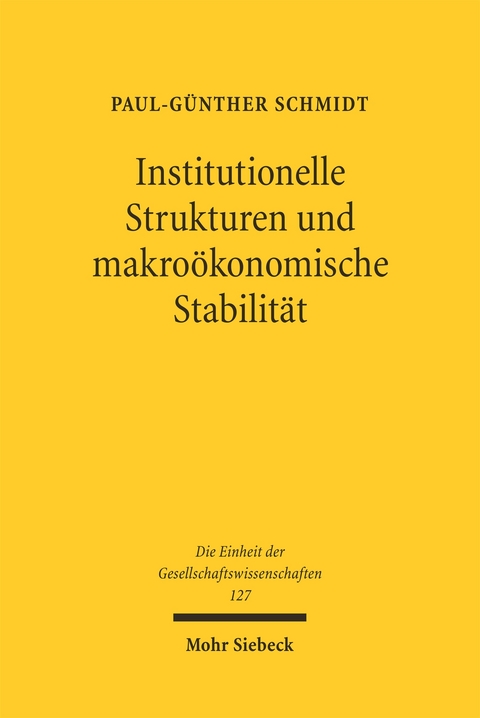
Institutionelle Strukturen und makroökonomische Stabilität
Eine international vergleichende Analyse
2024
Mohr Siebeck (Hersteller)
978-3-16-162854-2 (ISBN)
Mohr Siebeck (Hersteller)
978-3-16-162854-2 (ISBN)
Wie läßt sich angesichts hoher Inflation und Arbeitslosigkeit in vielen Ländern der Welt mehr Geldwertstabilität und Beschäftigung verwirklichen? Paul-Günther Schmidt legt in diesem Buch einen Erklärungsansatz vor, der die Bedeutung institutioneller Merkmale des Zentralbank-, Wechselkurs-, Banken-, Regierungs- und Arbeitsmarktsystems für die gesamtwirtschaftliche Stabilität eines Landes aufzeigt.
In view of chronic inflation and mass unemployment in many countries around the world, this book addresses the question of how and under which circumstances a higher degree of economic stability could be achieved. Paul-Günther Schmidt presents a "post-monetarist" theory drawing special attention to a variety of institutional factors that condition the macroeconomic performance of a market economy in the long run. In a cross-national empirical analysis of central banks, exchange rate regimes, banking sectors, political systems and labor market relations in 47 democracies during the last quarter of the twentieth century, the author delivers strong empirical support for the basic message of his book: in the long run the degree of macroeconomic stability is conditioned by the institutional architecture of the national economic and political system.
In view of chronic inflation and mass unemployment in many countries around the world, this book addresses the question of how and under which circumstances a higher degree of economic stability could be achieved. Paul-Günther Schmidt presents a "post-monetarist" theory drawing special attention to a variety of institutional factors that condition the macroeconomic performance of a market economy in the long run. In a cross-national empirical analysis of central banks, exchange rate regimes, banking sectors, political systems and labor market relations in 47 democracies during the last quarter of the twentieth century, the author delivers strong empirical support for the basic message of his book: in the long run the degree of macroeconomic stability is conditioned by the institutional architecture of the national economic and political system.
Geboren 1954; Studium der Wirtschafts- und Sozialwissenschaften, der Statistik und der Politischen Wissenschaft in Dortmund und Mainz; 1984 Promotion und 2001 Habilitation in Mainz, seit 2004 Professor für Volkswirtschaftslehre und Leiter des Centre for Financial Economics an der Wissenschaftlichen Hochschule der Bankakademie in Frankfurt am Main.
| Erscheint lt. Verlag | 8.7.2024 |
|---|---|
| Reihe/Serie | Die Einheit der Gesellschaftswissenschaften |
| Zusatzinfo | + 1 CD |
| Verlagsort | Tübingen |
| Sprache | deutsch |
| Themenwelt | Sozialwissenschaften ► Soziologie |
| Wirtschaft ► Volkswirtschaftslehre ► Makroökonomie | |
| Schlagworte | Institutionen • Ländervergleich • Makroökonomie |
| ISBN-10 | 3-16-162854-3 / 3161628543 |
| ISBN-13 | 978-3-16-162854-2 / 9783161628542 |
| Zustand | Neuware |
| Informationen gemäß Produktsicherheitsverordnung (GPSR) | |
| Haben Sie eine Frage zum Produkt? |
Mehr entdecken
aus dem Bereich


aus dem Bereich
Online Resource (2024)
Pearson Education Limited (Hersteller)
CHF 84,50
Online Resource (2024)
Pearson Education Limited (Hersteller)
CHF 45,90
Online Resource (2025)
Pearson Education Limited (Hersteller)
CHF 84,50


