


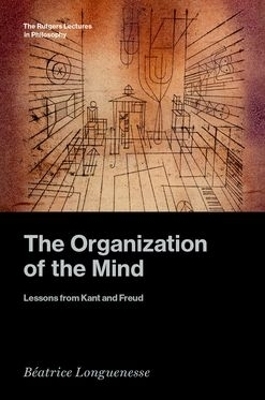
The Organization of the Mind
Lessons from Kant and Freud
Seiten
2026
Oxford University Press Inc (Verlag)
978-0-19-778126-5 (ISBN)
Oxford University Press Inc (Verlag)
978-0-19-778126-5 (ISBN)
- Lieferbar (Termin unbekannt)
- Portofrei ab CHF 40
- Auch auf Rechnung
- Artikel merken
As a prominent figure of the 18th century Enlightenment, Kant advocated faith in reason and in the possibility of human progress through the development of human beings' rational capacities. In contrast, as the founder of 20th century psychoanalysis, Freud revealed that rationality itself is rooted in the non-rational soil of mental life. For Freud, rational thinking is pervaded with irrational motivations for thinking and acting. For Kant, the capacity to affirm and endorse on rational grounds one's beliefs and actions is the highest capacity in human beings, one that raises them above all other living beings.
Those contrasts between the two thinkers have led to countless philosophical manifestos pitting Freud and Kant against each other. Some accuse Kant of having played a central role in the promotion of the hubris of modern rationality, which resulted in the domination and destruction of nature. Others accuse Freud of being a prime culprit in the attacks against reason, progress and the very possibility of a better future for humanity.
In The Organization of the Mind, Béatrice Longuenesse paints a more nuanced picture. She arguesthat Kant's analysis of our mental capacities reveals deep-seated and irresolvable conflicts within the mind--an insight that brings him closer to Freud than is often recognized. At the same time, Freud's concept of “the unconscious” is as original and revolutionary as Freud claimed. Freud developed that concept in connection to aspects of the mind that earlier philosophers had touched upon but never fully explored: the organization of memory traces and the way they are shaped by emotions and affects. The dynamic interplay of memory, emotion, and affect significantly influences rational thinking itself. Freud's articulation of these connections gives his theory of the unconscious its distinctive power. The Organization of the Mind, based on the author's Rutgers Lectures in Philosophy and the Isaiah Berlin Lectures she gave a year later at Oxford University, creates space for a dialogue between Kant's and Freud's first-personperspectives onthe mind, on the one hand;and, on the other, the third-person approaches of affective and cognitive neuroscience, particularly in the study of memory. These convergences offer fresh directions for contemporary philosophy of mind and psychology.
Those contrasts between the two thinkers have led to countless philosophical manifestos pitting Freud and Kant against each other. Some accuse Kant of having played a central role in the promotion of the hubris of modern rationality, which resulted in the domination and destruction of nature. Others accuse Freud of being a prime culprit in the attacks against reason, progress and the very possibility of a better future for humanity.
In The Organization of the Mind, Béatrice Longuenesse paints a more nuanced picture. She arguesthat Kant's analysis of our mental capacities reveals deep-seated and irresolvable conflicts within the mind--an insight that brings him closer to Freud than is often recognized. At the same time, Freud's concept of “the unconscious” is as original and revolutionary as Freud claimed. Freud developed that concept in connection to aspects of the mind that earlier philosophers had touched upon but never fully explored: the organization of memory traces and the way they are shaped by emotions and affects. The dynamic interplay of memory, emotion, and affect significantly influences rational thinking itself. Freud's articulation of these connections gives his theory of the unconscious its distinctive power. The Organization of the Mind, based on the author's Rutgers Lectures in Philosophy and the Isaiah Berlin Lectures she gave a year later at Oxford University, creates space for a dialogue between Kant's and Freud's first-personperspectives onthe mind, on the one hand;and, on the other, the third-person approaches of affective and cognitive neuroscience, particularly in the study of memory. These convergences offer fresh directions for contemporary philosophy of mind and psychology.
Béatrice Longuenesse is Silver Professor of Philosophy Emerita at New York University. She is the author of Kant and the Capacity to Judge, Kant on the Human Standpoint, Hegel's Critique of Metaphysics, The First Person in Cognition and Morality, and I, Me, Mine: Back to Kant, and Back Again.
Lecture 1: Conflicting Logics of the Mind
Lecture 2: Kant on Consciousness and Its Limits
Lecture 3: Consciousness, Memory, and Freud's Concept of the Unconscious
Lecture 4: Kant and Freud on Morality
| Erscheinungsdatum | 20.12.2025 |
|---|---|
| Reihe/Serie | The Rutgers Lectures in Philosophy |
| Verlagsort | New York |
| Sprache | englisch |
| Maße | 149 x 213 mm |
| Gewicht | 313 g |
| Themenwelt | Geisteswissenschaften ► Philosophie ► Ethik |
| Geisteswissenschaften ► Philosophie ► Geschichte der Philosophie | |
| Geisteswissenschaften ► Philosophie ► Philosophie der Neuzeit | |
| Sozialwissenschaften | |
| ISBN-10 | 0-19-778126-8 / 0197781268 |
| ISBN-13 | 978-0-19-778126-5 / 9780197781265 |
| Zustand | Neuware |
| Informationen gemäß Produktsicherheitsverordnung (GPSR) | |
| Haben Sie eine Frage zum Produkt? |
Mehr entdecken
aus dem Bereich


aus dem Bereich
Buch | Hardcover (2025)
Suhrkamp (Verlag)
CHF 32,15
ein Versuch über Kardinaltugenden und Laster
Buch | Hardcover (2025)
De Gruyter (Verlag)
CHF 55,90


