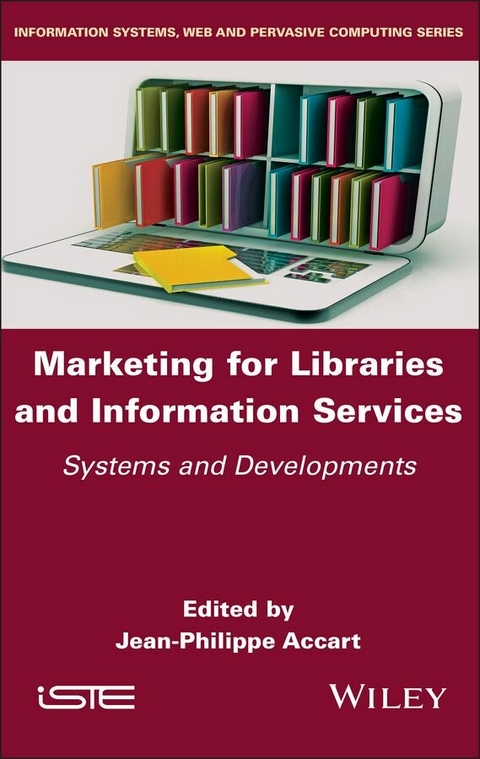
Marketing for Libraries and Information Services (eBook)
237 Seiten
Wiley-Iste (Verlag)
978-1-394-40156-7 (ISBN)
This book explores how marketing strategies - used in businesses and organizations - can be applied to promote libraries by placing users at the heart of every decision. It positions the library within a rich and diverse cultural ecosystem that includes bookstores, publishers, professional associations, magazines, and museums. In today's landscape, the user experience (UX), once exclusive to retail and digital industries, is now a shared priority across these sectors, and a key component of modern library marketing.
From audience research and satisfaction surveys to loyalty-building strategies, cutting-edge digital tools, and the rise of AI-driven practices, the book examines the evolving face of library marketing. Drawing on insights from experts across Europe (notably the Netherlands) and the French-speaking world (Canada, France, Belgium and Switzerland), it offers a comprehensive and forward-thinking look at the new challenges and opportunities shaping the profession today.
Jean-Philippe Accart is a consultant and trainer at JP ACCART Formation Conseil. He has worked in the field of information sciences in France and Switzerland for several decades, with the aim of creating and developing innovative services and sharing his vision for the future of libraries.
This book explores how marketing strategies used in businesses and organizations can be applied to promote libraries by placing users at the heart of every decision. It positions the library within a rich and diverse cultural ecosystem that includes bookstores, publishers, professional associations, magazines, and museums. In today s landscape, the user experience (UX), once exclusive to retail and digital industries, is now a shared priority across these sectors, and a key component of modern library marketing. From audience research and satisfaction surveys to loyalty-building strategies, cutting-edge digital tools, and the rise of AI-driven practices, the book examines the evolving face of library marketing. Drawing on insights from experts across Europe (notably the Netherlands) and the French-speaking world (Canada, France, Belgium and Switzerland), it offers a comprehensive and forward-thinking look at the new challenges and opportunities shaping the profession today.
Introduction
Marketing and the Book Trades
What is the use and specificity of marketing as applied to the book trades (publishing, bookstores, libraries, upstream creation and downstream literary events), and more generally, to other cultural areas (museums, archives, heritage, visual arts, live performance, cinema, etc.)?
For a long time, marketing for publishers, booksellers and a fortiori librarians, who are not “companies”, and far less, cultural “industries”, has been reduced to communication. Over 40 years after its acclimatization in this sector, not only is its acceptance much broader, it is also shared by all book professionals. Still, marketing’s role and positioning remain ambivalent and controversial because the fundamental questions characterizing this managerial approach (who are my customers? Who are my competitors?) do not immediately seem appropriate or relevant for certain fields of activity.
I.1. Marketing and the cultural trades
It is important for culture professionals to immediately assess the challenges and effectiveness of a marketing approach applied to their trades. Like other cultural fields, books are not exempt from the rules of the market, imposed through the combined effect of the concentration of production structures, the evolution of marketing and/or mediation networks, and the profound change in public practices, as well as the ambiguity of the characteristics specific to “cultural goods and activities”1. Notwithstanding the fact that they are both works of the mind and commodities, expressions of thought and consumer products, as a result of dematerialization, they have merely become “contents” or services2, in parallel or as replacements.
We propose defining marketing as the organization, in the most satisfactory way possible, of the meeting between (original, new, unheard of) supply and (existing or latent) demand. Now in concrete terms, what do we observe in the book and cultural market in general? First, there is a supply plethora, saturated with identical me-too3 characteristics and similar contents.
This growing competition – or even “cannibalization” – spares no cultural sector since it also affects the field of creation of books, which are a priori singular and non-substitutable. Not only do they compete with each other in “large cultural supermarkets” and even more so across online sales sites and platforms, but also in media reviews, Internet users’ opinions, social networks and, above all, in the time devoted to cultural practices, in the budget allocated to the purchase of these “goods and activities”, and more globally, in the “investment” dedicated to other forms of knowledge, entertainment, information or leisure.
On the demand side, we see that even though they have new methods for observing and analyzing the market, professionals in the book and culture sector still have little knowledge about the audience’s practices and expectations. As preferences become increasingly diverse and atomized, publishing houses, for example, continue to market books in a homogeneous way, despite their being destined for different clienteles. All studies point to increasingly segmented readerships and heterogeneous motivations, particularly concerning new uses related to digital technology and audiobooks. Over time, a survey conducted by the French Ministry of Culture and Communication (“Pratiques culturelles des Français”) has become the main tool for monitoring the cultural behavior of the French people by placing culture in the broader framework of spare time uses. In this respect, while the book market is holding up better than the music and video markets, the main trends identified as early as the 1970s, and therefore well before the Internet’s arrival, are confirmed: in 2018, despite progress in education, 38% of French people declared not having read any books in the previous 12 months, indicating the continued decline of “medium” readers (over nine books per year) as well as of “frequent” readers (20 and over). Other observations included readership aging and the feminization – from pre-adolescence onwards – of all book-related activities, not only of reading (especially fiction) but also book purchases or library visits. These demand characteristics were also identified in studies by the Centre national du livre (CNL, French National Book Center)4: 89% of French people declared themselves as readers in 2023 (only 80% among 15–24 year olds), the main reasons for not reading being lack of time (78%), competition with other leisure activities (74%) and alternative reading (press, networks, etc.). In parallel, the annual SNE-SOFIA-SGDL barometers on the use of digital books revealed that although new modes of consumption (on tablets and smartphones rather than on e-readers) did in fact rejuvenate the overall market, they did not expand it, as it was mainly the “frequent readers” of paper books who had diversified their access practices to written media.
Whether public or private, regardless of its size and even its specialty, every cultural structure has an interest in better understanding an increasingly unstable environment, in analyzing a fiercely competitive market and in getting to know its audiences in greater depth, as these are becoming rarer5.
Let us emphasize that the main role of marketing within an organization, no matter what “form” it takes, always places the addressee (end reader, customer, user, visitor, or even spectator) and the other participants in the process (for the publisher, for example: broadcaster, distributor, bookseller, librarian, journalist, etc.) at the heart of the strategy, then of the activity, constantly promoting mediation between cultural supply and demand.
I.2. The three stages of the marketing approach applied to books
While marketing is above all a “state of mind” to be shared with other actors in the publishing house, bookstore or library and a certain way of asking the “right questions”, it also implies the rigorous and adapted use of tools and techniques to better address them. It also assumes proceeding following a certain order, which guarantees consistency and a priori the effectiveness of the entire approach applied to the field of books.
The first marketing stage is collection and analysis of external and internal information6, which enables ulterior strategic and operational choices, prepared “with full knowledge of the facts”. This sometimes straining stage – collecting and exploiting more or less available, more or less costly data, if only in terms of the time spent finding and interpreting it – is nonetheless crucial. The quality of the whole process that follows depends on the richness and variety of the information collected and the rigor with which it is processed. We call this first stage “marketing intelligence studies”, a stage that encourages us to listen to our own environment and market, to better appraise them and intervene appropriately.
The next phase, called “strategic marketing”7, involves making three fundamental decisions, which can generate engagement for several years (and often longer) with regard to partners, possible guardianship and, of course, audiences. This requires clarifying quantitative goals (e.g. increasing a publisher’s market share, expanding a bookseller’s trading area, increasing a library’s reputation) and qualitative goals (e.g. rejuvenating an image), targets (subsets of the global demand to be targeted as a priority) and positioning (the way in which the publishing house, bookstore, or library wish to “stand out” and be perceived in relation to the existing competing offer, either for “products” or services).
Then comes the third and final stage, “operational marketing”, which involves concrete action and “merchandising”, in other words, all the precise and concrete choices concerning the books’ characteristics as well as the places, their organization, their arrangement, and the fixing of the price or tariff; the distribution across different modes of access to the supply; and finally, the selection of the means and of communication messages. It is during this phase that each book (and cultural) trade diversifies the most through its specific components, most of which are nonetheless transposable (see Table I.1).
Figure I.1. The three stages of the marketing approach
(Source: Françoise Geoffroy-Bernard)
- Marketing intelligence studies – know and analyze:
- monitoring (including the macro-environment);
- market studies (analysis of competitive demand and supply);
- SWOT diagnosis (opportunities/threats – strengths/weaknesses).
- Strategic marketing – recommend and decide:
- quantitative and qualitative goals;
- priority target(s);
- distinctive positioning.
- Operational marketing8 – act and control:
- global supply: products and services (Product);
- price/rate (Price);
- marketing/access methods (Place);
- communication (Promotion).
I.3. Marketing intelligence studies: libraries and publishing houses
If we observe marketing...
| Erscheint lt. Verlag | 19.8.2025 |
|---|---|
| Reihe/Serie | ISTE Invoiced |
| Sprache | englisch |
| Themenwelt | Sozialwissenschaften ► Kommunikation / Medien ► Buchhandel / Bibliothekswesen |
| Sozialwissenschaften ► Pädagogik | |
| Sozialwissenschaften ► Politik / Verwaltung | |
| Schlagworte | Information Sciences • Information Services • libraries • library sciences • Marketing strategies |
| ISBN-10 | 1-394-40156-6 / 1394401566 |
| ISBN-13 | 978-1-394-40156-7 / 9781394401567 |
| Informationen gemäß Produktsicherheitsverordnung (GPSR) | |
| Haben Sie eine Frage zum Produkt? |
 EPUB (Adobe DRM)
Kopierschutz: Adobe-DRM
Adobe-DRM ist ein Kopierschutz, der das eBook vor Mißbrauch schützen soll. Dabei wird das eBook bereits beim Download auf Ihre persönliche Adobe-ID autorisiert. Lesen können Sie das eBook dann nur auf den Geräten, welche ebenfalls auf Ihre Adobe-ID registriert sind.
Details zum Adobe-DRM
Dateiformat: EPUB (Electronic Publication)
EPUB ist ein offener Standard für eBooks und eignet sich besonders zur Darstellung von Belletristik und Sachbüchern. Der Fließtext wird dynamisch an die Display- und Schriftgröße angepasst. Auch für mobile Lesegeräte ist EPUB daher gut geeignet.
Systemvoraussetzungen:
PC/Mac: Mit einem PC oder Mac können Sie dieses eBook lesen. Sie benötigen eine
eReader: Dieses eBook kann mit (fast) allen eBook-Readern gelesen werden. Mit dem amazon-Kindle ist es aber nicht kompatibel.
Smartphone/Tablet: Egal ob Apple oder Android, dieses eBook können Sie lesen. Sie benötigen eine
Geräteliste und zusätzliche Hinweise
Buying eBooks from abroad
For tax law reasons we can sell eBooks just within Germany and Switzerland. Regrettably we cannot fulfill eBook-orders from other countries.
aus dem Bereich