


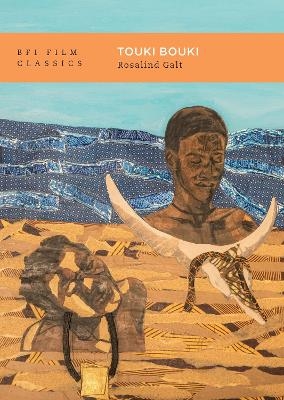
Touki Bouki
Seiten
2026
BFI Publishing (Verlag)
978-1-83902-900-4 (ISBN)
BFI Publishing (Verlag)
978-1-83902-900-4 (ISBN)
- Noch nicht erschienen (ca. April 2026)
- Portofrei ab CHF 40
- Auch auf Rechnung
- Artikel merken
A study of Djibril Diop Mambéty’s 1973 film Touki Bouki (The Journey of the Hyena) in the BFI Film Classics series.
Djibril Diop Mambéty’s exuberant, inventive and urgent film Touki Bouki (The Journey of the Hyena) (1973) follows a young couple, Mory (Magaye Niang) and Anta (Mareme Niang), who dream of leaving their home in Dakar, Senegal for an imagined better life in Paris.
Rosalind Galt’s insightful study analyses Touki Bouki’s cinematic worlds, from its narrative of postcolonial migration to its influence by international film style, both nonetheless grounded in African visual cultures and critical perspectives. Touki Bouki explores the intertwined histories of the postcolonial and the transnational, showing how the aesthetic and political ideas found in the experimentation of cinematic modernisms and New Waves are as African as they are European.
Galt’s study interweaves a conceptual framework of world cinema studies and anti/decolonial theory with close analysis of Touki Bouki’s innovative audiovisual forms and its representations of desire and identity in postcolonial Senegal. Providing a detailed reading of the film’s themes and cinematic style, she argues for its classic status and for its long-lasting influence on world cinema.
Djibril Diop Mambéty’s exuberant, inventive and urgent film Touki Bouki (The Journey of the Hyena) (1973) follows a young couple, Mory (Magaye Niang) and Anta (Mareme Niang), who dream of leaving their home in Dakar, Senegal for an imagined better life in Paris.
Rosalind Galt’s insightful study analyses Touki Bouki’s cinematic worlds, from its narrative of postcolonial migration to its influence by international film style, both nonetheless grounded in African visual cultures and critical perspectives. Touki Bouki explores the intertwined histories of the postcolonial and the transnational, showing how the aesthetic and political ideas found in the experimentation of cinematic modernisms and New Waves are as African as they are European.
Galt’s study interweaves a conceptual framework of world cinema studies and anti/decolonial theory with close analysis of Touki Bouki’s innovative audiovisual forms and its representations of desire and identity in postcolonial Senegal. Providing a detailed reading of the film’s themes and cinematic style, she argues for its classic status and for its long-lasting influence on world cinema.
Rosalind Galt is Professor of Film Studies at King's College London, UK. She is the author of Alluring Monsters: the Pontianak and Cinemas of Decolonization (2021), Pretty: Film and the Decorative Image (2011) and The New European Cinema: Redrawing the Map (2006); the co-author with Karl Schoonover of Queer Cinema in the World and the co-editor with Karl Schoonover of Global Art Cinema: New Theories and Histories (2010).
Acknowledgments
1. Introduction
2. Africa and Europe
3. Liberated aesthetics: “an African film language”
4. Embodiment
5. Afterlives
Notes
Credits
| Erscheint lt. Verlag | 2.4.2026 |
|---|---|
| Reihe/Serie | BFI Film Classics |
| Zusatzinfo | 60 colour illus |
| Sprache | englisch |
| Maße | 135 x 190 mm |
| Themenwelt | Kunst / Musik / Theater ► Film / TV |
| Sozialwissenschaften ► Kommunikation / Medien ► Medienwissenschaft | |
| ISBN-10 | 1-83902-900-5 / 1839029005 |
| ISBN-13 | 978-1-83902-900-4 / 9781839029004 |
| Zustand | Neuware |
| Informationen gemäß Produktsicherheitsverordnung (GPSR) | |
| Haben Sie eine Frage zum Produkt? |
Mehr entdecken
aus dem Bereich



aus dem Bereich


