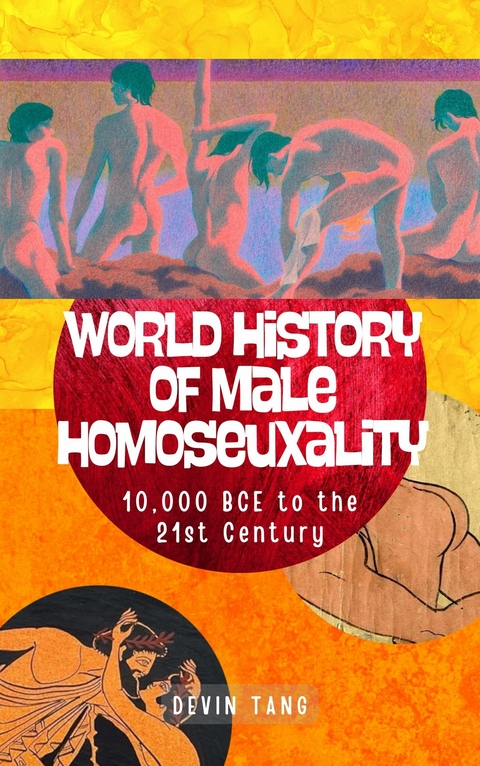
World History of Male Homosexuality (eBook)
350 Seiten
YiKai Books (Verlag)
978-0-00-101793-1 (ISBN)
What if the story of humanity was also the story of male love, desire, and brotherhood-articulated through every era, culture, and continent?
'World History of Male Homosexuality: 10,000 BCE to the 21st Century' invites readers on a sweeping journey across time, exploring how men have loved, bonded, and desired each other throughout the ages. From prehistoric double burials and spiritual rituals to the clandestine societies of Victorian England and the global Pride movements of today, this book uncovers the hidden and celebrated facets of male-male relationships in every corner of the world.
Frank descriptions of intimate moments are woven alongside cultural analysis, showing both the everyday realities and extraordinary stories- such as the legendary devotion of Gilgamesh and Enkidu, the erotic poetry of Persian courts, the sexual practices in Roman baths, and the displaced camaraderie of soldiers during the two world wars-this book shines a light on both the joy and peril of male-male intimacy. With vivid case studies, each chapter uncovers how desire, affection, and sexuality shaped societies, challenged norms, and left a legacy still felt today.
Ready to discover a hidden history of men who loved men? Buy your copy today and see the world through a new lens.
Prehistoric Societies (10,000 BCE – 3000 BCE) — Origins and Earliest Expressions
Archaeological Evidence of Male-Male Bonds
The earliest traces of human experience—etched into the earth long before written records—invite speculation and careful interpretation. In the vast span between 10,000 BCE and 3000 BCE, amid the slow transition from Paleolithic hunter-gatherers to settled agrarian communities, the world’s first societies left behind a patchwork of burial sites, figurines, and cave art. These remnants, silent witnesses to vanished lives, bear subtle hints of the bonds and intimacies that may have existed between men.
Archaeological evidence from prehistoric Eurasia, particularly the Upper Paleolithic and Neolithic periods, provides tantalizing glimpses into social relationships. At the site of Sungir (c. 32,000–28,000 BCE), in what is now Russia, double and triple burials have raised questions about the nature of companionship and the meaning attributed to close male associations. While definitive proof of sexual relationships lies beyond the reach of the spade, the positioning of bodies—sometimes with arms linked, faces together, or accompanied by shared grave goods—suggests that bonds between men could be honored and memorialized.
Similar mysteries emerge from the late Neolithic period (c. 4000–3000 BCE) in Central Europe. At the burial ground of Talheim, Germany, a mass grave dating from around 5000 BCE includes pairs of adult males interred side by side. The arrangement has sparked debate among scholars: were these men kin, comrades-in-arms, or partners? Though certainty proves elusive, the deliberate pairing and the care taken in burial practices hint at affiliations that may have extended beyond blood ties.
Beyond the graves, prehistoric art offers further clues. The painted caves of Lascaux (c. 17,000 BCE) and Chauvet (c. 30,000 BCE) in France, while dominated by animal imagery, also contain enigmatic human figures. Some researchers have highlighted scenes depicting groups of men engaged in ritual activity or close embrace. Elsewhere, in the rock art of the Tassili n’Ajjer plateau (c. 6000–4000 BCE) in the central Sahara, male figures are shown in pairs, sometimes in intimate postures. Though modern interpretations must tread carefully—mindful of the chasm between ancient intent and present-day categories—such images invite reflection on the spectrum of male-male relationships that may have coexisted with spiritual and communal life.
The material record is not limited to Europe or Africa. In ancient Anatolia, figurines dating from Çatalhöyük (c. 7500–5700 BCE) feature paired male forms, their gestures ambiguous but evoking a sense of connection. Whether these objects served as talismans, offerings, or symbols of a social role, they reinforce the impression that relationships between men were woven into the fabric of society, at times commemorated in durable form.
The challenge for historians lies in resisting the temptation to impose modern categories upon these ancient traces. The language of identity—homoerotic, homosexual, companionate—belongs to a much later age. Yet, taken together, the archaeological record points to the enduring presence of meaningful bonds between men, bonds strong enough to be recorded in the rituals of death and the art of daily life. In the cold earth, in ochre and bone, lie the faint signatures of affection, alliance, and perhaps desire, inscribed long before the first chronicles of kings and cities.
Spirituality, Ritual, and the Body
Long before the invention of writing, prehistoric societies (10,000 BCE – 3000 BCE) wove their beliefs, fears, and aspirations into the fabric of daily life through ritual and myth. In this early world, the boundaries between the sacred and the bodily were porous, and the human form became a vessel for spiritual expression. For men, especially, the intertwining of ritual and corporeality created spaces in which intimacy, affection, and even eroticism could be sanctified.
Archaeological discoveries across Eurasia and Africa reveal that ritual activity was often communal, performed in caves, groves, or around hearths. It is within these liminal spaces—the shadowed interiors of Lascaux (c. 17,000 BCE) and the sun-baked rocks of Tassili n’Ajjer (c. 6000–4000 BCE)—that the earliest depictions of the human body emerge. Male figures, sometimes adorned with elaborate headdresses or painted in vivid ochre, appear in postures suggesting dance, embrace, and collective ecstasy. These scenes, interpreted by scholars as shamanic or initiatory rites, reveal a world in which the male body itself was a site of transformation and power.
In many hunter-gatherer societies of the Mesolithic and Neolithic eras, the passage from youth to adulthood was marked by ritual, often orchestrated exclusively by men. Archaeological finds from sites such as Lepenski Vir (c. 7000–5500 BCE) on the Danube and Göbekli Tepe (c. 9600–8200 BCE) in Anatolia suggest that male initiation ceremonies were elaborate affairs. Sculptures and reliefs from these places sometimes depict male pairs or groups, their gestures ambiguous but imbued with a sense of shared purpose. Ethnographic analogies, drawn from later societies, hint that these rituals could involve bodily contact—wrestling, dancing, or mutual adornment—believed to confer sacred energy or social cohesion.
The spiritual dimension of male-male intimacy is further suggested by the presence of “twin” or “paired” burials in sacred precincts. At Dolní Věstonice (c. 26,000 BCE) in Moravia, a grave containing two young men, laid side by side and dusted with red ochre, speaks to the sanctity afforded to certain relationships. Whether these unions were based on kinship, companionship, or ritual partnership remains unknown, yet the care bestowed on their burial bespeaks a reverence for the bond between them.
Shamanic traditions, prevalent in many prehistoric societies, often positioned certain men as spiritual intermediaries—figures who, by virtue of ecstatic trance or ritual performance, bridged the worlds of the living and the divine. Cave art and figurines sometimes depict these shamans in the company of other men, their bodies intertwined or merged, as if suggesting a fusion of souls in the pursuit of supernatural power. While modern categories such as “homosexuality” impose anachronistic boundaries, these ancient images evoke a recognition of bodily intimacy as a route to transcendence.
Through the interplay of ritual, spirituality, and the male body, prehistoric peoples crafted a world where bonds between men could be publicly enacted and ritually consecrated. The echoes of their ceremonies linger in ochre dust, weathered stone, and the enduring mystery of human desire, inviting each new generation to ponder the depths of connection beneath the surface of ancient rites.
Sexual Practices in Hunter-Gatherer and Early Agrarian Societies
The deep past of human sexuality, stretching from the waning millennia of the Paleolithic into the dawn of agrarian civilization (10,000 BCE – 3000 BCE), is a landscape shaped by conjecture, fragmentary evidence, and the mute eloquence of bone and artifact. Within this shadowed terrain, the sexual practices of men with men must be reconstructed with care, drawing on both the archaeological record and ethnographic parallels from later societies.
In the era of hunter-gatherers—a world defined by mobility, kinship bands, and the relentless pursuit of sustenance—sexuality was embedded in the rhythms of life rather than confined to rigid categories. Social scientists, examining the customs of 20th-century forager societies as analogues, have noted that sexual intimacy between men could emerge in settings of companionship, ritual, and play. While the term “homosexuality” itself belongs to a much later historical moment, prehistoric practices often allowed for same-sex encounters as a natural extension of male camaraderie and bonding. Within the intimacy of shared sleeping quarters or the isolation of hunting expeditions, men might have found opportunities for mutual caressing, genital stimulation, or playful contests that blurred the boundary between sport and eroticism. Such acts, far from being hidden or stigmatized, could be accepted as part of the natural order—expressions of friendship, pleasure, or the reaffirmation of group ties.
Evidence, though indirect, can be traced in the patterns of habitation and communal living. Cave sites such as those at Gough’s Cave (c. 12,000 BCE) in Somerset, England, and Franchthi Cave (c. 20,000–3000 BCE) in Greece, yield clues to intimate human arrangements. The close quarters of seasonal shelters, coupled with the absence of strict taboos found in later, more stratified societies, likely fostered a fluidity of sexual expression among men. In these settings, acts of tenderness, eroticism, and mutual pleasure were woven into the fabric of daily existence, often escaping the binary distinctions imposed by later epochs. The warmth of a shared fire, the comfort of physical closeness on cold nights, and the communal nature of bathing or grooming could all provide the context for moments of sexual experimentation or sustained erotic bonds.
As the Neolithic Revolution (beginning c. 10,000 BCE) swept across the Fertile Crescent and beyond, the rise of agriculture and settled villages transformed not only economies but also patterns of intimacy....
| Erscheint lt. Verlag | 9.8.2025 |
|---|---|
| Sprache | englisch |
| Themenwelt | Sozialwissenschaften ► Politik / Verwaltung |
| ISBN-10 | 0-00-101793-4 / 0001017934 |
| ISBN-13 | 978-0-00-101793-1 / 9780001017931 |
| Informationen gemäß Produktsicherheitsverordnung (GPSR) | |
| Haben Sie eine Frage zum Produkt? |
 EPUB (Adobe DRM)
Größe: 5,5 MB
Kopierschutz: Adobe-DRM
Adobe-DRM ist ein Kopierschutz, der das eBook vor Mißbrauch schützen soll. Dabei wird das eBook bereits beim Download auf Ihre persönliche Adobe-ID autorisiert. Lesen können Sie das eBook dann nur auf den Geräten, welche ebenfalls auf Ihre Adobe-ID registriert sind.
Details zum Adobe-DRM
Dateiformat: EPUB (Electronic Publication)
EPUB ist ein offener Standard für eBooks und eignet sich besonders zur Darstellung von Belletristik und Sachbüchern. Der Fließtext wird dynamisch an die Display- und Schriftgröße angepasst. Auch für mobile Lesegeräte ist EPUB daher gut geeignet.
Systemvoraussetzungen:
PC/Mac: Mit einem PC oder Mac können Sie dieses eBook lesen. Sie benötigen eine
eReader: Dieses eBook kann mit (fast) allen eBook-Readern gelesen werden. Mit dem amazon-Kindle ist es aber nicht kompatibel.
Smartphone/Tablet: Egal ob Apple oder Android, dieses eBook können Sie lesen. Sie benötigen eine
Geräteliste und zusätzliche Hinweise
Buying eBooks from abroad
For tax law reasons we can sell eBooks just within Germany and Switzerland. Regrettably we cannot fulfill eBook-orders from other countries.
aus dem Bereich