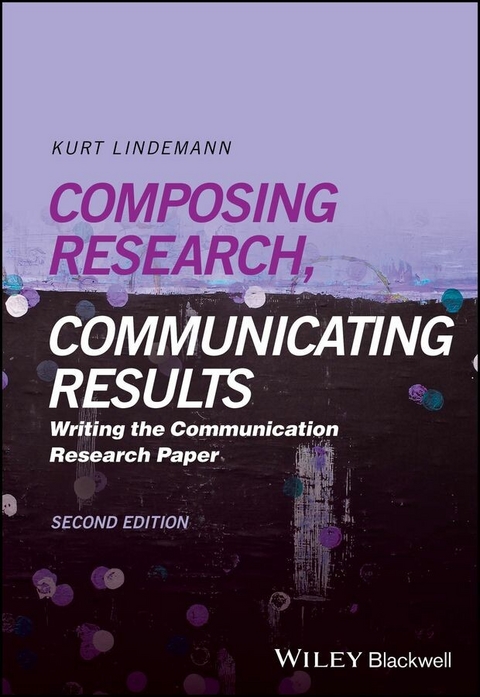
Composing Research, Communicating Results (eBook)
368 Seiten
Wiley-Blackwell (Verlag)
978-1-394-24478-2 (ISBN)
Offers practical guidance on writing communication research papers in an evolving academic landscape
Writing remains central to student assessment and professional development, yet many students enter communication classes without the skills needed to craft effective, scholarly work. Composing Research, Communicating Results: Writing the Communication Research Paper is a comprehensive, practice-based guide to academic writing in communication and related social sciences. Walking students through every stage of the writing process-from brainstorming and outlining to constructing sentences and presenting their final papers-Kurt Lindemann demystifies writing through clear explanations, practical exercises, and real student examples.
With the rapid emergence of AI writing tools, students need more than tips-they need ethical frameworks and critical strategies for integrating these technologies into their work. This edition addresses these needs head-on, providing real-world advice on maintaining academic integrity when using AI in the writing process. Expanded content also includes a new chapter on incorporating feedback into revisions, and enhanced discussions on inclusive language, citation practices, and diversity in source selection.
Applying writing principles specifically to communication-focused assignments such as literature reviews and application papers, Composing Research, Communicating Results:
- Offers the most comprehensive treatment available of sentence and paragraph construction in communication writing
- Equips students to present and submit papers to academic and professional outlets, including conferences and podcasts
- Introduces the TESLA Method for effective paragraph development and writing flow
- Highlights common grammar issues with accessible, relatable explanations
- Features pedagogical tools such as 'Write Away' exercises, 'Building Blocks' assignments, 'Engaging Ethics' tips, and 'Student Spotlight' examples
Composing Research, Communicating Results: Writing the Communication Research Paper, Second Edition, is perfect for upper-division undergraduate and graduate-level courses in Communication, including methods, media, interpersonal, intercultural, and organizational communication. It fits within Communication and related social science degree programs as a writing companion text or course supplement.
KURT LINDEMANN is a Professor of Communication and Associate Dean at San Diego State University. With over three decades of teaching experience, he has designed and led courses in public speaking, writing, performance studies, and research methods. His scholarly and creative work has appeared in both academic journals and public media, and he is a frequent presenter at national and international conferences.
Offers practical guidance on writing communication research papers in an evolving academic landscape Writing remains central to student assessment and professional development, yet many students enter communication classes without the skills needed to craft effective, scholarly work. Composing Research, Communicating Results: Writing the Communication Research Paper is a comprehensive, practice-based guide to academic writing in communication and related social sciences. Walking students through every stage of the writing process from brainstorming and outlining to constructing sentences and presenting their final papers Kurt Lindemann demystifies writing through clear explanations, practical exercises, and real student examples. With the rapid emergence of AI writing tools, students need more than tips they need ethical frameworks and critical strategies for integrating these technologies into their work. This edition addresses these needs head-on, providing real-world advice on maintaining academic integrity when using AI in the writing process. Expanded content also includes a new chapter on incorporating feedback into revisions, and enhanced discussions on inclusive language, citation practices, and diversity in source selection. Applying writing principles specifically to communication-focused assignments such as literature reviews and application papers, Composing Research, Communicating Results: Offers the most comprehensive treatment available of sentence and paragraph construction in communication writing Equips students to present and submit papers to academic and professional outlets, including conferences and podcasts Introduces the TESLA Method for effective paragraph development and writing flow Highlights common grammar issues with accessible, relatable explanations Features pedagogical tools such as Write Away exercises, Building Blocks assignments, Engaging Ethics tips, and Student Spotlight examples Composing Research, Communicating Results: Writing the Communication Research Paper, Second Edition, is perfect for upper-division undergraduate and graduate-level courses in Communication, including methods, media, interpersonal, intercultural, and organizational communication. It fits within Communication and related social science degree programs as a writing companion text or course supplement.
1
So You Have to Write a Research Paper …
CHAPTER CONTENTS
- Chapter Learning Outcomes
- Chapter Features
- What This Book Is Not …
- What This Book Is …
- Features of This Book
- The Purpose of This Chapter
- Writing Papers: Chore Or Challenge?
- Procrastinating? It’s All in Your Mind
- Challenge: How Do I Find Research On My Topic?
- Debunking Myths About Research Papers
- The “Tao” of Writing
- Types of Papers
- Thinking Beyond the Paper – Writing for a Professional Career
- Chapter Summary
- References
- Further Reading
Chapter Learning Outcomes
- Identify Myths About Writing Research Papers
- Distinguish Types of Papers Commonly Written
- Identify the Purposes of Different Research Papers
- Apply Writing Skills to “Real‐World” Texts
Chapter Features
- “Write Away”
- Building Blocks
You are sitting in a cramped chair facing the front of the classroom. You look around the classroom and listen to the low chatter of students awaiting the start of class. Some faces and voices are familiar, while others are not. You look forward to making new friends, talking to people with different experiences and ideas, and maybe learning something. You hope to get a good grade, too, of course. You check your phone for the time. Class is about to start. The teacher enters the room with a pleasant demeanor, conversational tone, and is funny. This might just be a fun class, you think. Then the teacher begins to explain the assignments for the upcoming term. The major one is the assignment upon which most of your grade rests: a research paper. Why? You think. Why a research paper? You re‐evaluate the class and the teacher. Suddenly, all the positive things you initially thought about the class seem, well …, not so positive.
The above scenario is likely a common one in many students’ experiences. The course research paper, sometimes called a “term paper,” is an object of much derision, disdain, and dread among students. And, certainly, writing a research paper is difficult. Writing a good research paper is even more difficult. I’m not writing this book to convince you otherwise. I do, however, think that, with some knowledge and skills, almost anyone can succeed in writing a good research paper. Some people think that good writers are born not made, that some people – genetically blessed or with gifts granted by a divine being – somehow just get writing. I don’t believe this. Sure, some folks have an easier time writing papers; I’m not denying that. But I think good writers can be made; otherwise, I wouldn’t be writing this book. And you probably don’t think “good writers are born, not made”; otherwise, you wouldn’t be reading this book. Of course, it’s entirely possible you’re reading this because your teacher required you to read it. If this is the case, then at least your teacher probably thinks the same as I do.
What This Book Is Not …
Here’s what this book is not. While we will explore some common grammar mistakes, this is not a text on proper grammar and sentence diagramming. While we will talk about integrating scholarly and popular literature into a research paper, this is not a how‐to on research, nor is it a summary of relevant communication and social science research. While I will provide some easy‐to‐remember steps to complete commonly assigned papers, this is not a fill‐in‐the‐blank template for outlines and papers.
What This Book Is …
I admit that I had selfish reasons for writing this book. I am a professor of communication at a university. I teach research methods, performance studies, organizational communication, and a few other courses. I regularly assign research papers to my undergraduate and graduate students. While I have a PhD in communication, I also have a graduate degree in English language and literature, which required me to teach English composition classes and work in the department’s writing tutoring center. As a result, much to my current students’ dismay, I found myself frequently commenting on sentence structure, topic sentence usage, grammar mistakes, and other writing issues. I found myself writing the same comments time and again. I began to think, “It would be great if there were a book that collected all these comments and explained them for students.” Shortly after thinking about this, I began writing this book.
That said, this book isn’t meant to replace the instruction from your own teacher. It is meant to help guide you through a sometimes daunting and intimidating process. This book is not meant to convince you to like writing papers. If you don’t already, chances are a textbook isn’t going to change your mind. What this book is intended to do is to make the writing process easier and to help ensure the entire writing process results in successful outcomes: well‐written arguments and analysis and … oh, yeah, possibly a good grade!
Features of This Book
As you read this book, you’ll find several features that will be helpful in understanding the concepts and practices covered in each chapter. The first one is “Write Away” boxes that offer writing exercises that you can immediately put into practice to improve your writing. “Building Blocks” are meant to be short “mini assignments” which, once completed, you can integrate into your larger writing assignment. Research papers are fraught with ethical challenges, from plagiarizing to improperly citing sources. For this reason, the “Engaging Ethics” feature provides some things to consider to better avoid the ethical pitfalls that may arise in the course of your research and writing. We’ll be addressing the use of artificial intelligence (AI) throughout the book in a legitimate way to help brainstorm and generate ideas, as there are many ethical issues involved in the use of AI. As such, some of the “Engaging Ethics” sections will focus heavily on AI in the writing process. Finally, since we often learn best from our peers, the Student Spotlight sections provide actual examples of student writing that illustrate the concepts and assignments covered in this book. Each feature should not only help you better understand the concepts we cover in this book, but they should also help you write better.
The Purpose of This Chapter
So, we “begin at the beginning,” as the King instructs the White Rabbit in Alice’s Adventures in Wonderland (Carroll, 1920, p. 182). This chapter is a beginning: the first step, the first brick in a sidewalk path, the first word in a sentence, and the first page of a book. No better place to start. This is true for writing papers as well.
This chapter will first try to debunk some myths about writing. Mental blocks are the most difficult obstacles to writing well; you can always learn proper sentence structure and new words, but it’s much harder to unlearn solidified beliefs. As such, we’ll address some of these commonly held beliefs or myths. Then we’ll review some of the major types of papers commonly assigned, which I’ll also cover in detail in subsequent chapters. Finally, we’ll discuss how the skills you gain from these assignments can transfer to other types of writing you might do in the “real world.”
We’ll start with some commonly held beliefs or myths about writing papers for class. I’ll reframe as challenges what we might normally think of as chores. After that, we’ll move on to myths specific to composing research papers, ones that I’ve heard students (and some professors!) say over and over again.
Writing Papers: Chore Or Challenge?
In this section, we’ll discuss challenges to writing well, writing efficiently, and just plain writing. This last part is important because simply writing – writing anything – is sometimes the best way to start. The questions that begin each of the following sections are common ones asked by all types of writers, from students to professionals. While I attempt to respond to each question, I don’t always provide answers. Instead, I try to offer different ways to think about each question, framing them...
| Erscheint lt. Verlag | 14.8.2025 |
|---|---|
| Sprache | englisch |
| Themenwelt | Sozialwissenschaften ► Kommunikation / Medien |
| Sozialwissenschaften ► Politik / Verwaltung | |
| Sozialwissenschaften ► Soziologie | |
| Schlagworte | Academic Writing • AI academic writing • communication research paper guide • Communication writing • communication writing skills • Scholarly Writing • social science research paper guide • social sciences writing • student writing guide • TESLA method |
| ISBN-10 | 1-394-24478-9 / 1394244789 |
| ISBN-13 | 978-1-394-24478-2 / 9781394244782 |
| Informationen gemäß Produktsicherheitsverordnung (GPSR) | |
| Haben Sie eine Frage zum Produkt? |
 EPUB (Adobe DRM)
Kopierschutz: Adobe-DRM
Adobe-DRM ist ein Kopierschutz, der das eBook vor Mißbrauch schützen soll. Dabei wird das eBook bereits beim Download auf Ihre persönliche Adobe-ID autorisiert. Lesen können Sie das eBook dann nur auf den Geräten, welche ebenfalls auf Ihre Adobe-ID registriert sind.
Details zum Adobe-DRM
Dateiformat: EPUB (Electronic Publication)
EPUB ist ein offener Standard für eBooks und eignet sich besonders zur Darstellung von Belletristik und Sachbüchern. Der Fließtext wird dynamisch an die Display- und Schriftgröße angepasst. Auch für mobile Lesegeräte ist EPUB daher gut geeignet.
Systemvoraussetzungen:
PC/Mac: Mit einem PC oder Mac können Sie dieses eBook lesen. Sie benötigen eine
eReader: Dieses eBook kann mit (fast) allen eBook-Readern gelesen werden. Mit dem amazon-Kindle ist es aber nicht kompatibel.
Smartphone/Tablet: Egal ob Apple oder Android, dieses eBook können Sie lesen. Sie benötigen eine
Geräteliste und zusätzliche Hinweise
Buying eBooks from abroad
For tax law reasons we can sell eBooks just within Germany and Switzerland. Regrettably we cannot fulfill eBook-orders from other countries.
aus dem Bereich