


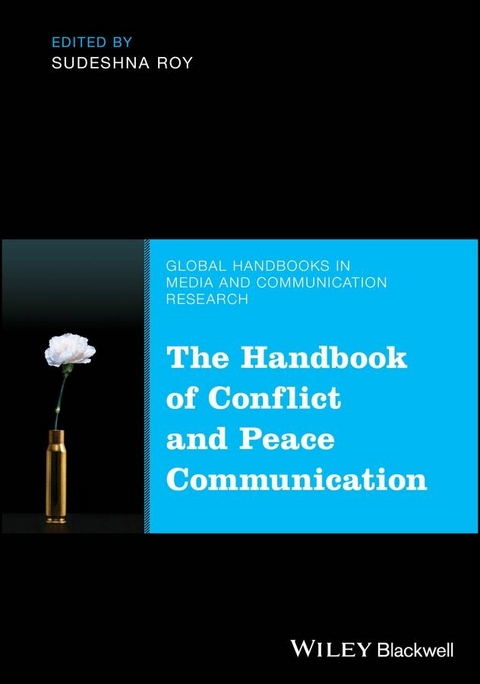
The Handbook of Conflict and Peace Communication (eBook)
850 Seiten
Wiley-Blackwell (Verlag)
978-1-119-24643-5 (ISBN)
An incisive collection of essays highlighting conflict and peace issues in the Global South, with coverage of theory, method, mediated, case-oriented, and innovative approaches
In Handbook of Conflict and Peace Communication, renowned communication and media scholar Dr. Sudeshna Roy delivers an authoritative exploration of a variety of critical conflicts in the world and a spectrum of approaches to peace communication. This book offers an in-depth view of how intricate and intractable conflicts can be and how the communicative aspects of conflict are equally challenging. The author reviews and guides readers through classic and contemporary analysis in the field, providing a truly interdisciplinary work.
Handbook of Conflict and Peace Communication is divided into five navigable sections-Theory Development, Method Development, Traditional/Digital Media and Peace and Conflict, Case Studies, and Innovative Approaches - that help illuminate workable and innovative peace communication strategies relevant to today's conflicts.
Readers will also find:
- Informative contributions from a collection of outstanding scholars, practitioners, and activists
- Comprehensive explorations of past conflict communication theory in the context of contemporary theory
- Practical tools to navigate complex local and global conflicts
- In-depth examinations of strategies of peace communication from the margins that acknowledge and elevate solutions for and from the most vulnerable
Perfect for undergraduate and graduate students, scholars, and practitioners of peace and conflict studies, media studies, intercultural communication, human rights, and social justice, Handbook of Conflict and Peace Communication will also earn a place in the libraries of interdisciplinary studies involving philosophy, anthropology, political science, history, geography, economics, psychology, and others.
An incisive collection of essays highlighting conflict and peace issues in the Global South, with coverage of theory, method, mediated, case-oriented, and innovative approaches In Handbook of Conflict and Peace Communication, renowned communication and media scholar Dr. Sudeshna Roy delivers an authoritative exploration of a variety of critical conflicts in the world and a spectrum of approaches to peace communication. This book offers an in-depth view of how intricate and intractable conflicts can be and how the communicative aspects of conflict are equally challenging. The author reviews and guides readers through classic and contemporary analysis in the field, providing a truly interdisciplinary work. Handbook of Conflict and Peace Communication is divided into five navigable sections Theory Development, Method Development, Traditional/Digital Media and Peace and Conflict, Case Studies, and Innovative Approaches that help illuminate workable and innovative peace communication strategies relevant to today s conflicts. Readers will also find: Informative contributions from a collection of outstanding scholars, practitioners, and activists Comprehensive explorations of past conflict communication theory in the context of contemporary theory Practical tools to navigate complex local and global conflicts In-depth examinations of strategies of peace communication from the margins that acknowledge and elevate solutions for and from the most vulnerablePerfect for undergraduate and graduate students, scholars, and practitioners of peace and conflict studies, media studies, intercultural communication, human rights, and social justice, Handbook of Conflict and Peace Communication will also earn a place in the libraries of interdisciplinary studies involving philosophy, anthropology, political science, history, geography, economics, psychology, and others.
Notes on Contributors
Nizar Ahmad is Lecturer in Sociology in the Department of Sociology, Political Science and Education at Bacha Khan University, Charsadda, Pakistan. His research interest includes peace and conflict resolution, terrorism, youth and peace, community peacebuilding and Pakhtun culture and peacebuilding. His recent article is on Understanding Pakhtun Hujran (a socio‐cultural institute) and its relevance to peacebuilding in Pakistan Journal of Criminology.
Syed Ali Hussain studies social influence, persuasion, and behavior change communication. Before joining ASU, Dr. Hussain completed his Master's in Health & Risk Communication (2013), and PhD in Journalism (2018) from Michigan State University.
Natasha Azarian‐Ceccato is an Adjunct Professor at EDHEC Business School, Nice, France. She is an experienced higher education professional with a demonstrated history of working in intercultural communications and management. She earned her Doctor of Philosophy (PhD) focused in Education, Language Literacy, Society & Culture from University of California, Berkeley.
Ian M. Borton is a Professor at the Department of Communication in Aquinas College. His research interests are in communication ethics, peace and conflict studies, conflict, and restorative justice. He loves teaching about Art, Shakespeare, and the Black Death.
Mary Bresnahan (PhD, 1985, University of Michigan) is a Beal Professor in the Department of Communication at Michigan State University. Bresnahan has authored over 100 peer‐reviewed journal publications. She conducts research on stigma and intergroup communication. She also studies breastfeeding attitudes and smoking prevention and cessation.
Julia Chaitin is Senior Lecturer in the School of Social Work at Ben Gurion University of the Negev, Eilat campus, Israel. She is a social psychologist with an expertise in peace building, especially in the Israeli–Palestinian context. Her qualitative/narrative research focuses on the long‐term social–psychological aspects of massive social trauma (the Holocaust, wars, genocide, refugees). Chaitin especially looks at issues of collective identity, dialogue between “enemies,” memory, intergenerational transmission of trauma. Her academic and grassroots work aims to draw attention to obstacles to peace and peaceful paths.
Dhiman Chattopadhyay (PhD Bowling Green State University) is Assistant Professor in the Department of Communication/Journalism at Shippensburg University. A former journalist, he spent two decades as a reporter and managing editor/editor in some of India’s best‐known news organizations. His current research focuses on social media’s effects on journalism practice and media management challenges. His work has appeared in peer‐reviewed journals such as JMCQ¸ Journal of Graphic Novels & Comics, Asian Communication Research, and Global Media & Communication.
Stephen Croucher is a Professor of Communication at Clemson University, South Carolina, and is the former Head of the School of Communication, Journalism, and Marketing at Massey University, New Zealand. He completed his PhD in 2003 from the University of Oklahoma. His research focuses on intercultural communication, immigrant integration, organizational communication, and research methods. He has served as the editor of the Journal of Intercultural Communication Research and is currently the President of the World Communication Association.
Tamara Dejanovic‐Vukasovich is an independent scholar focusing on discourses of conflict and identity in the Balkans, propaganda, and diasporic identity. Her most recent work is published in the journal Global Media and Communication, where she explores the nexus of identity, war, and discourse in global contexts.
Lisen Dellenborg is the Head of The Life Context and Health Promotion, Senior Lecturer, Institute of Health and Care Sciences PhD in Social Anthropology, at Sahlgrenska Academy at University of Gothenburg.
Nathalie Desrayaud, PhD, is an assistant professor in the Department of Communication at Florida International University in Miami. She earned her PhD in Organizational Communication from Purdue University. Desrayaud researches perceptions and interpretations of conflict, especially in organizational contexts, both face‐to‐face and online. Her work also centers on women’s experiences and perspectives.
Mohan J. Dutta is the Dean's Chair Professor of Communication at Massey University. He is the Director of the Center for Culture‐Centered Approach to Research and Evaluation (CARE), developing culturally centered, community‐based projects of social change, advocacy, and activism that articulate health as a human right. Mohan Dutta's research examines the role of advocacy and activism in challenging marginalizing structures, the relationship between poverty and health, political economy of global health policies, the mobilization of cultural tropes for the justification of neo‐colonial health development projects, and the ways in which participatory culture‐centered processes and strategies of radical democracy serve as axes of global social change.
Donald Ellis is a Professor Emeritus of Communication at the University of Hartford School of Communication, with a joint appointment in Rhetoric, Language, and Culture. In 2022, he published a theory paper that continues his work in communication and ethnopolitical conflict. The paper is titled Building a Theory of Communication and Ethnopolitical Conflict and was published in the journal, Communication Monographs. He is an active member of the National Communication Association, International Communication Association, Association for Israel studies, APA Peace and Conflict Group, and International Association for Conflict Management. He has served in many roles as program planner, paper reader, division president.
Hala Guta (PhD Mass Communication, Ohio University) is Assistant Professor in the Department of Mass Communication at Qatar University. Her research interests include international communication, gendered communication, communication for social change; and the intersection of communication, culture, and identity. Her publications and conference presentations include papers on the role of culture in communication, communication role in peace building in societies emerging from conflict, and the role media and other cultural institutions play in social change and the construction of identity.
Kelsea Jackson is an Assistant Lecturer in the School of Communication, Journalism, and Marketing at Massey University, New Zealand. She is currently completing her PhD (ABD), which focuses on the perceptions of intercultural empathy, peace, and the “other” within the Palestinian Israeli conflict. Kelsea received her BA (2015) in Speech Communication with a minor in Peace and Justice Studies from Utah Valley University, and she received her MA (2017) in Intercultural Communication from the University of Jyväskylä, Finland.
Immaculate Kelighai (MA, ASMAC, University of Yaoundé II SOA) is a PhD Candidate, Global Studies (Peace and Security in Africa), IPSS ‐ Addis Ababa University, Ethiopia.
Timothy A. Lavis is a Reader Services Associate Head at Binghamton University where he has also completed his doctoral dissertation titled Language after L=A=N=G=U=A=G=E. He has taught poetics, writing, and related topics at Binghamton University, Hartwick College, and St. Bonaventure University, emphasizing ideological dimensions of rhetoric, the power of civil discourse, and the affective potential of student writing. His critical and creative work can be found in Interdisciplinary Literary Studies, American Chordata, and elsewhere.
Marta N. Lukacovic is Associate Professor in the Department of Communication and Mass Media at Angelo State University. Her recent research concentrates on online user‐generated content intersecting with the matters of security and political violence. She is a vice‐president of Communication Association of Eurasian Researchers, which connects global communication scholars with colleagues from post‐Soviet and Eastern European countries.
Jake Lynch is Associate Professor at University of Sydney. In 2020, he was on secondment as a Leverhulme Visiting Professor at the Centre for Trust, Peace and Social Relations at Coventry University, UK. He was formerly Director of the Center for Peace and Conflict Studies at Sydney University, and later Chair of the Department of Peace and Conflict Studies at the university. Dr. Lynch’s scholarly publications include several books and many book chapters and refereed articles on peace and Peace Journalism. Jake has served as Guest Editor of themed special issues of scholarly journals: Global Change, Peace and Security (2008); Ethical Space: The International Journal of Communication Ethics (2013) and Media, War and Conflict (2014). Dr. Lynch’s teaching interests range broadly over topics in Peace and Conflict Studies and cognate disciplines.
Maria F. Malmström is currently a Visiting Research Fellow at the Aga Khan University’s Institute for the Study of Muslim Civilizations in London working on a research project begun in 2018 which focuses on Making and Unmaking Masculinities and Religious Identities through the Politics of the Ear...
| Erscheint lt. Verlag | 12.8.2025 |
|---|---|
| Reihe/Serie | Global Handbooks in Media and Communication Research |
| Sprache | englisch |
| Themenwelt | Sozialwissenschaften ► Kommunikation / Medien |
| Sozialwissenschaften ► Politik / Verwaltung | |
| Sozialwissenschaften ► Soziologie | |
| Schlagworte | conflict communication • conflict communication case studies • conflict communication methods • conflict communication theory • peace communication approaches • peace communication case studies • peace communication methods • peace communication theory |
| ISBN-10 | 1-119-24643-1 / 1119246431 |
| ISBN-13 | 978-1-119-24643-5 / 9781119246435 |
| Informationen gemäß Produktsicherheitsverordnung (GPSR) | |
| Haben Sie eine Frage zum Produkt? |
 EPUB (Adobe DRM)
Kopierschutz: Adobe-DRM
Adobe-DRM ist ein Kopierschutz, der das eBook vor Mißbrauch schützen soll. Dabei wird das eBook bereits beim Download auf Ihre persönliche Adobe-ID autorisiert. Lesen können Sie das eBook dann nur auf den Geräten, welche ebenfalls auf Ihre Adobe-ID registriert sind.
Details zum Adobe-DRM
Dateiformat: EPUB (Electronic Publication)
EPUB ist ein offener Standard für eBooks und eignet sich besonders zur Darstellung von Belletristik und Sachbüchern. Der Fließtext wird dynamisch an die Display- und Schriftgröße angepasst. Auch für mobile Lesegeräte ist EPUB daher gut geeignet.
Systemvoraussetzungen:
PC/Mac: Mit einem PC oder Mac können Sie dieses eBook lesen. Sie benötigen eine
eReader: Dieses eBook kann mit (fast) allen eBook-Readern gelesen werden. Mit dem amazon-Kindle ist es aber nicht kompatibel.
Smartphone/Tablet: Egal ob Apple oder Android, dieses eBook können Sie lesen. Sie benötigen eine
Geräteliste und zusätzliche Hinweise
Buying eBooks from abroad
For tax law reasons we can sell eBooks just within Germany and Switzerland. Regrettably we cannot fulfill eBook-orders from other countries.
aus dem Bereich


