


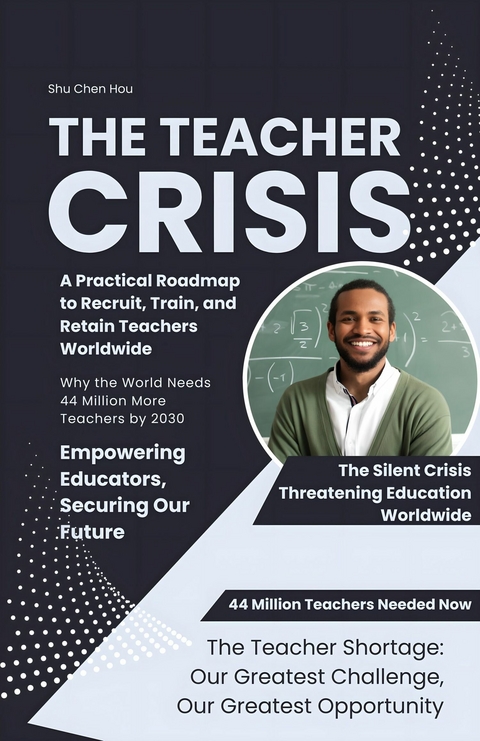
The Teacher Crisis-Closing the 44 Million Educator Gap (eBook)
110 Seiten
Publishdrive (Verlag)
978-0-00-100095-7 (ISBN)
A silent global emergency is threatening the future of education: by 2030, the world will need 44 million additional teachers. The Teacher Crisis offers an urgent, evidence-based, and hopeful roadmap to reverse this trend. Drawing on UNESCO data, case studies from around the world, and proven strategies, Dr. Shu Chen Hou explores why teachers are leaving, why recruitment is failing, and how we can build sustainable solutions.
From sub-Saharan Africa's overcrowded classrooms to North America's STEM shortages, this book examines the unique challenges facing every region, revealing the systemic causes of teacher attrition-from low pay and poor working conditions to burnout and lack of professional respect. It then lays out practical, scalable approaches for recruiting, training, and retaining talented educators.
Packed with actionable recommendations for policymakers, school leaders, NGOs, and community advocates, The Teacher Crisis is both a call to action and a blueprint for change. If we act now, we can restore the prestige of teaching, ensure quality education for all, and secure a brighter future for the next generation.
Chapter 1 – Understanding the Teacher Crisis: Scope, Trends, and Human Impact
Introduction
Education systems are the scaffolding upon which societies build their future. Yet a silent crisis is undermining this foundation: a global shortage of qualified teachers. In 2024 UNESCO warned that the world will need 44 million new primary and secondary teachers by 2030 to realise the promise of universal education. This figure is not a distant forecast but a looming reality. Attrition rates among primary teachers have nearly doubled in just seven years, from 4.6 % in 2015 to 9.0 % in 2022. The crisis spans continents and income levels: rural Malawi classrooms spill over with more than 100 pupils per teacher, while suburban U.S. schools struggle to hire math and special-education instructors. High-income countries face an ageing teacher workforce and shortages in specialised subjects; low-income countries face surging enrolment and dwindling public budgets. In this chapter we map the scale of the crisis, trace its roots, and put a human face on the numbers. We then explore the underlying themes that will guide the solutions presented throughout this book.
A global snapshot
Teacher shortages manifest in different ways across the world, but the data tell a stark story. UNESCO’s 2024/25 Global Teacher Report estimates that 44 million additional teachers are needed worldwide within the next decade. The distribution of this need is highly unequal. Sub-Saharan Africa accounts for roughly 15 million of the shortfall, Southern Asia about 7.8 million, and Europe & North America almost 4.8 million. Smaller regions still face acute shortages: South-Eastern Asia needs around 4.5 million, Northern Africa & Western Asia 4.3 million, Eastern Asia 3.3 million, Latin America & the Caribbean 3.2 million, and Central Asia and Oceania together need just over 1 million. These numbers represent more than just vacant posts; they represent children left without mentors, curricula left untaught, and communities deprived of the social and economic benefits that come from a well-educated populace.
Chart showing additional teachers needed by region
Chart showing unfilled and uncertified teaching positions in the United States
The crisis is not solely a problem of supply but also of attrition. Around the globe, experienced teachers are leaving at unprecedented rates. In the United States, teacher turnover spiked from 5.7 % pre-pandemic to 10 % in 2021–22 before settling at 7 % in 2023–24—still higher than before. Globally, the share of primary teachers who left the profession doubled in just seven years. Attrition now constitutes approximately 90 % of teacher demand in some countries, meaning that hiring more teachers alone cannot solve the crisis. Even high-income countries like Germany, Japan and the United States see large numbers of trained teachers leaving mid-career. In England, more than 40 % of new teachers leave within five years. The LPI notes that in the U.S. only about 16 % of leavers are retiring; the rest leave for other professions, higher pay, or out of frustration with working conditions.
Chart showing teacher attrition rates between 2015 and 2022
Behind the numbers: attrition and pipeline
Teacher attrition is driven by a combination of systemic and personal factors. Surveys in 2025 show that 62 % of U.S. teachers report frequent job-related stress and 53 % report burnout. 52 % identify managing student behaviour as a top stressor, and 39 % cite inadequate pay. Burnout is not limited to the United States; teachers in Japan routinely work more than 56 hours a week, the highest among OECD countries, and cite exhaustion and overwork as primary reasons for leaving. In sub-Saharan Africa and South Asia, workloads are overwhelming because of enormous class sizes. Many teachers are expected to teach multiple grades simultaneously, prepare their own materials, and perform administrative duties—all for salaries that may not cover basic living expenses.
The pipeline of new teachers is simultaneously shrinking. Teacher training programmes struggle to attract applicants, particularly in high-need subjects like mathematics, science and special education. In the U.S. enrolment in teacher preparation programmes has declined by more than a third since 2010. Many prospective teachers are deterred by low salaries relative to education level; American teachers earn only 69 cents for every dollar earned by other college-educated workers. Starting salaries hover around $46,526, and the national average is $72,030—both lower than a decade ago when adjusted for inflation. Salaries vary widely depending on union presence: teachers in states with collective bargaining earn roughly 27 % more than those in states where bargaining is prohibited. Globally, pay disparities are just as striking; OECD data show that teachers in primary education earn only 81 % of what similarly educated professionals make, rising to 88 % in upper secondary. Such wage gaps undermine the appeal of teaching, particularly for those who may have significant student debt.
Regional disparities and hotspots
Sub-Saharan Africa: A crisis of access and resources
With more than 15 million teachers needed by 2030, sub-Saharan Africa is the epicentre of the teacher shortage. Rapid population growth, ambitious education targets, and limited public funding mean that many classrooms have more than 60 pupils. In Malawi’s rural Machinga district, it is not unusual for a single teacher to oversee 100 or more first-grade students, rotating groups through lessons because there are not enough desks for everyone. Many teachers are volunteers or have no formal training; UNESCO estimates that one in four children in the region is taught by someone without a teaching qualification. Poor pay and lack of professional development opportunities push many trained teachers into other careers or out of the region entirely. For women teachers, safety concerns and family obligations further complicate retention. Yet there are glimmers of hope: countries like Senegal and Rwanda have invested in teacher training colleges and community-based education programmes that provide stipends and housing, encouraging teachers to serve in rural areas.
Southern Asia: Balancing quality and quantity
Southern Asia needs an estimated 7.8 million additional teachers. India alone has a shortfall of nearly a million elementary teachers. The region’s challenge is twofold: recruiting enough teachers to meet growing enrolment, and ensuring they receive adequate training. Many teachers in India, Pakistan and Bangladesh have little more than a high-school education themselves, and professional development is sporadic. Urban-rural disparities are acute; schools in major cities attract qualified teachers, while rural schools rely on contract or volunteer teachers. Efforts such as India’s National Education Policy 2020, which emphasises teacher education reforms and better working conditions, are steps toward closing the gap. Bangladesh has launched stipend programmes and career ladders to encourage teachers to remain in the classroom. Yet these measures often fail to keep pace with demographic pressures.
High-income countries: Specialised shortages and an ageing workforce
In Europe and North America, the teacher shortage is less about absolute numbers and more about specialised skills and impending retirements. Although these regions require 4.8 million additional teachers, many systems have enough teachers overall but lack specialists in STEM, special education, and foreign languages. Demographic shifts compound the problem: in Germany and Italy more than 40 % of teachers are over 50. A retirement wave looms even as fewer young people enter teaching. Economic conditions and the private sector’s pull make it difficult to attract graduates in fields like computer science or engineering into teaching. Additionally, policy environments can exacerbate shortages; in the United States, some states have cut funding and removed requirements for full certification, leading to high numbers of uncertified teachers and decreased morale.
Historical perspective: How did we get here?
The current teacher crisis results from decades of policy and economic trends. After World War II, many countries expanded access to primary and secondary education, but teacher recruitment and training often lagged behind enrolment booms....
| Erscheint lt. Verlag | 9.8.2025 |
|---|---|
| Sprache | englisch |
| Themenwelt | Sozialwissenschaften ► Pädagogik |
| ISBN-10 | 0-00-100095-0 / 0001000950 |
| ISBN-13 | 978-0-00-100095-7 / 9780001000957 |
| Informationen gemäß Produktsicherheitsverordnung (GPSR) | |
| Haben Sie eine Frage zum Produkt? |
 EPUB (Adobe DRM)
Größe: 554 KB
Kopierschutz: Adobe-DRM
Adobe-DRM ist ein Kopierschutz, der das eBook vor Mißbrauch schützen soll. Dabei wird das eBook bereits beim Download auf Ihre persönliche Adobe-ID autorisiert. Lesen können Sie das eBook dann nur auf den Geräten, welche ebenfalls auf Ihre Adobe-ID registriert sind.
Details zum Adobe-DRM
Dateiformat: EPUB (Electronic Publication)
EPUB ist ein offener Standard für eBooks und eignet sich besonders zur Darstellung von Belletristik und Sachbüchern. Der Fließtext wird dynamisch an die Display- und Schriftgröße angepasst. Auch für mobile Lesegeräte ist EPUB daher gut geeignet.
Systemvoraussetzungen:
PC/Mac: Mit einem PC oder Mac können Sie dieses eBook lesen. Sie benötigen eine
eReader: Dieses eBook kann mit (fast) allen eBook-Readern gelesen werden. Mit dem amazon-Kindle ist es aber nicht kompatibel.
Smartphone/Tablet: Egal ob Apple oder Android, dieses eBook können Sie lesen. Sie benötigen eine
Geräteliste und zusätzliche Hinweise
Buying eBooks from abroad
For tax law reasons we can sell eBooks just within Germany and Switzerland. Regrettably we cannot fulfill eBook-orders from other countries.
aus dem Bereich


