


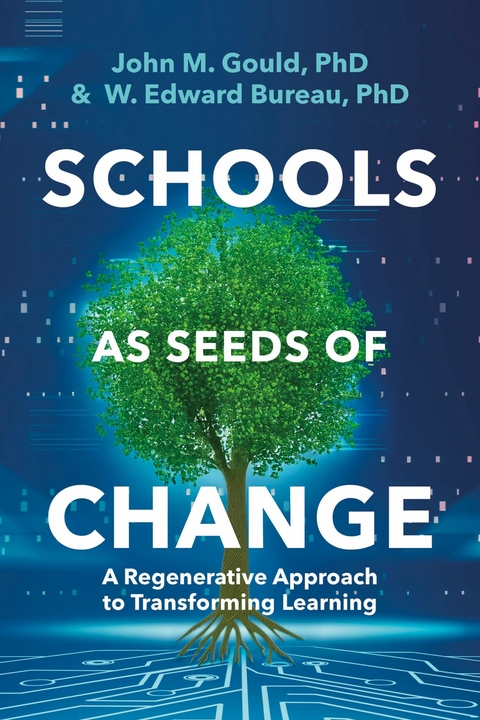
Schools As Seeds of Change (eBook)
208 Seiten
Bookbaby (Verlag)
979-8-3178-0620-0 (ISBN)
W. Edward Bureau, PhD: With over fifty years of experience as a high school teacher, school district administrator, and higher education professor, Ed brings his accumulated knowledge and insights to all the facets of this book. As a social constructivist, Ed believes deeply that together, we can create the synergies to transform schools, teaching, and learning. With conviction he believes that we must do so for students, teachers, and our collective futures through processes that are organic, whole, and generative. To reach Ed, email him at: edbureauphd@gmail.com
Can the prevailing factory model of American education be regenerated into one that prepares students for the emerging future? Absolutely, it can. The entrenched factory model of schools, teaching, and learning must be transformed if we are to prepare students for the rapidly emerging future. In keeping with the book's title, we must change our beliefs and behaviors away from merely "e;reforming"e; schools to realizing they are "e;seedbeds"e; from which can grow whole, organic, and radically redesigned systems. To do so, we must engage with regenerative frameworks, processes, and strategies, which are detailed in the book's chapters. Complacency with the historic model is not an option given the manifesting and mutating inorganic life form we and our students know as artificial intelligence. As discussed in the final chapter, AI can be our facilitator in system transformation or will redesign schooling without us. This purpose and six others are woven throughout the book to focus and unify our thinking about the possibilities and paths for transforming schooling from what has been to what can be. Rather than leaving readers to wonder how to lead for school system regeneration, the book threads the transformational leadership approach throughout frameworks and activities. The book's first section, Frameworks for Thinking, engages the reader in considering philosophic approaches, shifting deep-held beliefs and behaviors, knowing the historic roots of the factory model, and understanding the regenerative mindset. To offer specific ways to create substantive change, the second section, Tools for Changing School Systems, brings the reader deeply into the concepts and processes of understanding the nature of systems, engaging in artful conversation, and regenerating the development of systems. Regenerative change and transformational leadership are tightly woven together in the final section, Putting It Together. Deeply discussed are the symbiotic relationships between a system and the place in which it exists, how to realize potential futures, and the transformative nature of artificial intelligence as an inorganic life form. In essence, the book challenges readers to move beyond the paradoxical trap of believing education must be transformed yet perpetuating the entrenched factory model. Multiple paths are offered for move out from schooling as it is to what it is becoming with or without our leadership. Readers embracing or curious about the need for radical change of learning systems will find this book full of provocations and possibilities. This book is written to nurture the development of transformational leaders known for their charisma, vision, and ability to foster a sense of purpose and commitment among their followers. They often challenge the status quo and encourage innovative thinking, and they are deeply invested in the personal and professional development of those they lead. A focus on collaboration, empowerment, and the creation of generative contexts and relationships characterizes this leadership style. All the chapters and the concepts, frameworks, and activities are focused on developing the reader's sense of what transformational leadership will mean to their developing potential and capacity to disrupt the present norms found in our schools to evolve and nurture new structures for learning for all within a given community.
Chapter 1:
Philosophic
Approaches
As this chapter opens, we invite you to explore philosophies and beliefs that can lead to the vibrant, novel, and substantive reshaping of systems, human experiences, and inventions—existentialism and phenomenology. These illuminate how the deep origins of change can arise from shared human dialogue and endeavors. To add emphasis, they are contrasted with a philosophy that does not lie beneath our thinking about regenerative change—scientific realism. For further contrast and deeper thinking, we consider the distinctions and impacts on systems of Newtonian versus quantum perspectives.
As the book’s purpose A states, we must know “where we are coming from” in order to “shape where we are going.” Foundational to that is knowing our philosophies and beliefs because they shape our behaviors. Seeking and embracing our philosophies fuels our capacities for regenerating and reimagining systems as we know them. The discussions of select philosophies in this chapter may encourage you to seek and articulate the deep sources of your professional endeavors and, perhaps, shift them to support regenerative change.
Existentialism
Conceptually, existentialism and phenomenology are symbiotic—our understanding and practices of each intertwine with the other. There is no alpha or omega in these two, but we’ll enter this philosophical loop with existentialism. As existentialists we wonder about the significance of beliefs, values, and knowledge in terms of our existence, more particularly our daily existence. For instance, if we believe that light should be shed on truth, how does that manifest in our words and actions in this moment? As existentialists, we ask ourselves, “Individually and collectively, how do we describe our existence in this world, this place, this system? What do those descriptions tell us about the meanings of our existence?”
The meanings that emerge might perpetuate our current existence or reshape it. Through phenomenological approaches, we can understand how we and others exist in and shape the existing school system. Just as likely, though, found meanings can reveal how we might exist in schools synchronous with an emerging future that lies beyond the traditional, factory model structure. By understanding the phenomena of our existence, we can or cannot choose to reinvent or modify the system—or design a new one. The bravery, the leap is in accepting that any such changes will bring us to new realities that reshape our existence. While that might be discomforting, we can accept that we exist in a present that is quite likely much different than the future.
As existentialists we affirm the existence of others with their personalities, foibles, and beliefs, doing so without judgment. Putting judgment on others’ existence precludes emergence of the rich descriptions that begin to illustrate patterns of meaning. For instance, judgment of others in a system blocks us from seeing how they experience existence in the system. In turn, that creates the phenomenon of molding humans’ existence into preconceived notions of who they should be, which is the classic progenitor of Byzantine systems that do not change. We existentialists and phenomenologists must step back to see and accept patterns of meaning without judging them or the people who create them. If we cannot, the deep dynamics of systems change will elude us.
What exists in the people and the system is fluid from moment to moment. Attempts to capture and solidify the fluidity both denies the dynamic nature of change and reifies the system. Consider the “moment of teaching and learning” when two or more people exist in that electric point in time when teaching and learning processes merge into new knowledge, skill, or understanding (otherwise known as “the light comes on”). We can create that moment and all that is fluid in it if we unbound ourselves from system reifications, such as scripted teaching or teaching to a test. If we can listen without judgment, we can hear the patterns of meaning that exist in moments such as these.
Listening to how we and others describe our existences reveals our lived experiences—the phenomena of our lives. With a hermeneutic interpretation of ours and others’ words, such as through metaphoric language, we reveal our understanding of existence in the past, present, and future. With such understanding, we can move regeneratively to living in and leading for the emerging future rather than existing in the static present. For example, if we embrace the phenomenon of social constructivism, in which we make meaning together, we can collaborate with others to create reimagined systems of learning, such as the school as “seedbed.”
We engage in social processes that are simultaneously existential and phenomenological. If we are “leading” humans in the system and are leading through social constructivism, we collectively share in processes with the potential to generate synergies and, perhaps, the “ah-hah” moments of creative design and inventiveness. Openness to how we exist individually and collectively in these moments reveals phenomena that shape and reshape our beliefs and behaviors.
Phenomenology
Not to trip over the obvious, but we cannot deny that dynamic, ecological systems of human endeavors originate because of us. We humans are the progenitors of the systems, and we strategically modify and complicate them. Ours is a remarkable ability to rationalize the existence of the systems we know, rather than to generate alternate models and structures. That notion begs these questions, “Why do we do this? What are the patterns in our behavior that show what we are doing? What beliefs do we hold that shape our behaviors in systems?”
All of this is phenomenological in nature. Phenomena arise from the systems we create and perpetuate with each other, such as the factory model. To sense and make sense of the phenomenon, we need to find patterns of meaning that emerge from peoples’ voices and stories. Doing so is observational and intentional in nature and may include such processes as interviewing, focus groups, and journaling. If those processes sound like phenomenological research methods, they are. However, an important distinction must be made: we use these methods fluidly rather than formally in highly structured, approved research projects.
By finding patterns of meaning, we can see phenomena central to regenerating systems, as well as those that perpetuate the “paradox.” From voices emerge our stories of how we experience stasis, change efforts, and consequent failures and successes. These language-based approaches reveal a richness of meaning and possibility not found in the analysis of numbers. Descriptive language-based patterns provide the fertile understandings that can reshape existing systems or create novel systems.
Deep change in systems originates in hearing peoples’ voices, specifically in how they experience phenomena and how those phenomena reveal what shapes their actions. While it might seem on the surface that people can work within systems on their own or with little interaction with others, in reality, we are socially and complexly intertwined. Thus, a phenomenological approach can reveal our shared understandings of what is and what could be. We listen to each other’s voices and stories, and, perhaps, find shared imaginings of new models that evolve into prototypes of regenerated systems. The phenomena of regeneration and invention beg to be heard and heeded.
Scientific Realism
In as much as existentialism and phenomenology are expansive and language based, scientific realism is restrictive and numerical based. By taking the position that reality can be quantified, scientific realists believe that the most precise picture of reality is “in the numbers.” Not taken into account nor validated in describing reality are the voices and stories of people in the system from which arise patterns of meaning and understood phenomena.
A tenet central to scientific realism is the notion that what can be quantified can be controlled. Not surprisingly, this philosophy had its roots in the factory model of nineteenth-century industry and education, both PreK-12 and higher education. Scientific realism promotes and embeds “reification” in systems. By quantifying and controlling, by using evermore precise data, “polished” products will emerge, be those inanimate objects from the factory assembly line or human “products” from a school system—the graduates.
For example, we need to look no further than the high-stakes testing obsession in PreK-12. Scientific realists have imbedded in law and policy an emphasis on numerical data that has decimated school curricula, eliminated enrichment programs, and required scripted teaching. Numbers and data sets drive decision-making, not the voices and stories of students, teachers, and administrators. We only need to listen to them to hear how scientific realism has taken the joy out of teaching and learning; that we could do as phenomenologists. We also can choose to teach the “whole child” rather than an aspect of a child represented by a test score number.
Given how this restrictive, numbers-based philosophy continues to impact schools, we’re not surprised that it perpetuates the factory model and locks us into the “paradox.” Such stasis manifests the notion that “structure shapes behavior over time.” In contrast, though, if we listen to the voices and stories of teachers, we will hear that some woefully...
| Erscheint lt. Verlag | 11.8.2025 |
|---|---|
| Sprache | englisch |
| Themenwelt | Sozialwissenschaften ► Pädagogik |
| ISBN-13 | 979-8-3178-0620-0 / 9798317806200 |
| Informationen gemäß Produktsicherheitsverordnung (GPSR) | |
| Haben Sie eine Frage zum Produkt? |
 EPUB (Ohne DRM)
Größe: 4,4 MB
Digital Rights Management: ohne DRM
Dieses eBook enthält kein DRM oder Kopierschutz. Eine Weitergabe an Dritte ist jedoch rechtlich nicht zulässig, weil Sie beim Kauf nur die Rechte an der persönlichen Nutzung erwerben.
Dateiformat: EPUB (Electronic Publication)
EPUB ist ein offener Standard für eBooks und eignet sich besonders zur Darstellung von Belletristik und Sachbüchern. Der Fließtext wird dynamisch an die Display- und Schriftgröße angepasst. Auch für mobile Lesegeräte ist EPUB daher gut geeignet.
Systemvoraussetzungen:
PC/Mac: Mit einem PC oder Mac können Sie dieses eBook lesen. Sie benötigen dafür die kostenlose Software Adobe Digital Editions.
eReader: Dieses eBook kann mit (fast) allen eBook-Readern gelesen werden. Mit dem amazon-Kindle ist es aber nicht kompatibel.
Smartphone/Tablet: Egal ob Apple oder Android, dieses eBook können Sie lesen. Sie benötigen dafür eine kostenlose App.
Geräteliste und zusätzliche Hinweise
Buying eBooks from abroad
For tax law reasons we can sell eBooks just within Germany and Switzerland. Regrettably we cannot fulfill eBook-orders from other countries.
aus dem Bereich


