


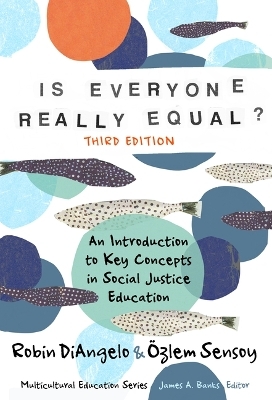
Is Everyone Really Equal?
Teachers' College Press (Verlag)
978-0-8077-8779-3 (ISBN)
- Noch nicht erschienen (ca. Januar 2026)
- Versandkostenfrei
- Auch auf Rechnung
- Artikel merken
This is the long-awaited third edition of the bestselling, multi-award–winning introduction to foundational concepts in social justice education.
Accessible to students from high school through graduate school, this comprehensive resource addresses the most common stumbling blocks to understanding social justice. In response to the deep divides in public discourse, this edition provides a framework for reaching common ground on issues of justice within a pluralistic democracy.
The authors have updated statistics, research, and examples, and revised discussion questions and extension activities to guide classroom dialogue and engagement with today’s complex issues. New topics include the science of sex and gender, and the political backlash against equity and racial justice efforts. The authors trace the roots of white supremacy globally in the history of colonialism. Concepts such as oligarchy, kleptocracy, and capitalism’s relationship to democracy are introduced and discussed.
Is Everyone Really Equal? is an up-to-date and engaging textbook and professional development resource that includes many user-friendly features, examples, vignettes, and activities to not just define but illustrate key concepts.
Book Features:
User-friendly features such as accessible language, “definition boxes” to reinforce concepts, “perspective checks” to acknowledge multiple viewpoints, and “stop boxes” that anticipate and address common points of resistance.
A glossary that includes an explanation of social justice language and its complexities and changes over time.
Discussion questions, extension activities, and exercises for book groups and classroom study.
An accessible resource for instructors in disciplines including education, sociology, political science, criminal justice, nursing, social work, health sciences, gender and sexuality studies, and race and ethnic studies in the United States and Canada.
Robin DiAngelo is an affiliate associate professor of education at the University of Washington and author of Seeing Whiteness: The Essential Essays of Robin DiAngelo. Özlem Sensoy is professor of education and inaugural director of the Cassidy Centre for Educational Justice at Simon Fraser University, Vancouver, Canada.
Contents
Series Foreword James A. Banks xiii
Acknowledgments xix
Preface xxi
What Is Critical Social Justice? xxi
Chapter Summaries xxiii
Prologue xxvii
A Parable: Hodja and the Foreigner xxvii
Layers of the Parable xxviii
1. How to Engage Constructively in Courses That Take a Critical Social Justice Approach 1
An Open Letter to Students 3
A Story: The Question of Planets 5
Guideline 1: Strive for Intellectual Humility 6
Guideline 2: Everyone Has an Opinion. Opinions Are Not the Same as Informed Knowledge 9
Guideline 3: Let Go of Anecdotal Evidence and Examine Patterns 11
Guideline 4: Use Your Reactions as Entry Points for Gaining Deeper Self-Knowledge 13
Guideline 5: Recognize How Your Social Position Informs Your Reactions to Your Instructor and the Course Content 15
Grading 17
Conclusion 20
Discussion Questions 21
Extension Activity 21
2. About Knowledge 22
Knowledge as Socially Constructed 22
Research on Knowledge as Socially Constructed 26
Applying Critical Theory 29
Finding Common Ground 33
Discussion Questions 36
Extension Activities 36
Patterns to Practice Seeing 37
3. Culture and Socialization 38
What Is Culture? 39
What Is Socialization? 39
Cultural Norms and Conformity 43
Implicit Bias 44
You in Relation to the Groups to Which You Belong 48
Discussion Questions 53
Extension Activities 53
Patterns to Practice Seeing 55
4. Prejudice and Discrimination 56
What Is Prejudice? 57
What Is Discrimination? 61
All Humans Have Prejudice and Discriminate 62
Discussion Questions 64
Extension Activities 64
Patterns to Practice Seeing 65
5. Oppression and Power 66
Social Stratification 67
Understanding Power 69
What Is Oppression? 71
Understanding the “Isms” 75
Internalized Dominance 81
Internalized Oppression 82
Discussion Questions 88
Extension Activities 88
Patterns to Practice Seeing 89
6. Understanding Privilege Through Ableism 90
What Is Privilege? 91
External and Structural Dimensions of Privilege 92
Internal and Attitudinal Dimensions of Privilege 98
Common Dominant Group Misconceptions About Privilege 106
Discussion Questions 109
Extension Activities 110
Patterns to Practice Seeing 110
7. Understanding the Invisibility of Oppression Through Sexism 111
What Is an Institution? 112
Sex/Gender and Science 113
An Example: Sexism Today 118
What Makes Sexism Difficult to See? 121
Dominant Discourses of Sexism as Empowerment 126
Discussion Questions 137
Extension Activities 137
Patterns to Practice Seeing 138
8. Understanding the Structural Nature of Oppression Through Racism 139
What Is Race? 141
A Brief History of the Social Construction of Race in the United States 141
A Brief History of the Social Construction of Race in Canada 142
What Is Racism? 144
Two Key Challenges to Understanding Racism 145
Racism Today 148
Dynamics of White Racial Superiority 151
Dynamics of Internalized Racial Oppression 155
Racism and Intersectionality 157
Common White Misconceptions About Racism 161
Discussion Questions 168
Extension Activities 169
Patterns to Practice Seeing 169
9. Understanding the Global Organization of Racism Through White Supremacy 170
Whiteness and White Supremacy 171
White Supremacy in the Global Context 174
Discussion Questions 189
Extension Activities 189
Patterns to Practice Seeing 190
10. Understanding Intersectionality Through Classism 191
Mr. Rich White and Mr. Poor White Strike a Bargain 191
What Is Class? 193
Common Class Terms 203
Class Socialization 210
Common Misconceptions About Class 212
Understanding Intersectionality 219
Examples of Everyday Class Privilege 221
Common Classist Beliefs 222
Discussion Questions 226
Extension Activities 226
Patterns to Practice Seeing 227
11. “Yeah, But . . .”: Common Rebuttals 228
Claiming That Schools Are Politically Neutral 229
Dismissing Social Justice Scholarship as the Personal Opinions of Woke Radicals 230
Citing Exceptions to the Rule 230
Arguing That Oppression Is Just Human Nature 231
Appealing to a Universalized Humanity 232
Insisting on Immunity From Socialization 232
Ignoring Intersectionality 233
Refusing to Recognize Structural and Institutional Power 234
Denying the Politics of Language 235
Invalidating Claims of Oppression as Oversensitivity 236
Positioning Social Justice Education as Something “Extra” 237
Being Paralyzed by Guilt 238
Discussion Questions 240
Extension Activity 240
Patterns to Practice Seeing 241
12. Putting It All Together 242
Recognize How Relations of Unequal Social Power Are Constantly Being Enacted 243
Understand Our Own Positions Within Relations of Unequal Power (Intersectionality) 246
Think Critically About Knowledge 250
Act in Service of a More Just Society 254
Discussion Questions 258
Extension Activities 259
Patterns to Practice Seeing 261
References 263
Glossary 291
Index 301
About the Authors 321
| Erscheinungsdatum | 03.01.2026 |
|---|---|
| Reihe/Serie | Multicultural Education Series |
| Mitarbeit |
Herausgeber (Serie): James A. Banks |
| Verlagsort | New York |
| Sprache | englisch |
| Maße | 162 x 235 mm |
| Themenwelt | Sozialwissenschaften ► Ethnologie |
| Sozialwissenschaften ► Pädagogik | |
| Sozialwissenschaften ► Soziologie ► Allgemeines / Lexika | |
| ISBN-10 | 0-8077-8779-5 / 0807787795 |
| ISBN-13 | 978-0-8077-8779-3 / 9780807787793 |
| Zustand | Neuware |
| Informationen gemäß Produktsicherheitsverordnung (GPSR) | |
| Haben Sie eine Frage zum Produkt? |
aus dem Bereich


