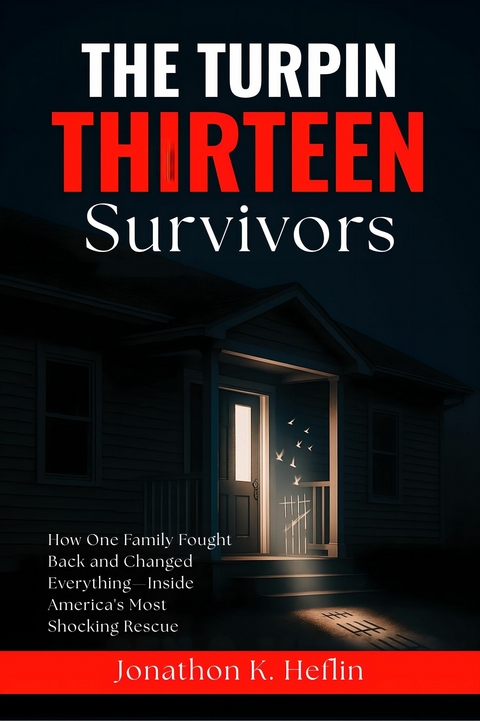
The Turpin Thirteen Survivors (eBook)
212 Seiten
Seahorse Pub (Verlag)
978-0-00-098671-9 (ISBN)
In the quiet suburban streets of Perris, California, a house of horrors hid behind closed doors for over two decades. Thirteen siblings, ranging from toddlers to young adults, lived in conditions so shocking they would capture worldwide attention and forever change how we understand family abuse.
The Turpin Thirteen Survivors reveals the complete, untold story of America's most disturbing rescue mission. When seventeen-year-old Jordan Turpin risked everything to escape through a bedroom window and dial 911, she triggered a chain of events that would expose systematic torture, starvation, and imprisonment that defied comprehension.
This gripping true crime investigation takes readers inside the methodical police work that built an unshakeable case, the courtroom drama that brought justice, and the remarkable healing journey of thirteen survivors who refused to let their past define their future. From the initial 911 call to the emotional victim impact statements, every moment is documented with unprecedented access to law enforcement files, court records, and exclusive interviews.
Author Jonathon K. Heflin masterfully weaves together the perspectives of investigators, prosecutors, social workers, and the survivors themselves to create a comprehensive account that is both heartbreaking and inspiring. This isn't just another true crime story-it's a testament to human resilience and the power of one person's courage to save lives.
The book exposes critical failures in child protection systems while celebrating the dedicated professionals who work tirelessly to protect our most vulnerable citizens. It reveals how warning signs were missed, how systems failed, and most importantly, how communities can do better.
The Turpin Thirteen Survivors offers hope alongside horror, showing that even in humanity's darkest moments, love, courage, and the determination to survive can triumph over unimaginable evil.
Chapter 1
The Escape
The house at 160 Muir Woods Road stood silent in the pre-dawn darkness of January 14, 2018, its beige stucco walls holding secrets that had festered for decades. Inside, seventeen-year-old Jordan Turpin pressed her trembling hands against the cool window frame of her bedroom, her heart hammering against her ribs as she prepared to change everything. The digital clock on her nightstand glowed 5:47 AM, its red numbers marking the moment between a lifetime of imprisonment and the possibility of freedom.
Jordan's fingers traced the window latch one final time, a gesture she had practiced in her mind countless times over the past months. The mechanism was old, requiring just the right pressure and angle to release without the telltale creak that might wake her parents. She had memorized every sound the house made, every board that groaned under weight, every door that squeaked on its hinges. Survival had taught her to be invisible, but tonight, she would need to be brave.
The weight of thirteen lives rested on her shoulders—her own and those of her twelve siblings who remained trapped in the squalid conditions that had defined their existence for as long as any of them could remember. Some were chained to beds, others too weak to move, all bearing the physical and psychological scars of systematic abuse and neglect. Jordan knew that if she failed, if she was caught, the consequences would be devastating not just for herself but for every brother and sister counting on her courage.
She closed her eyes briefly, steadying her breathing as she had learned to do during the worst moments of her captivity. The plan was simple in concept but terrifying in execution: climb out the window, find help, and pray that someone would believe her story. The simplicity was deceptive—she had never been allowed outside unsupervised, had no real understanding of the world beyond the four walls that had confined her, and possessed no identification or proof of her identity.
The window slid open with barely a whisper, cool January air rushing into the stifling room. Jordan paused, listening for any sound that might indicate her parents had awakened. The house remained silent except for the labored breathing of her siblings in nearby rooms. Taking one last look at the home that had been her prison, she lifted her leg over the windowsill and stepped into the unknown.
The escape itself unfolded with the surreal quality of a dream Jordan had rehearsed a thousand times but never believed she would actually live. Her bare feet touched the cold concrete of the small side yard, sending shocks of sensation through her body—the first time she had felt unfiltered earth beneath her feet in years. The sensation was both liberating and terrifying, a stark reminder of how completely her world had been controlled.
She moved carefully around the perimeter of the house, staying close to the walls where shadows provided cover from the streetlights. The neighborhood of Perris was quiet in the early morning hours, with only the distant hum of traffic on nearby Interstate 215 breaking the silence. Jordan had studied this landscape from her bedroom window for months, memorizing the positions of houses, the layout of streets, and the location of what appeared to be a shopping center about a mile away.
Her body, weakened by years of malnutrition and physical abuse, protested with each step. At seventeen, Jordan weighed barely ninety pounds, her growth stunted by chronic starvation and medical neglect. Her muscles, unused to sustained physical activity, began to cramp within the first few blocks. But the urgency of her mission drove her forward, each painful step taking her farther from the house of horrors and closer to the possibility of rescue for her siblings.
The first major obstacle came at the intersection of Muir Woods Road and Indian Street. Traffic lights cycled through their colors, and Jordan realized she had no practical experience with basic navigation. The concepts of street signs, traffic patterns, and urban geography were foreign to her, learned only through glimpses from windows and fragments of overheard conversations. She had to rely on instinct and the vague memory of seeing a shopping center with what looked like businesses that might have telephones.
As she walked, Jordan's mind raced with the story she would need to tell. How could she explain the reality of her family's situation to someone who had never experienced such systematic cruelty? How could she make them understand that her parents, David and Louise Turpin, had created a world where children were chained to beds, where basic hygiene was forbidden, where education consisted of occasional glimpses at outdated textbooks, and where meals were rationed to the point of starvation?
The physical evidence was written across her body—the hollow cheeks, the protruding bones, the scars from restraints and abuse. But Jordan also carried invisible wounds, the psychological trauma of a childhood spent in captivity, where normal human interaction was forbidden and the outside world existed only in imagination. She had prepared for this moment by creating a mental script, practicing the words she would need to speak to make someone understand the urgency of returning to save her siblings.
The shopping center appeared ahead, its parking lot mostly empty except for a few early-morning commuters. Jordan's heart pounded as she approached the first business she saw—a small convenience store with lights on inside. Through the windows, she could see a clerk behind the counter, the first stranger she had encountered in years. The moment of truth had arrived, and there was no turning back.
She pushed through the glass door, bells chiming to announce her arrival. The clerk looked up, his expression shifting from routine boredom to concern as he took in Jordan's appearance—the obvious signs of malnourishment, the ill-fitting clothes, the wild desperation in her eyes. This was the moment when Jordan Turpin would have to find the courage to speak words that would shatter the silence of years and set in motion a chain of events that would expose one of the most shocking cases of child abuse in California history.
"I need to call 911," Jordan said, her voice barely above a whisper but carrying the weight of absolute determination. The convenience store clerk, a middle-aged man named Hassan who had worked the early shift for three years, had never heard such a combination of terror and resolve in a customer's voice. He immediately handed her the phone, recognizing that something was seriously wrong.
Jordan's hands shook as she dialed the three numbers that represented her only connection to the outside world. The phone rang once, twice, and then a voice answered—calm, professional, trained to handle emergencies but perhaps not prepared for the story that was about to unfold.
"911, what's your emergency?"
"Hi, I need help," Jordan began, her voice growing stronger with each word. "I live at 160 Muir Woods Road in Perris, and I escaped from my house. My parents are abusing me and my siblings. Some of my siblings are chained up right now."
The dispatcher, a veteran named Kelly with twelve years of experience handling emergency calls, felt her training kick in even as the unusual nature of the call registered. Something in the caller's voice—a combination of youth, desperation, and sincerity—told her this was not a prank or a routine domestic dispute.
"Okay, honey, I need you to stay calm and tell me your name and age."
"My name is Jordan Turpin. I'm seventeen years old."
"Are you safe where you are right now?"
"Yes, I'm at a store. But my siblings aren't safe. They're still in the house, and some of them are chained to beds. My parents chain them up when they do something wrong."
Kelly's pen moved quickly across her notepad, documenting the details while simultaneously dispatching units to the location. In her years of service, she had handled countless domestic violence calls, but something about this situation felt different—more urgent, more desperate.
"Jordan, I need you to stay exactly where you are. Police officers are on their way to you right now. Can you tell me how many siblings you have?"
"Twelve. There are thirteen of us total. The youngest is two years old."
"Are any of your siblings hurt right now?"
Jordan's voice broke slightly as she responded, "They're all hurt. They're really skinny like me, and they don't get to eat much. Some of them can't even walk properly because they've been chained up for so long."
The dispatcher's supervisor, monitoring the call, had already begun coordinating what would become one of the largest emergency responses in Riverside County history. Child Protective Services was being notified, additional units were being dispatched, and the Sheriff's Department was preparing for what appeared to be a major child abuse case.
"Jordan, you're being very brave right now. I need you to describe your parents for me."
"My dad is tall and thin, and my mom is shorter with dark hair. They're probably still asleep, but they usually wake up around seven. Please hurry—if they find out I'm gone, they'll hurt my siblings even worse."
The urgency in Jordan's voice was palpable, and Kelly could hear the genuine fear for her siblings' safety. "The officers are almost there, sweetheart. You did the right thing by calling for help. Can you tell me about the house? How many rooms? Are there any weapons?"
"It's a regular house, but it's really dirty and it smells bad. My parents have some guns, I think, but I don't know where they keep them. Please just get my siblings out...
| Erscheint lt. Verlag | 5.8.2025 |
|---|---|
| Sprache | englisch |
| Themenwelt | Sozialwissenschaften ► Politik / Verwaltung |
| ISBN-10 | 0-00-098671-2 / 0000986712 |
| ISBN-13 | 978-0-00-098671-9 / 9780000986719 |
| Informationen gemäß Produktsicherheitsverordnung (GPSR) | |
| Haben Sie eine Frage zum Produkt? |
 EPUB (Adobe DRM)
Größe: 1,9 MB
Kopierschutz: Adobe-DRM
Adobe-DRM ist ein Kopierschutz, der das eBook vor Mißbrauch schützen soll. Dabei wird das eBook bereits beim Download auf Ihre persönliche Adobe-ID autorisiert. Lesen können Sie das eBook dann nur auf den Geräten, welche ebenfalls auf Ihre Adobe-ID registriert sind.
Details zum Adobe-DRM
Dateiformat: EPUB (Electronic Publication)
EPUB ist ein offener Standard für eBooks und eignet sich besonders zur Darstellung von Belletristik und Sachbüchern. Der Fließtext wird dynamisch an die Display- und Schriftgröße angepasst. Auch für mobile Lesegeräte ist EPUB daher gut geeignet.
Systemvoraussetzungen:
PC/Mac: Mit einem PC oder Mac können Sie dieses eBook lesen. Sie benötigen eine
eReader: Dieses eBook kann mit (fast) allen eBook-Readern gelesen werden. Mit dem amazon-Kindle ist es aber nicht kompatibel.
Smartphone/Tablet: Egal ob Apple oder Android, dieses eBook können Sie lesen. Sie benötigen eine
Geräteliste und zusätzliche Hinweise
Buying eBooks from abroad
For tax law reasons we can sell eBooks just within Germany and Switzerland. Regrettably we cannot fulfill eBook-orders from other countries.
aus dem Bereich