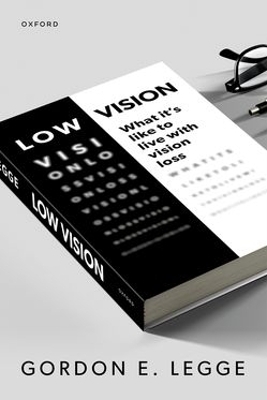
Low Vision
Oxford University Press (Verlag)
978-0-19-894693-9 (ISBN)
- Noch nicht erschienen (ca. April 2026)
- Versandkostenfrei
- Auch auf Rechnung
- Artikel merken
Do you have low vision? Do you know someone with low vision? One out of every five people who live into their eighties will encounter vision loss. Some may grow up with healthy vision and then experience vision loss from macular degeneration, glaucoma, or some other eye disease later in life. Others may be born with an inherited or congenital condition that results in low vision such as albinism or retinopathy of prematurity. Most people with vision loss have useful remaining vision; we call it low vision. But what can they see? What is the impact of low vision on their daily lives? Put it simply, what's it like to live with low vision?
Low vision is any form of vision impairment, not correctable by glasses or contacts, resulting from eye disease or injury. Low vision is a broad spectrum lying between total blindness and normal vision. The number of people with low vision is rising rapidly as our population ages, with conservative estimates ranging upward from seven million in the United States to hundreds of millions worldwide.
Despite its high prevalence, there is little understanding of low vision among the general public and even in the medical community. Gordon Legge is a leading vision scientist who has devoted more than forty years to research on low vision. He has low vision himself, providing him with a unique perspective on the science and its implications. In the book, he describes the diverse nature of low vision, how it is measured and characterized, and its impact on daily experience. By understanding the science behind these experiences, we will all better understand the challenges and possibilities of life with low vision.
Gordon Legge is Distinguished McKnight University Professor at the University of Minnesota. He received a Bachelor's degree in Physics from MIT in 1971, a Master's in Astronomy from Harvard in 1972, and a Ph.D. in Experimental Psychology from Harvard in 1976. He is currently director of the Minnesota Laboratory for Low-Vision Research and scientific co-director of the Center for Applied and Translational Sensory Science (CATSS). His research focuses on low vision with emphasis on the roles of vision in reading and mobility, and the impact of impaired vision on the visual centers in the brain.
Introduction
Part I1:
2: What Is Low Vision?
3: Acuity: Size Matters
4: Contrast and Color
5: The Peripheral Visual Field: Parts and Wholes
The Central Field of Vision: Missing in Action
Part II6:
7: Mobility and Low Vision-Getting Around on Foot
8: Mobility and Low Vision: Let's Go for a Drive
Part III
9: Childhood Low Vision: A Moving Target
10: Sight Restoration: The Dream
Epilogue: Looking Ahead
Appendix:Structures of the Eye
| Erscheint lt. Verlag | 2.4.2026 |
|---|---|
| Verlagsort | Oxford |
| Sprache | englisch |
| Maße | 156 x 234 mm |
| Themenwelt | Geisteswissenschaften ► Psychologie ► Allgemeine Psychologie |
| Geisteswissenschaften ► Psychologie ► Verhaltenstherapie | |
| Medizin / Pharmazie ► Medizinische Fachgebiete ► Augenheilkunde | |
| Sozialwissenschaften ► Soziologie | |
| ISBN-10 | 0-19-894693-7 / 0198946937 |
| ISBN-13 | 978-0-19-894693-9 / 9780198946939 |
| Zustand | Neuware |
| Informationen gemäß Produktsicherheitsverordnung (GPSR) | |
| Haben Sie eine Frage zum Produkt? |
aus dem Bereich