


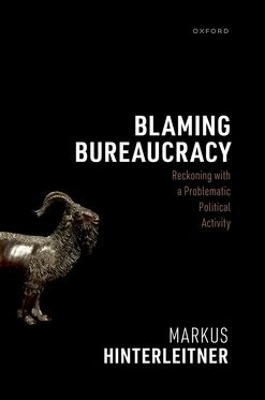
Blaming Bureaucracy
Reckoning with a Problematic Political Activity
Seiten
2025
Oxford University Press (Verlag)
978-0-19-898015-5 (ISBN)
Oxford University Press (Verlag)
978-0-19-898015-5 (ISBN)
Why do politicians, the media, and the public routinely blame bureaucracy for society's problems? This book explores why the bureaucracy is such a convenient scapegoat in modern democracies-even when it is not the real cause of political and economic challenges.
Political life in advanced democracies is steeped in negativity towards bureaucracy. Politicians, parties, and the media routinely blame the bureaucracy for all kinds of political, social, or economic problems. Whenever there is controversy to be processed, bureaucracy is often the scapegoat. While one might expect this negativity to be due to the bureaucracy's actual performance, or simply a reflection of more general frustrations with democracy, the truth lies elsewhere. We don't blame the bureaucracy so much because its performance is so poor or because we're fed up with how things are run in our countries, but rather because democracies are characterized by dynamics and discourses in which the bureaucracy almost “automatically” finds itself at the receiving end of blame.
This book is the first to unpack these dynamics. For many actors, blaming the bureaucracy is the most convenient thing to do in controversial and conflictual situations-of which there are many in modern democracies. Bureaucracy is everyone's favorite scapegoat because it can be plausibly blamed for almost anything and because it is unlikely to fight back. Unfortunately, the bureaucracy is far too valuable to be everyone's punching bag. Rampant bureaucracy blaming undermines administrative performance and creates a public discourse in which a weak and curtailed bureaucracy becomes popular. Because bureaucracy blaming threatens to dismantle the very structures that sustain our democracies, this problematic political activity deserves our full attention.
Political life in advanced democracies is steeped in negativity towards bureaucracy. Politicians, parties, and the media routinely blame the bureaucracy for all kinds of political, social, or economic problems. Whenever there is controversy to be processed, bureaucracy is often the scapegoat. While one might expect this negativity to be due to the bureaucracy's actual performance, or simply a reflection of more general frustrations with democracy, the truth lies elsewhere. We don't blame the bureaucracy so much because its performance is so poor or because we're fed up with how things are run in our countries, but rather because democracies are characterized by dynamics and discourses in which the bureaucracy almost “automatically” finds itself at the receiving end of blame.
This book is the first to unpack these dynamics. For many actors, blaming the bureaucracy is the most convenient thing to do in controversial and conflictual situations-of which there are many in modern democracies. Bureaucracy is everyone's favorite scapegoat because it can be plausibly blamed for almost anything and because it is unlikely to fight back. Unfortunately, the bureaucracy is far too valuable to be everyone's punching bag. Rampant bureaucracy blaming undermines administrative performance and creates a public discourse in which a weak and curtailed bureaucracy becomes popular. Because bureaucracy blaming threatens to dismantle the very structures that sustain our democracies, this problematic political activity deserves our full attention.
Markus Hinterleitner is an Assistant Professor of Public Administration and Political Institutions at the University of Lausanne's IDHEAP (the Swiss Graduate School of Public Administration). He is the author of Policy Controversies and Political Blame Games (2020) and the co-editor of The Politics and Governance of Blame (2024). He received his PhD from the University of Bern, Switzerland in 2018 and held postdoctoral positions at UC Berkeley, Brown University, and LMU Munich.
| Erscheinungsdatum | 21.10.2025 |
|---|---|
| Verlagsort | Oxford |
| Sprache | englisch |
| Maße | 156 x 16 mm |
| Gewicht | 295 g |
| Themenwelt | Sozialwissenschaften ► Politik / Verwaltung ► Politische Theorie |
| Sozialwissenschaften ► Politik / Verwaltung ► Staat / Verwaltung | |
| ISBN-10 | 0-19-898015-9 / 0198980159 |
| ISBN-13 | 978-0-19-898015-5 / 9780198980155 |
| Zustand | Neuware |
| Informationen gemäß Produktsicherheitsverordnung (GPSR) | |
| Haben Sie eine Frage zum Produkt? |
Mehr entdecken
aus dem Bereich


aus dem Bereich
Leben und letzte Reise eines Revolutionärs
Buch | Hardcover (2025)
C.H.Beck (Verlag)
CHF 36,40
Weltherrschaft und Menschheitsethos
Buch | Hardcover (2025)
Suhrkamp (Verlag)
CHF 67,20


