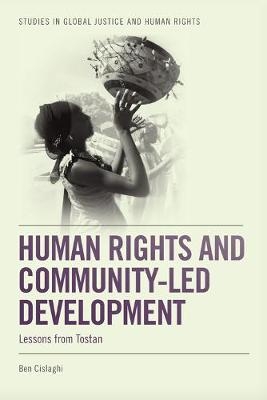
Human Rights and Community-led Development
Edinburgh University Press (Verlag)
978-1-4744-1979-6 (ISBN)
Divided into three parts, the book firstly assesses why top-down approaches to education and development are unhelpful and offers a theoretical understanding of what constitutes helpful development. Part two examines Tostan’s community-based participatory approach as an example of a helpful development intervention, and offers qualitative evidence of its effectiveness. Part three builds a model of how community-led development works, why it is helpful, and what practitioners can do to help people at the grassroots level lead their own human development.
Ben Cislaghi is Lecturer in Social Norms at the London School of Hygiene and Tropical Medicine. He previously worked as a development professional.
Index of Figures and Tables
List of Abbreviations
1. Introduction
Origin of this book and research methodsThree useful things that are in this bookPart one. Some useful concepts to rethink development practicesPart two. The programme in actionPart three. Helpful development
Part I: Some Useful Tools to Rethink Development Practices
2. Rethinking development interventions: Potential and challenges of human rights education
IntroductionBringing international human rights into local contextsA nonformal problem-posing approach to human rights educationA human development framework for human rights educationCognitive and social constructions of the status quoGender roles and social changePower dynamics in social reproductionConclusion
3. Modernisation at work: Senegal, Tostan and the Fulɓe
IntroductionSenegal: Gender, Decision Making and Human Rights Challenges The NGO Tostan: approach, curriculum and limitationsThe Fulɓe identity: values and characteristicsConclusion
Part II: The Programme in Action
4. Galle Toubaaco before the programme
IntroductionGalle ToubaacoGender roles and relations: invisible powerPolitical structure and decision-making: visible and hidden powerOther human-rights-inconsistent social practicesConclusion
5. Human rights education in action: the programme unfolds
IntroductionThe Learning ContextThe Experiential LearningThe CurriculumResistance to and limitations of the Tostan classes in Galle ToubaacoConclusion
6. The 'now-women' and other changes: a wider horizon of possibilities?
IntroductionGalle ToubaacoGender roles and relations: invisible powerPolitical Structure and decision-making: visible and hidden powerOther Human-rights-inconsistent social practicesPossible pitfalls of the Tostan programme in Galle ToubaacoConclusion
Part III: Helpful Development
7. Dynamics of social change: a model for indirect development practitioners
IntroductionThe pedagogical approach of the HRE programmeThe substantive content of the HRE programmeThe process of coinvestigation breaking norms of gender segregationExperiencing new clues to make sense of the worldDeveloping capacity to aspireExpanding freedoms and gaining new capabilitiesThe interactive process between two communities of practiceA people-centred indirect approach to human developmentConclusion
8. Conclusion
What changed in Galle Toubaaco: gender relations, power balance, and harmful practicesA theory of change for the CEP: three steps for social changeComparing the Tostan model: three case studiesFour Contributions to Theory and Practice of International DevelopmentFuture research trajectories
References
| Erscheinungsdatum | 01.08.2025 |
|---|---|
| Reihe/Serie | Studies in Global Justice and Human Rights |
| Verlagsort | Edinburgh |
| Sprache | englisch |
| Maße | 156 x 234 mm |
| Gewicht | 595 g |
| Themenwelt | Sozialwissenschaften ► Ethnologie |
| Sozialwissenschaften ► Politik / Verwaltung | |
| Sozialwissenschaften ► Soziologie ► Spezielle Soziologien | |
| ISBN-10 | 1-4744-1979-8 / 1474419798 |
| ISBN-13 | 978-1-4744-1979-6 / 9781474419796 |
| Zustand | Neuware |
| Informationen gemäß Produktsicherheitsverordnung (GPSR) | |
| Haben Sie eine Frage zum Produkt? |
aus dem Bereich