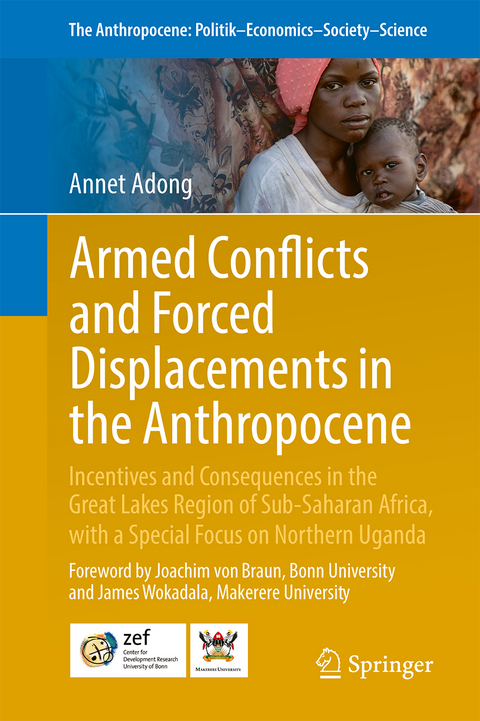
Armed Conflicts and Forced Displacements in the Anthropocene
Springer International Publishing (Verlag)
978-3-032-04819-6 (ISBN)
- Noch nicht erschienen - erscheint am 29.01.2026
- Versandkostenfrei
- Auch auf Rechnung
- Artikel merken
This book focuses on the incentives for armed conflict in the Great Lakes Region of Sub-Saharan Africa and its consequences, including social preferences and refugee integration. The contribution of this book is twofold. First, the book adds to the limited literature on incentives for engaging in armed conflict in Sub-Saharan Africa and the post-conflict recovery trajectory. Secondly, it provides evidence on likely forms of discrimination due to biases from social identity amongst refugees and hosts, which may affect refugee integration.
The book is organized as follows: the first chapter is a general motivation and framing of the studies. The second chapter investigates the incentives and disincentives for engaging in armed conflicts in the Great Lakes Region (GLR). The GLR has a history of armed conflict, with some active armed conflicts in South Sudan and the Democratic Republic of the Congo, which have affected the development of the region. The GLR is also characterized by criss-crossing hostilities, including governments supporting fellow incumbent governments to quell a rebellion or supporting rebel groups hostile to sitting governments. The region provides an excellent case study for understanding the incentives and disincentives for armed conflict, especially in SSA. The third and fourth chapters address a highly policy-relevant issue in the context of refugee-hosting and integration. Humanitarian efforts to manage refugees have emphasized the need for self-reliance and reintegration with the host communities. The chapters examine the potential discrimination and biases that hosting communities may harbor towards refugees and how these attitudes can impact land transactions. Refugees may face discrimination emerging from differences in social identity and characterization within and external to refugee settlements. The behavioral attitudes of hosts may also influence their willingness to engage in land transactions with refugees. Amidst costly, unsustainable approaches to land distribution to refugees by hosting governments, land arrangements that hinge on the hosting communities behavioral attributes, such as trust and altruism, may offer lasting solutions. If fairness or social preferences are profound amongst refugees and hosting communities, land transactions between hosts and refugees might provide an alternative sustainable approach for refugees to acquire land. Ignoring positive behavioral attributes through government provision may crowd out such private provision.
Adds to the literature on incentives for armed conflict
Evidence on trajectory for post- conflict recovery
Dr. Annet Adong is a Development Economist with PhD obtained from the University of Bonn, Germany. Her research interest is at the intersection of agriculture, nutrition, conflicts, and forced displacements. Her PhD research was "Armed Conflicts and Forced Displacements: Incentive and Consequences on Consumption and Social Preferences." Annet also received a post-doctoral research fellowship with IMMANA fellowship, supported by Tuft University. She is a member of several professional networks, including the Evidence in Governance and Politics and the Network for Impact Evaluators in Africa. Annet has published in renowned journals including the Journal of World Development.
Chapter 1.Introduction and Motivations.- Chapter 2.Armed conflicts in the Great Lakes Region attempts to explain them based on different theories, including the role of incentives.- Chapter 3.Conflict exposure and Food Consumption Pathways during and after conflict: Evidence from Uganda.- Chapter 4.Prosocial attitudes between Refugees and Host communities exposed to armed conflict: Experimental evidence from Northern Uganda.- Chapter 5.Informal land arrangements between refugees and host communities in Northern Uganda: Do social preferences matter?.- Chapter 6. General Conclusions and Policy implications.
| Erscheinungsdatum | 29.11.2025 |
|---|---|
| Reihe/Serie | The Anthropocene: Politik—Economics—Society—Science |
| Zusatzinfo | XIII, 170 p. 25 illus. in color. |
| Verlagsort | Cham |
| Sprache | englisch |
| Maße | 155 x 235 mm |
| Themenwelt | Sozialwissenschaften ► Soziologie ► Spezielle Soziologien |
| Schlagworte | armed conflicts • consumption • Great Lake Regions • Land Arrangemnts • Refugees • Uganda, Incentives |
| ISBN-10 | 3-032-04819-2 / 3032048192 |
| ISBN-13 | 978-3-032-04819-6 / 9783032048196 |
| Zustand | Neuware |
| Informationen gemäß Produktsicherheitsverordnung (GPSR) | |
| Haben Sie eine Frage zum Produkt? |
aus dem Bereich