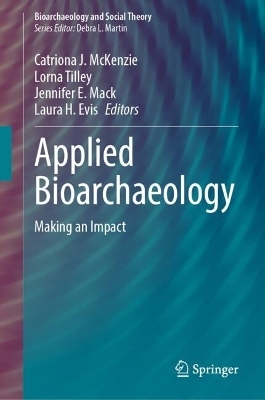
Applied Bioarchaeology
Springer International Publishing (Verlag)
978-3-032-04691-8 (ISBN)
- Noch nicht erschienen - erscheint am 24.01.2026
- Versandkostenfrei
- Auch auf Rechnung
- Artikel merken
This is the first book to address theory and practice in Applied Bioarchaeology a term used to describe bioarchaeological research which addresses matters of relevance today, and which actively engages people in the research process in ways that are respectful and relevant to the studied population, their communities, and their descendants. This book provides examples of best practice; identifies challenges and opportunities for developing the field of Applied Bioarchaeology; and illustrates the role of bioarchaeology in effecting change through advocacy and activism.
The book is divided into four parts. The first part, Using Past Experience to Inform Modern Behaviour and Health , demonstrates how bioarchaeology has the potential to contribute towards better appreciation of the diverse factors that influence behaviour and health, and how this information can shape, inform, and empower future decision-making, from individuals to wider health policies. The second part, Developing Community-Led Research , focuses on developing active community engagement in bioarchaeological research, with chapters arguing for community-led research designed to empower a wide range of peoples that have been marginalized (or even ignored) in traditional archaeological practice. The third part, Bioarchaeology and the Arts , illustrates how Applied Bioarchaeology is enhanced by cross-disciplinary teamwork, and how the arts can be used to create safe spaces to explore difficult issues, to aid us in critically reflecting on our practices, to interrogate gaps in knowledge, and to develop new ideas and ways of thinking, learning, and creating knowledge. The final part, A Way Forward , is a personal reflection written by Lorna Tilley, which argues the case for developing the field of Applied Bioarchaeology and suggests some possible approaches for achieving this goal.
Catriona J. McKenzie is Associate Professor at the University of Exeter, UK. She has been developing the field of Applied Bioarchaeology through projects such as Literary Archaeology: Exploring the Lived Environment of the Slave (AHRC funded), and Care, the Great Human Tradition: A Multidisciplinary Collaborative Exploration of Family Care Across Time and Culture (Wellcome Trust funded). Previous books include the co-edited volume Writing Remains: New Intersections of Archaeology, Literature and Science; the co-authored book Life and Death in Medieval Gaelic Ireland: The Skeletons from Ballyhanna, Co. Donegal; and a co-edited volume The Science of a Lost Medieval Gaelic Cemetery: The Ballyhanna Research Project.
Lorna Tilley is an independent researcher living in Australia. Her research focuses on lived experiences of disability and care in the past, and the methodology she developed is described in Theory and Practice in the Bioarchaeology of Care (the first volume in the Bioarchaeology and Social Theory series). She has since co-edited a volume on advances in the bioarchaeology of care approach New Developments in the Bioarchaeology of Care: Further Case Studies and Extended Theory and two Special Issues in the International Journal of Paleopathology on Mummy Studies and the Bioarchaeology of Care and Disability and Care in Western Europe during Medieval Times:
Chapter 1. Introduction (McKenzie).- Part 1. Using Past Experience to Inform Modern Behaviour and Health.- Chapter 2. Continuing Bonds: Using (Bio)Archaeology for Bereavement, Grief, and Wellbeing (Sutton-Butler et al).- Chapter 3. Bioarchaeology of Care Outreach: How Lessons from the Past May Help Improve the Present (Sáez).- Chapter 4. One Paleopathology: Raising Awareness and Advancing Knowledge (Buikstra et al).- Chapter 5. Using Bioarchaeological Data to Inform Diagnostic Criteria for Acquired Syphilis in Clinical Care and Public Health through Translational Science (Zuckerman et al).- Part 2. Developing Community-Led Research.- Chapter 6. Marching Forward Together: Towards a Decolonized, Collaborative Bioarchaeology in California (Tapia and Arellano).- Chapter 7. The Care Connection: Using Co-Production to Link Archaeology and Unpaid Carers (McKenzie et al).- Chapter 8. Child of A ua u, Returning Home: A Community-Led Repatriation Project to Mangaia, Cook Islands (King et al).- Part 3. Bioarchaeology and the Arts.- Chapter 9. Acting Queerly: Creative Collaboration in Applied Bioarchaeology (Charles and McDaniel). Chapter 10. Interesting Characters Find Graves in the Potter s Field : The Value of Fictive Storytelling in Historical Bioarchaeology (Drew).- Chapter 11. Buried Threads: Weaving Narratives Through Art and Bioarchaeology at the Asylum Hill Cemetery Mack et al).- Part 4. A Way Forward.- Chapter 12. A Personal Reflection: We have come this far but where do we go from here? (Tilley).
| Erscheinungsdatum | 29.11.2025 |
|---|---|
| Reihe/Serie | Bioarchaeology and Social Theory |
| Zusatzinfo | XXVI, 273 p. 48 illus., 34 illus. in color. |
| Verlagsort | Cham |
| Sprache | englisch |
| Maße | 155 x 235 mm |
| Themenwelt | Geisteswissenschaften ► Archäologie |
| Geschichte ► Allgemeine Geschichte ► Altertum / Antike | |
| Sozialwissenschaften ► Soziologie ► Allgemeines / Lexika | |
| Schlagworte | Collaborative bioarchaeology • Decolonization bioarchaeology • Descendant communities bioarchaeology • Disability bioarchaeology • Engagement in bioarchaeology • Ethics bioarchaeology • human skeletal remains • Impairment bioarchaeology • Indigenous bioarchaeology • Social inequality bioarchaeology |
| ISBN-10 | 3-032-04691-2 / 3032046912 |
| ISBN-13 | 978-3-032-04691-8 / 9783032046918 |
| Zustand | Neuware |
| Informationen gemäß Produktsicherheitsverordnung (GPSR) | |
| Haben Sie eine Frage zum Produkt? |
aus dem Bereich