


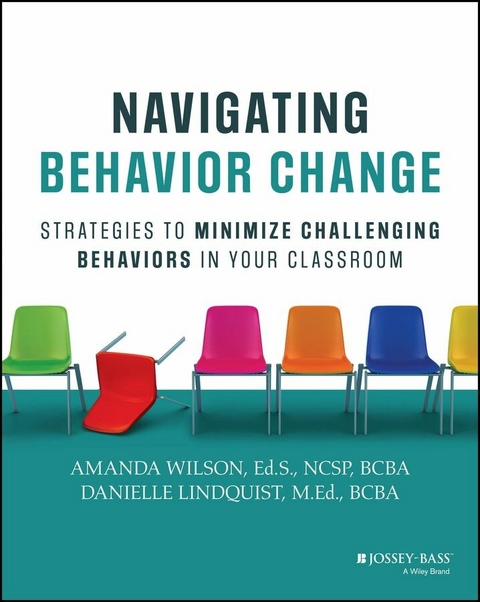
Navigating Behavior Change (eBook)
365 Seiten
Jossey-Bass (Verlag)
978-1-394-28270-8 (ISBN)
A master class in preventing challenging student behavior with confidence
Navigating Behavior Change is a book for all the teachers and school professionals who struggle with the constant cycle of reacting to student behavior. This guide outlines universal practices which should be in place within every classroom to prevent challenging behaviors before they start. When students are focused and ready to learn, educators can do the important work of teaching. In this book, school psychologist Amanda Wilson and special educator Danielle Lindquist help you build your skill set, so you can create an environment where students are regulated and motivated to learn. Inside, you'll find a comprehensive framework of components that you can implement in any K-12 classroom to prevent challenging behaviors and increase student engagement.
- Understand the influence of executive functions, missing skills, and motivation on student behavior
- Learn the core components of classroom management, including class structure and high-leverage instructional practices
- Effectively and meaningfully embed reinforcement to increase student motivation
- Learn how to effectively respond to challenging behaviors to assist students in de-escalating and re-engaging
- Manage your classroom in a trauma-informed way that maintains student dignity
This book will help K-12 teachers, special education teachers, school counselors, and other service providers, instructional coaches, and administrators of students with behavior challenges. Take a proactive approach to behavior and help students so you can spend more time teaching and they can spend more time learning.
Amanda Wilson, Ed.S., NCSP, BCBA, is CEO of Navigating Behavior Change-a professional development company committed to assisting educators in teaching, working with, and improving the lives of students who exhibit challenging behaviors. A nationally certified school psychologist with twenty years' experience in diverse public school settings, Amanda has significant experience assisting school teams in developing and implementing positive behavior intervention frameworks. Visit www.navigatingbehaviorchange.com to learn more.
Danielle Lindquist, M.Ed., BCBA, is a licensed special education teacher and board certified behavior analyst. She has extensive experience teaching students with significant mental health disorders and extreme interfering behavior, as well as coaching staff in providing effective supports.
A master class in preventing challenging student behavior with confidence Navigating Behavior Change is a book for all the teachers and school professionals who struggle with the constant cycle of reacting to student behavior. This guide outlines universal practices which should be in place within every classroom to prevent challenging behaviors before they start. When students are focused and ready to learn, educators can do the important work of teaching. In this book, school psychologist Amanda Wilson and special educator Danielle Lindquist help you build your skill set, so you can create an environment where students are regulated and motivated to learn. Inside, you'll find a comprehensive framework of components that you can implement in any K-12 classroom to prevent challenging behaviors and increase student engagement. Understand the influence of executive functions, missing skills, and motivation on student behavior Learn the core components of classroom management, including class structure and high-leverage instructional practices Effectively and meaningfully embed reinforcement to increase student motivation Learn how to effectively respond to challenging behaviors to assist students in de-escalating and re-engaging Manage your classroom in a trauma-informed way that maintains student dignity This book will help K-12 teachers, special education teachers, school counselors, and other service providers, instructional coaches, and administrators of students with behavior challenges. Take a proactive approach to behavior and help students so you can spend more time teaching and they can spend more time learning.
CHAPTER 1
Foundations of Behavior
What Does Behavior Have to Do with Universal Supports?
Behavior. It's everything that we think, say, or do. We often hear things like, “Ugh, Johnny had another behavior today.” And our internal thought response is “Well, I hope he is engaging in behavior. Otherwise, he's dead.” There's this misconception that behaviors are just the problematic things that students do when, in reality, it's everything that we do … all day, every day.
Another common misconception is thinking of behaviors as only being observable, meaning anyone around the individual can see or hear the behavior occurring. While we do engage in external behaviors that can be seen or heard by others, this does not encompass all forms of behavior. We also engage in internal behaviors like thoughts that can then drive our external, observable behaviors.
Here are two examples of behaviors a student may engage in within the classroom when presented a task that is difficult for them:
They may think “I'm so stupid; I can't do this.”
And they may say “This is dumb!”
And what they may do is swipe their textbook off their desk.
They may think “I hate writing argumentative essays.”
And may say “This is hard, but I can do hard things.”
And what they may do is type the assignment on their Chromebook.
The first example demonstrates behaviors that we may label as negative, disruptive, inappropriate, undesirable, unexpected, or challenging. The second example demonstrates behaviors we may label as positive, appropriate, expected, or desirable. To keep things simple throughout this text, we will be using the term challenging behavior to describe distracting, disruptive, or dangerous behaviors that interfere with the student's learning or the learning of others in some way. We will use the term desirable behavior to describe behavior that meets classroom expectations or is generally considered appropriate for the situation or setting.
Challenging Behavior:
Distracting, disruptive, or dangerous behavior that interferes with the student's learning or the learning of others.
While it is important to discriminate between challenging and desirable behaviors, we'd be remiss if we didn't pause to talk about the difference a bit more to reframe our thinking.
Let's consider the following two statements:
Typically, as educators, when we discuss student behavior, we consider our needs and the behaviors that we want to see less of. These very well may be distracting, disruptive, or dangerous behaviors that interfere with our ability to teach. However, when we focus solely on our needs, this places responsibility on the student to change their behaviors without considering why they are occurring. And this sets ourselves and students up for failure.
If we reframe our thinking to consider what we need to do, what students need to do, and how we can support them in doing so, we are more likely to achieve long‐term positive behavior change. It is important to recognize that for student behavior to change, adult behavior must also change. We are part of the environment. We set the stage for success or failure within the walls of our classroom through our relationships, our structures and routines, the use of effective strategies, and our responses to both desirable and challenging behaviors.
As we move through this text, you will notice that we continually highlight the adult behaviors we must engage in to support our students. We propose that any interventions to create long‐term behavior change be implemented with the goal of increasing a student's skills, their overall functioning, their ability to form and maintain relationships, and/or their independence. This is what behavior analysts refer to as social significance, and ethically, all interventions should consider this. We must look beyond “compliance” with adult instructions and expectations as the singular goal. If we operate under the mindset that they just need to suppress challenging behaviors, do as they are told, and meet expectations, we will not achieve long‐term behavior change.
To understand our and our students' behavior, we need to understand four core truths of behavior:
- Behavior is circumstantial: It does not occur in a vacuum, out of the blue, or without reason. Everything we do is directly influenced by the environment in which the behavior occurs. If we fail to consider the context under which the behavior is occurring, we will fail to effectively support our students. We will also see the challenging behavior continue. For example, if Johnny is an angel in Mr. Smith's class, following all classroom expectations and completing his work, but engages in disruptive behaviors in your class, then the context is different. There is something different within the environment that is setting the stage for the disruptive behavior. It may be that you interact differently with Johnny. Your classroom routines may be different, or your subject requires different skills (academic, social, or behavioral). Or, perhaps, the peer group or instructional format is different.
- Behavior has underlying influences: There are a wide variety of factors that impact individual human behavior. For example, genetic disorders can predispose an individual to engage in certain behavior. Likewise, medical conditions can result in behaviors that increase an individual's sensitivity to environmental stimuli. Medical conditions can also cause pain and discomfort for which a behavior, once engaged in, decreases or eliminates that pain. Traumatic experiences, both acute and chronic, impact an individual's future behavioral responses to events or stimuli within their environment. Being without access to something that is desired, such as food, can influence behaviors that assist the individual in getting what they need. Conversely, having too much of something (having eaten and being full) can decrease engagement in behaviors that result in obtaining food. Finally, we can generally consider factors that influence behaviors as setting events as they increase or decrease the likelihood of certain behaviors occurring when in play. For example, missing daily medication, poor sleep the night before, or feeling unwell may increase the chance of challenging behaviors occurring. Underlying influences are important to consider because when we are aware of them, we can make adjustments to support ourselves and our students more effectively. A note of caution: while it is important to consider and identify underlying influences of challenging behaviors, it is important to move beyond admiring their occurrence. Just because an underlying influence is present doesn't mean we can't implement strategies to lessen their impact.
- Behavior is functional: All behavior serves a purpose or meets a need for the individual engaging in it. This is true even if the behavior seems odd, out‐of‐context, or disproportionate to the situation. This behavior may be the only behavior the student knows how to engage in, in a moment of stress, to meet their needs. We can categorize all behaviors as either helping us to “get” more of the things that we want/like or “get away” from the things that we don't want/like. It's important to note that, sometimes, we do consciously think about what behavior we are going to engage in to meet a particular need in the moment. However, most of the time, we behave “automatically” because in the past certain behaviors have helped us to get or get away from things. This learning history influences our behaviors, as does our skill level, and the overall need for safety and quick outcomes. It's imperative that we consider the function or purpose of a behavior because simply trying to eliminate it without addressing the need it is meeting is unlikely to increase more desirable behaviors.
- Behavior can be changed: What we do or don't do has the potential to influence behavior, leading to an increase or decrease in challenging behaviors over time. To effectively change behavior, we can and should consider the circumstances under which it occurs, the factors that are influencing it, and the purpose or need it is serving. We can implement preventative strategies, including the universal supports outlined in this book, teach and reinforce desirable behaviors, and respond effectively to challenging behaviors to increase student independence, grow engagement, and improve quality of life.
At this point, you may be wondering how behavior, universal supports, and classroom management link to create optimal conditions for learning. More than likely, you are familiar with one or more of the following terms: Positive Behavior Interventions and Supports (PBIS), Response to Intervention (RTI), and Multi‐Tiered Systems of Supports (MTSS). These frameworks share a similarity in that they all include supports and interventions within a three‐tiered approach. The lowest tier (tier 1) is considered the universal support tier, wherein all students receive the same core supports. Statistically, most students (approximately 80%) will be successful with these supports in place and will not require additional supports. However, approximately 15% of a student population may require additional “targeted” tier 2...
| Erscheint lt. Verlag | 28.7.2025 |
|---|---|
| Sprache | englisch |
| Themenwelt | Sozialwissenschaften ► Pädagogik |
| Schlagworte | behavior challenges • Behavior Management • challenging behavior • Classroom management • classroom management book • elementary behavior • high school behavior • K-12 Classroom • k-12 teacher book • middle school behavior • MTSS • Multi-Tiered Systems of Support • Professional development book • Tier 1 intervention |
| ISBN-10 | 1-394-28270-2 / 1394282702 |
| ISBN-13 | 978-1-394-28270-8 / 9781394282708 |
| Informationen gemäß Produktsicherheitsverordnung (GPSR) | |
| Haben Sie eine Frage zum Produkt? |
 EPUB (Adobe DRM)
Kopierschutz: Adobe-DRM
Adobe-DRM ist ein Kopierschutz, der das eBook vor Mißbrauch schützen soll. Dabei wird das eBook bereits beim Download auf Ihre persönliche Adobe-ID autorisiert. Lesen können Sie das eBook dann nur auf den Geräten, welche ebenfalls auf Ihre Adobe-ID registriert sind.
Details zum Adobe-DRM
Dateiformat: EPUB (Electronic Publication)
EPUB ist ein offener Standard für eBooks und eignet sich besonders zur Darstellung von Belletristik und Sachbüchern. Der Fließtext wird dynamisch an die Display- und Schriftgröße angepasst. Auch für mobile Lesegeräte ist EPUB daher gut geeignet.
Systemvoraussetzungen:
PC/Mac: Mit einem PC oder Mac können Sie dieses eBook lesen. Sie benötigen eine
eReader: Dieses eBook kann mit (fast) allen eBook-Readern gelesen werden. Mit dem amazon-Kindle ist es aber nicht kompatibel.
Smartphone/Tablet: Egal ob Apple oder Android, dieses eBook können Sie lesen. Sie benötigen eine
Geräteliste und zusätzliche Hinweise
Buying eBooks from abroad
For tax law reasons we can sell eBooks just within Germany and Switzerland. Regrettably we cannot fulfill eBook-orders from other countries.
aus dem Bereich


