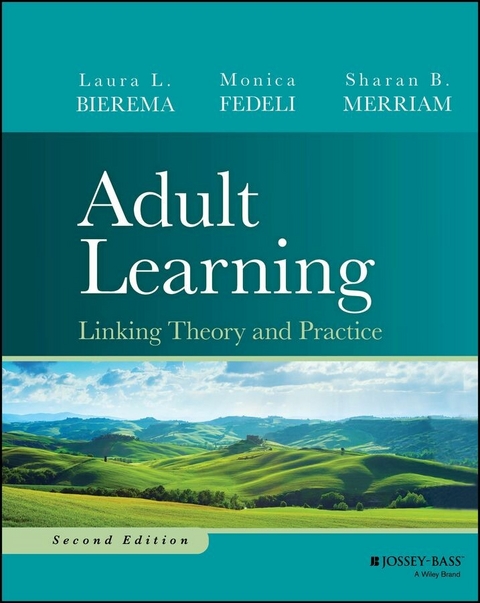
Adult Learning (eBook)
956 Seiten
Jossey-Bass (Verlag)
978-1-394-26533-6 (ISBN)
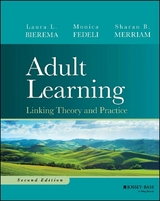
A freshly updated and science-based guide for contemporary adult educators
In the newly revised second edition of Adult Learning: Linking Theory and Practice, a team of veteran adult educators delivers an authoritative guide to adult education that is solidly grounded in theory and research while remaining concise and practice oriented. Each chapter is infused with practical applications for instruction you can implement immediately to improve concrete learning outcomes.
The authors cover a variety of topics, including adult learning in the contemporary world, traditional learning theories, andragogy, motivation and learning, and more.
Readers will also find:
- Explorations of the brain and cognitive functioning as it applies to adult learners
- How to adapt and improve the adult learning experience in the digital age
- Learning and reflection activities integrated throughout each chapter
Perfect for master's-level students and practitioners alike, Adult Learning: Linking Theory and Practice is the up-to-date and practical adult education resource that you've been waiting for.
Laura L. Bierema is a Professor at the University of Georgia, Mary Frances Early College of Education, in the Adult Learning, Leadership, and Organization Development program.
Monica Fedeli is a Professor and Vice-Rector at the University of Padova, and an expert in the international facilitation of adult education and learning. She is the co-editor of Connecting Adult Learning and Knowledge Management.
Sharan B. Merriam is professor emeritus of adult education and qualitative research at the University of Georgia. For five years, she was co-editor of Adult Education Quarterly, the major research and theory journal in adult education.
PREFACE
Introduction to the Book
As an adult, you are constantly learning. You might search the Internet to plan a vacation, hear about a new book you want to read on the radio, ask a co‐worker to explain a new reporting procedure, or sign up for a class to earn a certificate or a degree. Learning infiltrates your daily activities in family, work, and community life. Learning can occur anywhere, anytime, from human resource development programs at work to seminars and workshops sponsored by libraries, museums, religious organizations, hospitals, and other institutions to more formal programs offered by schools, colleges, and universities. Learning is also accessible in multiple formats, such as in‐person, online, or hybrid. The field of adult education—adults engaging in systematic, sustained learning activities to gain new knowledge, skills, attitudes, or values—is dedicated to the diverse and varied ways adults learn throughout their lives. You, the adult learner, are what unites practitioners and scholars of adult education and learning. Adult educators strive to understand their own learning to better design and facilitate meaningful adult learning activities.
Most likely, you are reading this book to discover more about adult learning. However, unlike Malcolm Knowles, who, as Director of Adult Education at the Boston YMCA in the 1940s, lamented his inability to “find a book that would tell me how to conduct a program of this sort” (Knowles, 1984, p. 2), and realized “that although there was general agreement among adult educators that adults are different from youth as learners, there was no comprehensive theory about these differences” (Knowles, 1984, pp. 3–4), this information exists for your benefit as a learner, educator, or both. Today, the literature on adult learning is vibrant and voluminous, serving both practitioner and scholarly audiences. This book will give you a solid foundation of adult learning theory and tangible ways to apply the ideas presented.
Purpose and Audience
The inspiration behind the first edition of Adult Learning: Linking Theory and Practice (Merriam & Bierema, 2014) was based on a survey of adult learning literature in the 2010s, revealing that it primarily focused on a particular aspect of adult learning, such as motivation (Wlodkowski, 2008; Wlodkowski and Ginsberg, 2017), andragogy—the art of teaching adults—and its application to workplace learning and human resource development (Knowles et al., 2011), critical thinking (Brookfield, 2012), experiential learning, (Fenwick, 2003), dialogic education (Vella, 2000), and transformative learning (Taylor & Cranton, 2012). At that time, many other textbooks were highly theoretical (Jarvis, 2006; Illeris, 2004) or theory and research‐intensive (Merriam et al., 2007). What was missing from the literature on adult learning was a book that provides an overview of the major theories and research in adult learning in language that those new to adult education can understand and, at the same time, point out applications of these ideas to practice.
The first edition of Adult Learning: Linking Theory and Practice presented adult learning theory, mindful that you, the reader, are yourself an adult learner. The first edition was also intended for adult learning practitioners who design and facilitate educational programs for adults. As authors, a driving goal of the first edition was to create a reader‐ and practitioner‐friendly book with included activities and resources at the end of each chapter for personal and instructional use. We have improved this aspect of the book significantly in this second edition, as explained later in this preface.
Today, adult learning is of crucial social importance, particularly in a time of globalization, VUCA (volatile, uncertain, complex, and ambiguous) social, environmental, and economic challenges, the rise of artificial intelligence, shifts as a consequence of the COVID‐19 pandemic and Great Resignation, and an aging society. Many of these changes have occurred in the last decade, making revising Adult Learning: Linking Theory and Practice timely.
The intended audiences for this book are students, faculty, and anyone interested in deepening their knowledge of the theory and practice of adult learning. The primary audience for this book is students and faculty in adult education, human resource development, and other programs dedicated to understanding and facilitating effective adult learning in any context. Usually, these academic programs have a core required course in adult learning. Whether these are undergraduate, master's, or doctoral‐level programs, typically, this course is the student's first introduction to adult learning. Another audience for this book is graduate students in professional preparation programs whose work may involve the education and training of adults, such as school administrators, public health personnel, social workers, corporate consultants and trainers, counselors, government administrators, higher education faculty, and administrators. Across the globe, academic programs dedicated to adult learning may have different names, such as Lifelong Learning, Social Education, Adult and Professional Education, Community Education, and others. Still, most have a course on adult learning. Of course, this book is also appropriate for anyone interested in adult learning.
Overview of Book Organization and Features
Adult learning theory emerged in the mid‐20th century and has evolved with the development of theory and practice to understand how adults learn to be contributing family members, workers, and citizens. Several theories, models, and practices have been developed over the decades, making the landscape of adult learning and education theory rich and daunting. Partelow (2023) explained that disciplinary frameworks articulate a set of assumptions, values, concepts, and practices and provide a basis for inquiry, underscoring, “Frameworks are positioned within a theory of science. Understanding this positioning can guide scholars in comprehending how their engagement with frameworks contributes to the overall advancement of their field” (p. 512).
Inspiration for the design of the second edition of Adult Learning: Linking Theory and Practice came from Merriam and Caffarella's (1999) premise that “Learning in adulthood can be distinguished from childhood in terms of the learner, the context, and to some extent the learning process” (p. 389). Their “configuration of context, learner, and process” (p. 399) inspired Bierema's (2008, 2019) framework of the context, educator, learner, process, and method, which was briefly introduced in the first edition of this book (Merriam & Bierema, 2014). According to this framework, the second edition of Adult Learning: Linking Theory and Practice represents a comprehensive exploration of adult learning.
The Framework for Adult Learning summarizes its key components, including the: (1) Adult learning context, (2) Adult educator, (3) Adult learner, (4) Adult learning process, and (5) Methods for adult learning facilitation, essentially considering the where, who, how, and what of adult learning, presented in Figure P.1. The framework melds key issues and ideas in adult learning and education, bridges theory and practice, and provides the organizing structure for the book. The adult learning framework captures the context or where learning occurs and how social dynamics impact individuals, groups, and learning systems. It considers the who, including adult educators, and how their values and approaches affect learning and learners and how best to honor their learning goals, motivations, and challenges. It also tackles the learning process or how learning unfolds in people's heads, hearts, and bodies. Finally, the framework addresses what is required to effectively integrate the context, educator, learner, and process in methods for planning and facilitating meaningful adult educational programs.
FIGURE P.1 FRAMEWORK FOR ADULT LEARNING
FIGURE P.2 CHAPTER FEATURES
The practical focus of Adult Learning: Linking Theory and Practice is its distinguishing feature. Many adult education and learning books are mired in theory with inadequate explanations of the applications. The second edition of Adult Learning: Linking Theory and Practice builds on the strong foundation of the first edition and introduces a new framework and features. As noted, the book is organized according to five adult learning domains introduced as a framework for understanding the field in the first edition. Further, the book has recurring feature boxes embedded in each chapter. Although the first edition incorporated helpful tips for practice and instruction at the end of each chapter, this edition has expanded that feature by integrating these activities throughout the text. The book features integrated boxes to provide chapter overviews, prompts for reflective practice, connections of evidence to practice, and tips and tools for teaching and learning to enhance the learning experience for readers and help them apply their knowledge in good adult education form. Figure P.2 illuminates the new features...
| Erscheint lt. Verlag | 28.7.2025 |
|---|---|
| Sprache | englisch |
| Themenwelt | Sozialwissenschaften ► Pädagogik ► Bildungstheorie |
| Schlagworte | Adult education book • adult education guide • adult education lessons • adult education perspectives • Adult education research • adult education strategies • adult education techniques • adult education theory • adult education tools |
| ISBN-10 | 1-394-26533-6 / 1394265336 |
| ISBN-13 | 978-1-394-26533-6 / 9781394265336 |
| Informationen gemäß Produktsicherheitsverordnung (GPSR) | |
| Haben Sie eine Frage zum Produkt? |
 EPUB (Adobe DRM)
Kopierschutz: Adobe-DRM
Adobe-DRM ist ein Kopierschutz, der das eBook vor Mißbrauch schützen soll. Dabei wird das eBook bereits beim Download auf Ihre persönliche Adobe-ID autorisiert. Lesen können Sie das eBook dann nur auf den Geräten, welche ebenfalls auf Ihre Adobe-ID registriert sind.
Details zum Adobe-DRM
Dateiformat: EPUB (Electronic Publication)
EPUB ist ein offener Standard für eBooks und eignet sich besonders zur Darstellung von Belletristik und Sachbüchern. Der Fließtext wird dynamisch an die Display- und Schriftgröße angepasst. Auch für mobile Lesegeräte ist EPUB daher gut geeignet.
Systemvoraussetzungen:
PC/Mac: Mit einem PC oder Mac können Sie dieses eBook lesen. Sie benötigen eine
eReader: Dieses eBook kann mit (fast) allen eBook-Readern gelesen werden. Mit dem amazon-Kindle ist es aber nicht kompatibel.
Smartphone/Tablet: Egal ob Apple oder Android, dieses eBook können Sie lesen. Sie benötigen eine
Geräteliste und zusätzliche Hinweise
Buying eBooks from abroad
For tax law reasons we can sell eBooks just within Germany and Switzerland. Regrettably we cannot fulfill eBook-orders from other countries.
aus dem Bereich