


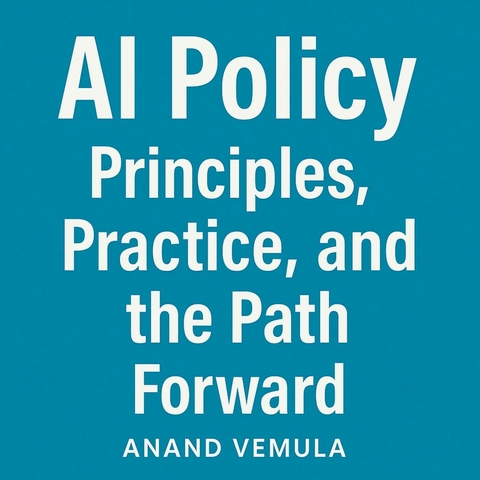
AI Policy Principles, Practice, and the Path Forward (eBook)
150 Seiten
Publishdrive (Verlag)
978-0-00-097245-3 (ISBN)
This comprehensive volume on AI policy provides an in-depth, forward-looking exploration of how artificial intelligence intersects with governance, ethics, law, economy, and society. Structured across four parts and thirty chapters, the book examines both foundational principles and emerging challenges in global AI policymaking.
The first part lays the groundwork, tracing historical technology policies, defining AI within regulatory contexts, and analyzing ethical frameworks and geopolitical approaches. Part II explores core policy themes such as data governance, algorithmic transparency, human rights, bias, accountability, economic disruption, surveillance, national security, and environmental impact. These chapters unpack the tensions between innovation and regulation, and between individual rights and collective risks.
Part III shifts to the tools of governance, distinguishing between soft law (standards, guidelines) and hard law (binding regulations), and addressing mechanisms like policy sandboxes, public procurement levers, and risk differentiation between safety and security. The final part uniquely delves into underexplored topics, including AI in informal economies, the Global South, participatory governance, open-source regulation, and liability insurance.
The concluding chapters anticipate future challenges-global treaty feasibility, long-term foresight, institutional capacity-building, and evaluating policy effectiveness. A strong emphasis is placed on democratizing AI policy, arguing that equitable, inclusive, transparent, and accountable governance must be central to any sustainable AI future.
By offering a holistic yet detailed view, the book equips policymakers, researchers, and civil society actors with the tools to navigate and shape AI governance in a way that serves the public good, respects diversity, and guards against harm across all societies.
Chapter 2: A Historical Overview of Technology Policy
The governance of artificial intelligence (AI) cannot be understood in isolation. It exists within a broader continuum of how societies have historically managed disruptive technologies. Technology policy has always been a reflection of prevailing values, economic priorities, security concerns, and institutional capabilities. This chapter explores the key historical moments, ideological frameworks, and policy instruments that have shaped technological governance over time, with particular attention to how these lessons inform the regulation of AI.
1. Industrial Revolutions and Policy Reactions
The First Industrial Revolution, beginning in the late 18th century, introduced mechanized manufacturing, steam power, and early forms of mass production. Government response was minimal at first, largely focused on enabling industrial expansion through property rights, patent laws, and infrastructure investments. Policy largely followed technological change rather than preceding it.
By the Second Industrial Revolution (late 19th century), which brought electricity, chemical engineering, and the telegraph, governments began to engage in more active forms of regulation. Antitrust policies emerged (notably the Sherman Antitrust Act of 1890 in the U.S.) to counter the concentration of power among monopolies like Standard Oil and American Telephone & Telegraph. This period also saw the rise of regulatory agencies that began to administer complex economic and industrial policy.
The Third Industrial Revolution, marked by the rise of digital computing in the mid-20th century, prompted new governance concerns. With the invention of semiconductors, telecommunications networks, and personal computing, policy began to focus on standards, interoperability, digital privacy, and intellectual property in the software era.
Each wave of industrial advancement exposed regulatory gaps that necessitated government adaptation. However, the pace of legal and institutional response was frequently outstripped by technological momentum, a theme that continues in the AI era.
2. The Cold War and Technonationalism
The mid-20th century also saw the alignment of technology policy with national security agendas. The Cold War drove massive investments in aerospace, computing, and telecommunications by both the United States and the Soviet Union. Governments became primary funders and architects of technological innovation, often bypassing commercial markets entirely.
DARPA (Defense Advanced Research Projects Agency), established in 1958, became a symbol of U.S. state-led innovation, funding the precursors to the internet, early neural networks, and autonomous systems. The Soviet Union’s parallel programs emphasized state control over research institutions and central planning.
This era saw the birth of “technonationalism”—the view that technological superiority was central to geopolitical dominance. Export controls (e.g., COCOM lists), embargoes, and technology transfer restrictions became integral parts of foreign policy. These mechanisms laid the groundwork for today’s tech-related national security debates, including semiconductor bans and AI-related sanctions.
3. The Rise of ICT and Deregulation
The late 20th century ushered in the Information and Communication Technology (ICT) revolution. Personal computers, the internet, mobile phones, and software platforms became commercial products with mass-market appeal. During this time, many governments adopted a deregulatory stance, influenced by neoliberal economic thinking.
The U.S. Telecommunications Act of 1996 exemplified this shift, aiming to increase competition by relaxing restrictions on media and telecommunication companies. In many countries, state-owned telecom monopolies were privatized, and global capital began flowing into tech startups.
Policy emphasis moved from state-led innovation to market-led development. Governments prioritized reducing “barriers to innovation,” often equating minimal regulation with economic dynamism. This shift enabled the rapid growth of firms like Microsoft, Google, Amazon, and Facebook—private entities that now wield quasi-governmental power in digital ecosystems.
However, this deregulatory trend also left major gaps: online harms, digital monopolies, mass surveillance, and misinformation emerged without adequate oversight. These unresolved issues now haunt AI governance, as many of the foundational infrastructures of AI were built during this period with minimal constraint.
4. The Emergence of the Internet and Platform Governance
The global internet introduced new governance dilemmas. From the 1990s through the 2000s, key policy debates emerged around content moderation, domain name systems, internet freedom, and intellectual property.
The U.S. adopted a model of limited liability for platforms (e.g., Section 230 of the Communications Decency Act), while the EU focused on stricter privacy laws and content regulation. International coordination became difficult due to divergent values about speech, surveillance, and sovereignty.
Platform companies became de facto governors of digital public spaces, setting rules about who could speak, what data could be collected, and how information was ranked. This privatization of governance has set a precedent for how AI platforms—especially in large language models and recommender systems—are governed today.
The absence of binding global treaties on internet governance has allowed private norms and proprietary technologies to become de facto standards. Efforts like the Internet Governance Forum (IGF) aimed to provide a multistakeholder space, but lacked enforcement power. These dynamics now reappear in AI forums, where voluntary commitments and guidelines often substitute for hard regulation.
5. Techlash and the Reassertion of Regulation
By the 2010s, a widespread “techlash” emerged—public and political backlash against the unregulated power of tech companies. Data breaches (e.g., Cambridge Analytica), algorithmic bias (e.g., in facial recognition), and platform manipulation (e.g., during elections) undermined the legitimacy of laissez-faire policies.
Governments began to reassert regulatory authority. The EU led with the General Data Protection Regulation (GDPR) in 2018, which redefined data privacy and gave citizens new rights. The U.S., while slower at the federal level, saw state-level laws (e.g., California Consumer Privacy Act) and congressional inquiries into platform practices.
This period marked a turning point, with policymakers acknowledging that digital technologies—including AI—were not neutral tools but socio-technical systems with real-world impacts. Regulatory frameworks began shifting from post-facto remedies to preemptive oversight, laying the groundwork for AI-specific policies.
6. Precedents from Biotech, Nuclear, and Aviation Policy
AI governance does not have to start from scratch. Valuable precedents exist in other domains of high-risk technology governance:
- Biotechnology and Genomics: The regulation of genetically modified organisms (GMOs), gene editing, and bioethics panels offers lessons in precautionary regulation and international coordination (e.g., the Cartagena Protocol on Biosafety).
- Nuclear Energy: The International Atomic Energy Agency (IAEA) provides a model of centralized oversight, monitoring, and inspection regimes for dual-use technologies.
- Aviation Safety: The International Civil Aviation Organization (ICAO) demonstrates the importance of global standards, mandatory reporting, and interoperable technical norms.
These domains underscore the importance of institutional infrastructure, independent oversight, and multilateral treaties—elements currently lacking in the AI space.
7. The Policy Life Cycle and Technology
Technology policy often follows a lifecycle: emergence, growth, regulation, and institutionalization. In early stages, technologies are poorly understood and often seen as niche or speculative. Policy attention is minimal. As adoption spreads, externalities become visible (e.g., inequality, environmental impact, concentration of power), prompting public concern and political engagement.
Regulation typically lags behind due to uncertainty, lobbying, and bureaucratic inertia. Once policy catches up, norms are codified, institutions are established, and enforcement mechanisms emerge. Eventually, regulation becomes part of the standard operating environment, as seen with aviation safety or pharmaceuticals.
AI is currently in a transitional phase—between rapid growth and policy response. Some countries have moved to formalize AI regulation, but most are still debating principles, definitions, and jurisdictional boundaries. Recognizing this cycle is key to designing responsive but anticipatory policies.
8. Path Dependency and Institutional Inertia
One of the most persistent features of technology policy is path dependency—the idea that early decisions shape long-term trajectories, often irreversibly. Policies enacted at the birth of a new industry become entrenched through investments, legal precedent, and institutional routines.
For instance, the early decision to treat internet platforms as neutral conduits (rather than publishers) led to decades of limited liability. In AI, early acceptance of proprietary data and closed-source models may similarly limit future efforts toward transparency and openness.
Institutional inertia also affects how quickly policy can adapt. Regulatory agencies may lack technical expertise, legislative...
| Erscheint lt. Verlag | 1.6.2025 |
|---|---|
| Sprache | englisch |
| Themenwelt | Sozialwissenschaften ► Pädagogik |
| ISBN-10 | 0-00-097245-2 / 0000972452 |
| ISBN-13 | 978-0-00-097245-3 / 9780000972453 |
| Informationen gemäß Produktsicherheitsverordnung (GPSR) | |
| Haben Sie eine Frage zum Produkt? |
 EPUB (Adobe DRM)
Größe: 4,6 MB
Kopierschutz: Adobe-DRM
Adobe-DRM ist ein Kopierschutz, der das eBook vor Mißbrauch schützen soll. Dabei wird das eBook bereits beim Download auf Ihre persönliche Adobe-ID autorisiert. Lesen können Sie das eBook dann nur auf den Geräten, welche ebenfalls auf Ihre Adobe-ID registriert sind.
Details zum Adobe-DRM
Dateiformat: EPUB (Electronic Publication)
EPUB ist ein offener Standard für eBooks und eignet sich besonders zur Darstellung von Belletristik und Sachbüchern. Der Fließtext wird dynamisch an die Display- und Schriftgröße angepasst. Auch für mobile Lesegeräte ist EPUB daher gut geeignet.
Systemvoraussetzungen:
PC/Mac: Mit einem PC oder Mac können Sie dieses eBook lesen. Sie benötigen eine
eReader: Dieses eBook kann mit (fast) allen eBook-Readern gelesen werden. Mit dem amazon-Kindle ist es aber nicht kompatibel.
Smartphone/Tablet: Egal ob Apple oder Android, dieses eBook können Sie lesen. Sie benötigen eine
Geräteliste und zusätzliche Hinweise
Buying eBooks from abroad
For tax law reasons we can sell eBooks just within Germany and Switzerland. Regrettably we cannot fulfill eBook-orders from other countries.
aus dem Bereich


