


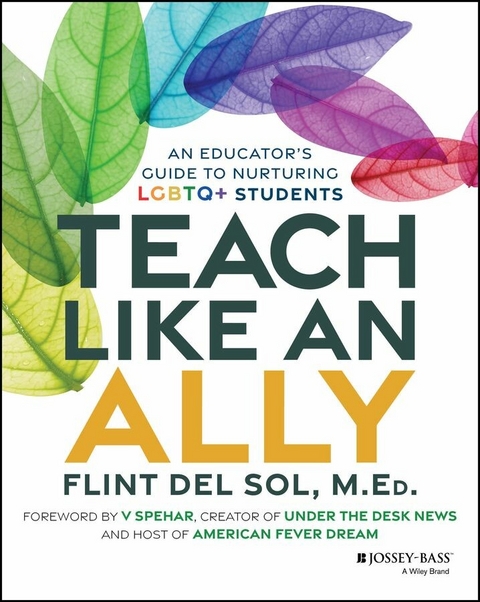
Teach Like an Ally (eBook)
292 Seiten
Jossey-Bass (Verlag)
978-1-394-29158-8 (ISBN)
Answers to all your burning questions and practical advice for helping LGBTQ+ students thrive
In Teach Like an Ally: An Educator's Guide to Nurturing LGBTQ+ Students, veteran classroom teacher and celebrated transgender advocate Flint Del Sol weaves humor, storytelling, and expertise into a hands-on guide for educator-allies. Del Sol offers actionable strategies that you can implement in classrooms right away. He also tackles the complex questions teachers face: What should you do when a student asks for one name in the classroom, but another at home? Or when you're sure a student is trans, but they haven't said anything to you? How do you know your bathroom pass policy isn't hurting your most vulnerable students? What do you do when your values are at odds with school policy?
Building a positive school climate doesn't have to be intimidating. In Teach Like an Ally, you'll learn how educators can support each other and how we can all give LGBTQ+ students the best possible chance to flourish.
- Get candid answers to difficult questions about LGBTQ+ students in the classroom
- Become a stronger ally by understanding what LGBTQ+ students go through in secondary school settings
- Learn the research-backed practices you can implement to make your classroom a safe space for all
- Support all students in developing compassion and understanding for one another
This pragmatic book is for teachers, administrators, families, and anyone committed to the wellbeing of LGBTQ+ students in secondary classrooms.
Rising to prominence as a thought leader and noted online presence after documenting his experiences transitioning as a public school teacher in conservative Southern California, FLINT DEL SOL has lent his voice for the edification of thousands in the world of queer advocacy, allyship, and social emotional pedagogy. With messaging that reaches across regions and political parties, he is an activist for connection, empathy, and nuance in a world that primarily rewards the rhetoric of division.
Answers to all your burning questions and practical advice for helping LGBTQ+ students thrive In Teach Like an Ally: An Educator's Guide to Nurturing LGBTQ+ Students, veteran classroom teacher and celebrated transgender advocate Flint Del Sol weaves humor, storytelling, and expertise into a hands-on guide for educator-allies. Del Sol offers actionable strategies that you can implement in classrooms right away. He also tackles the complex questions teachers face: What should you do when a student asks for one name in the classroom, but another at home? Or when you're sure a student is trans, but they haven't said anything to you? How do you know your bathroom pass policy isn't hurting your most vulnerable students? What do you do when your values are at odds with school policy? Building a positive school climate doesn't have to be intimidating. In Teach Like an Ally, you'll learn how educators can support each other and how we can all give LGBTQ+ students the best possible chance to flourish. Get candid answers to difficult questions about LGBTQ+ students in the classroom Become a stronger ally by understanding what LGBTQ+ students go through in secondary school settings Learn the research-backed practices you can implement to make your classroom a safe space for all Support all students in developing compassion and understanding for one another This pragmatic book is for teachers, administrators, families, and anyone committed to the wellbeing of LGBTQ+ students in secondary classrooms.
Notes from the Queer Teacher Survival Guide
Welcome to the Queer Teacher Survival Guide!
Reading this book as a queer teacher is going to hit different, so in every chapter (sometimes more than once), you will see a little box like this that will offer a perspective acknowledging that. Not every queer experience in a school is the same, but we are connected by a largely universal feeling of isolation and frequent tokenization. We are rarely seen in discussions about campus climate, and our lives and identities are often discussed as if we aren't in the room. We're invited to sit on panels, called on to supervise GSAs,i and asked to access our experiences to help our cisgender and straight colleagues and community learn and grow, but we are also held to an impossible standard: live authentically as an example for the students who look up to us, but don't talk openly about our lives. Be proud of our differences, but don't look or talk or act differently. We watch our colleagues down through kindergarten stage engagement announcements and gender reveals in the classroom, but we're asked to keep photos of our families off our desks and remove rainbow stickers from our laptops. We haven't lived every queer identity that we see reflected in our students, and so we are still allies, but our role in this work is very different. It's deeply personal for us. So, as you read, remember to take moments to find compassion and space for yourself – you are waking up every day and showing up as the adult you needed to see. That's enough.
And if you aren't part of this community, these boxed sections are still for you. As you navigate this book, take the time to consider the weight your queer colleagues are carrying with them. Even if you see your campus as a safe and equitable space for students, how does that carry through (or not) to the staff? What space is being made for them? It is very likely that there are adults on your campus – supervisors, nurses, counselors, custodians, teachers, administrators, nutrition staff, paraeducators – “out” or not, who are having a much different experience than you realize. Remember them too.
LGBTQ+ 101: Terminology Guide
How to Use This Guide
Nothing stresses out allies quite like queer terminology.
There's a pervasive fear that using the wrong word for someone's identity or experience is akin to throwing us from a moving train into an active forest fire, but honestly, it doesn't have to be that serious. The reason why language is such a pain point for all of us (that is, for both the LGBTQ+ community and our allies) is that it's the most likely and visible interaction that we will experience between our values. For a trans person like me, I don't have to find out how strangers feel about my community until they have a reason to talk about us, and the words they use will give me a quick assessment of how much knowledge and experience they're bringing to the table. For allies, searching for the “right” word can feel impossible without a glossary of terms queued up and ready to go, and the chances of failure keep climbing higher and higher the longer that glossary becomes.
But language isn't a trap; it's the structure for how we think about and relate to our own experiences and the experiences of other people, and being “right” 100% of the time is much less important than being curious and kind. The terms the LGBTQ+ community uses to talk about ourselves are constantly changing, because we keep learning more and more about the specifics and intricacies of our wholly unique lives. Yes, it was easier to learn how to talk about us when the only other option was “gay,” but just like a houseplant stuck in too small a pot, we were only able to grow to the edge of our constructed limits. As language evolves, so do we. It's a unique kind of blessing to get to be here to see it happen.
It's important also to remember that queer identity is more of a union than a country club. Because so many of us have lived in isolation and resentment as part of the “out” group within the general population, we have this internal pull to want to control the boundaries of who can get in with us when we're finally on the “inside.” For these definitions, I tend to err on the side of inclusivity, with a huge asterisk over the whole thing that says “These definitions are a starting point to learn how we talk about ourselves right now, but change is nature, the world continues to grow and shift, and I reserve the right to be completely wrong later.”
So how should you approach these terms in the meantime?
Consider that all of us are very much like cats and that a term or a label is an inviting cardboard box. Cats often choose to put themselves into boxes but don't usually like being stuck inside them against their will, even when it seems like they will fit. It's always best to ask someone what words they like to use for themselves and to trust them when they tell you, even if it goes against your current understanding. We're the experts in ourselves, and we all deserve the chance to figure it out in our own time.
AFAB/AMAB (pronounced “ayy‐fab”/“ayy‐mab”)
Acronyms for “assigned female at birth” and “assigned male at birth.” These are terms often used in transgender circles to discuss our unique experiences related to the gender we were assigned at birth but aren't generally common or preferred when we hear from allies.
“She says she wants to be more inclusive to trans people in her study, but she's still only talking to AFABs, which isn't ideal or inclusive.”
Ally
Can be used as a noun or a verb, for both a person who prioritizes and advocates on behalf of a marginalized community, and the action of following through on that advocacy in the world. Allyship isn't a badge you earn once, never to be looked at again, but a consistent attitude that asks us to examine and re‐examine how we show up for each other.
“I want to be an ally for the LGBTQ+ community, so I bought five copies of this book the day it hit the shelves.”
Asexual/Aromantic
Identities rooted in the lack of sexual or romantic attraction (or both), commonly shortened to “ace.”
“Why is there an asexual flag on the Pride parade float? Because ace people are queer too!”
Bisexual
A sexual identity where an individual has the capacity to be attracted to more than one gender. There's a common misconception that “bi” must mean two, as in “only attracted to men and women,” but historically “bi” has meant attraction to both “same” and “other” genders.
“My roommate has only ever been with one partner, but she is still very much bisexual.”
Deadname
The name a transgender person was given at birth but no longer uses in their own life. It can also be used as a verb, as in “deadnaming,” or the action of using a trans person's former name. It is generally considered to be not only rude, but often dangerous, to ask for or use a trans person's deadname.
“I updated my name on my driver's license three years ago, but my deadname still shows up on my phone bill no matter what I do.”
Gay
A common catchall sexual identity for someone who is attracted to people of their same gender. Over time, this term has become more flexible and inclusive and does not just refer to gay men or people who are solely same‐sex attracted.
“When I'm talking to someone new, I want to explain that I am a genderqueer pansexual, but for the sake of simplicity I usually just say I'm gay.”
Gender
Separate from sex, which is determined often by biological factors such as chromosomes, hormones, and reproductive anatomy, gender is constructed socially. All people have a gender identity, which we represent in our behaviors, activities, and how we relate to one another.
“He told me that I can't like that show, paint my nails, or wear these clothes because I'm a boy, but I get to decide how to express and live in my gender.”
Gender/Sex Assigned at Birth
Though sex and gender are different, most of us are assigned a gender (as well as a sex) at birth. Most Western medical protocols ask for healthcare professionals to determine a baby's gender and mark it on their birth certificate, though more states in the United States are beginning to offer “X” as an option to decline this process, instead of just “M” or “F.”
“They were born intersex, but the doctor still recorded their gender assigned at birth as female.”
Gender Creative
Describes someone who is questioning and/or “playing fast and loose” with the societally imposed boundaries of gender, though they may not identify as explicitly transgender. It is most used when talking about children who show an early interest in living outside of gendered expectations.
“Gender creative kids are going to save the world. My neighbor's kid just shrugged and went back to...
| Erscheint lt. Verlag | 21.7.2025 |
|---|---|
| Vorwort | V. Spehar |
| Sprache | englisch |
| Themenwelt | Sozialwissenschaften ► Pädagogik |
| Schlagworte | high school teacher ally • lgbtq ally book • lgbtq classroom • LGBTQ Students • Lgbtq teacher • lgbtq teens • safe classroom • secondary teacher ally • teaching trans students • trans ally book • trans high school students • trans students • trans teens |
| ISBN-10 | 1-394-29158-2 / 1394291582 |
| ISBN-13 | 978-1-394-29158-8 / 9781394291588 |
| Informationen gemäß Produktsicherheitsverordnung (GPSR) | |
| Haben Sie eine Frage zum Produkt? |
 EPUB (Adobe DRM)
Kopierschutz: Adobe-DRM
Adobe-DRM ist ein Kopierschutz, der das eBook vor Mißbrauch schützen soll. Dabei wird das eBook bereits beim Download auf Ihre persönliche Adobe-ID autorisiert. Lesen können Sie das eBook dann nur auf den Geräten, welche ebenfalls auf Ihre Adobe-ID registriert sind.
Details zum Adobe-DRM
Dateiformat: EPUB (Electronic Publication)
EPUB ist ein offener Standard für eBooks und eignet sich besonders zur Darstellung von Belletristik und Sachbüchern. Der Fließtext wird dynamisch an die Display- und Schriftgröße angepasst. Auch für mobile Lesegeräte ist EPUB daher gut geeignet.
Systemvoraussetzungen:
PC/Mac: Mit einem PC oder Mac können Sie dieses eBook lesen. Sie benötigen eine
eReader: Dieses eBook kann mit (fast) allen eBook-Readern gelesen werden. Mit dem amazon-Kindle ist es aber nicht kompatibel.
Smartphone/Tablet: Egal ob Apple oder Android, dieses eBook können Sie lesen. Sie benötigen eine
Geräteliste und zusätzliche Hinweise
Buying eBooks from abroad
For tax law reasons we can sell eBooks just within Germany and Switzerland. Regrettably we cannot fulfill eBook-orders from other countries.
aus dem Bereich


