


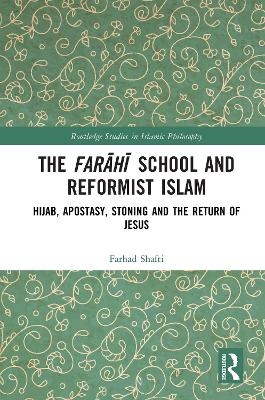
The Farahi School and Reformist Islam
Hijab, Apostasy, Stoning and the Return of Jesus
Seiten
2026
Routledge (Verlag)
9781032813509 (ISBN)
Routledge (Verlag)
9781032813509 (ISBN)
- Noch nicht erschienen (ca. Februar 2026)
- Versandkostenfrei
- Auch auf Rechnung
- Artikel merken
Examining the emergence and development of the Farāhī school of thought and its methodology, this book explores the four case studies of stoning, apostasy, hijab, and the return of Jesus.
It demonstrates the reforming Farāhī approach and divergence from traditional Islamic thought, tracing Farāhī scholarship through the years, from Hamiduddin Farahi to Amin Ahsan Islahi and Javed Ahmad Ghamidi. Through the case studies the author analyses Farāhī approach to the Qur’an, the Sunnah, and religion. For each case study, he looks at contested areas and critically reviews traditional approaches, evaluating various sources, including the Qur’an, Tafsīrs from both Sunni and Shia scholars, Ḥadīths, and where applies Fiqh, before moving on to discussing the Farāhī approach, including interviews with Javed Ahmad Ghamidi, the present academic leader of the approach. Each case study ends with comparative analysis, leading to extracting the methodological features of the Farāhī school of thought at the end of the book. The book closes with a critical discussion of the methodology of the Farāhī school of thought and a summary.
The Farahi School and Reformist Islam is the first academic work to go beyond the Farāhī school’s theory of Qur’anic coherence, aiming to derive its methodological features through original analysis and a case study approach. It will appeal to advanced students and scholars of Islam, particularly those interested in Qur’anic exegesis and Islamic jurisprudence. It will be invaluable for those exploring new or reformist methodologies in deriving rules and concepts from the text, especially the approach of the Farāhī school of thought. It will also be of considerable interest to general readers seeking insight into the background and evolving perspectives on any of the case study subjects addressed in the book.
It demonstrates the reforming Farāhī approach and divergence from traditional Islamic thought, tracing Farāhī scholarship through the years, from Hamiduddin Farahi to Amin Ahsan Islahi and Javed Ahmad Ghamidi. Through the case studies the author analyses Farāhī approach to the Qur’an, the Sunnah, and religion. For each case study, he looks at contested areas and critically reviews traditional approaches, evaluating various sources, including the Qur’an, Tafsīrs from both Sunni and Shia scholars, Ḥadīths, and where applies Fiqh, before moving on to discussing the Farāhī approach, including interviews with Javed Ahmad Ghamidi, the present academic leader of the approach. Each case study ends with comparative analysis, leading to extracting the methodological features of the Farāhī school of thought at the end of the book. The book closes with a critical discussion of the methodology of the Farāhī school of thought and a summary.
The Farahi School and Reformist Islam is the first academic work to go beyond the Farāhī school’s theory of Qur’anic coherence, aiming to derive its methodological features through original analysis and a case study approach. It will appeal to advanced students and scholars of Islam, particularly those interested in Qur’anic exegesis and Islamic jurisprudence. It will be invaluable for those exploring new or reformist methodologies in deriving rules and concepts from the text, especially the approach of the Farāhī school of thought. It will also be of considerable interest to general readers seeking insight into the background and evolving perspectives on any of the case study subjects addressed in the book.
Farhad Shafti is Senior Lecturer at the Adam Smith Business School at the University of Glasgow, UK, and the founder of Exploring Islam website.
Preface
1. Introduction
2. Emergence of a School of Thought
3. The Case Study of Stoning
4. The Case Study of Apostasy
5. The Case Study of Hijab
6. The Case Study of the Return of Jesus
7. The Methodological Features of the Farāhī School of Thought
8. Conclusion
Glossary
| Erscheint lt. Verlag | 13.2.2026 |
|---|---|
| Reihe/Serie | Routledge Studies in Islamic Philosophy |
| Zusatzinfo | 1 Tables, black and white; 1 Line drawings, black and white; 3 Halftones, black and white; 4 Illustrations, black and white |
| Verlagsort | London |
| Sprache | englisch |
| Maße | 156 x 234 mm |
| Gewicht | 453 g |
| Themenwelt | Geisteswissenschaften ► Religion / Theologie ► Islam |
| Sozialwissenschaften ► Soziologie ► Spezielle Soziologien | |
| ISBN-13 | 9781032813509 / 9781032813509 |
| Zustand | Neuware |
| Informationen gemäß Produktsicherheitsverordnung (GPSR) | |
| Haben Sie eine Frage zum Produkt? |
Mehr entdecken
aus dem Bereich

aus dem Bereich


