


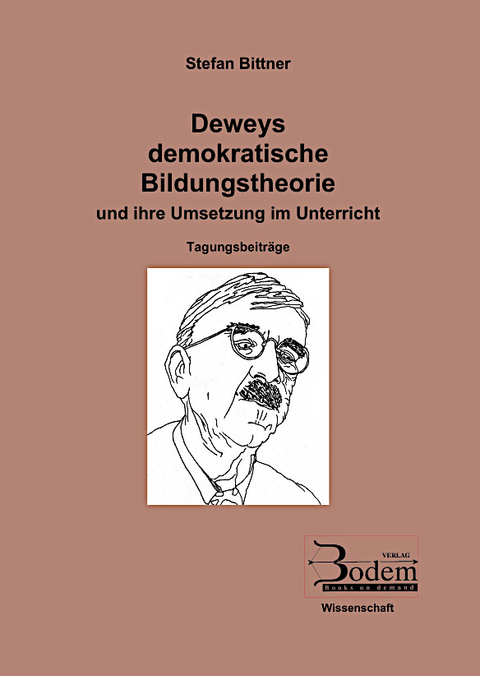
Deweys demokratische Bildungstheorie und ihre Umsetzung im Unterricht
Tagungsbeiträge
Seiten
Deweys Pädagogik enthält eine nicht systematisierte Bildungstheorie mitsamt Erziehungs- und Unterrichtstheorie: Kinder sind zuerst anhand von Produktionstechniken manuell-haptisch zu erziehen. Dabei erlernen sie den korrekten Umgang mit Werkzeugen und Materialien, aber auch Haltungen wie Geduld, Sorgfalt und innere Disziplin (self-direction). Die frühen Erlebnisse sind dann über Kenntnisse in individuelle Erfahrungen umzuwandeln (reconstruction of experience). Dies geschieht in üblichen Schulfächern, aber auch in Themenbreichen wie Kulturentwicklung, Naturerklärung oder Steuer- und Bankrechnung. Alle Methoden sind erlaubt, sofern sie die gewünschte Rekonstruktion evozieren und ein vorausschauendes (projizierendes) Denken trainieren. Oberstes Bildungsziel ist die Kompetenz, sich selbst sinnvoll in die gesellschaftliche Realität einzufügen. Dies ist demokratisch, weil nur eine ausgewogene Allgemeinbildung ideologische Polarisierungen verhindert. Rückblickend kam dieses Konzept in Deutschland nicht zum tragen.
Dewey's pedagogy contains a non-systematized theory of formal education, including a theory of upbringing and instruction: Children are to be educated first, manually and haptically, using production techniques. In doing so, they learn the correct use of tools and materials, as well as habits such as patience, diligence, and inner discipline. These early experiences are then to be transformed into individual experiences through knowledge. This occurs in common school subjects, but also in subject areas such as cultural development, the explanation of nature, or tax and banking calculations. All methods are permissible, provided they elicit the desired reconstruction and train forward-looking (projective) thinking. The primary educational goal is the ability to meaningfully integrate oneself into social reality. This is democratic because only a balanced general education prevents ideological polarization. Retrospectively, it is clear that this concept in particular has not yet been applied in Germany.
Dewey's pedagogy contains a non-systematized theory of formal education, including a theory of upbringing and instruction: Children are to be educated first, manually and haptically, using production techniques. In doing so, they learn the correct use of tools and materials, as well as habits such as patience, diligence, and inner discipline. These early experiences are then to be transformed into individual experiences through knowledge. This occurs in common school subjects, but also in subject areas such as cultural development, the explanation of nature, or tax and banking calculations. All methods are permissible, provided they elicit the desired reconstruction and train forward-looking (projective) thinking. The primary educational goal is the ability to meaningfully integrate oneself into social reality. This is democratic because only a balanced general education prevents ideological polarization. Retrospectively, it is clear that this concept in particular has not yet been applied in Germany.
Stefan Bittner ist examinierter Lehrer (Gy/Ge für die Fächer Geschichte, Philosophie, Pädagogik und Kunst), promovierter Althistoriker (LMU München) und habilitierter Erziehungswissenschaftler. Er war lange an verschiedenen Schulen tätig und wirkte an den Universitäten Köln, Berlin (HUB), Dresden, Dortmund, Braunschweig und Bayreuth. Neben vielen Einzelbeiträgen verfasste er Monographien über Cicero, Platons Naturphilosophie, Atlantis, Bildungsgeschichte, John Dewey, den Lern- und Unterrichtsdialog sowie Rhetorik.
| Erscheinungsdatum | 20.07.2025 |
|---|---|
| Zusatzinfo | dreidimensionale Diagramme statistisch ermittelter Mengen |
| Verlagsort | Frechen |
| Sprache | englisch; deutsch |
| Maße | 145 x 220 mm |
| Gewicht | 349 g |
| Themenwelt | Geschichte ► Teilgebiete der Geschichte ► Kulturgeschichte |
| Sozialwissenschaften | |
| Schlagworte | Bildungsgeschichte • Deweys Bildungstheorie • Deweys Unterricht • John Dewey • Laborschule • Projektunterricht |
| ISBN-10 | 3-934215-23-8 / 3934215238 |
| ISBN-13 | 978-3-934215-23-8 / 9783934215238 |
| Zustand | Neuware |
| Informationen gemäß Produktsicherheitsverordnung (GPSR) | |
| Haben Sie eine Frage zum Produkt? |
Mehr entdecken
aus dem Bereich
aus dem Bereich
Die Revolution des Gemeinen Mannes
Buch | Softcover (2024)
C.H.Beck (Verlag)
CHF 16,80
Eine Geschichte des Geschmacks
Buch | Hardcover (2025)
C.H.Beck (Verlag)
CHF 49,95
vom Mittelalter bis zur Gegenwart
Buch | Softcover (2024)
C.H.Beck (Verlag)
CHF 16,80


