


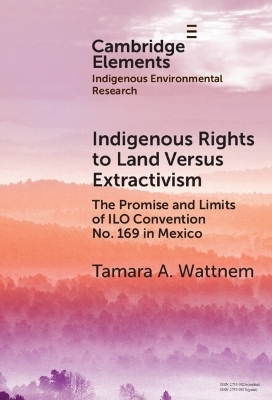
Indigenous Rights to Land Versus Extractivism
The Promise and Limits of ILO Convention No. 169 in Mexico
Seiten
2025
Cambridge University Press (Verlag)
978-1-009-59054-9 (ISBN)
Cambridge University Press (Verlag)
978-1-009-59054-9 (ISBN)
Indigenous and tribal communities often make claims to territory citing their longstanding ties to the land. Since 1989, they increasingly reference ILO Convention No. 169. This Element proposes a three-pronged analytical framework to assess the promise and limits of indigenous rights to land as influenced by international law.
Indigenous and tribal communities often make claims to territory citing their longstanding ties to the land. Since 1989, they increasingly reference ILO Convention No. 169, the only legally binding international agreement on Indigenous and tribal peoples rights. This Element proposes a three-pronged analytical framework to assess the promise and limits of indigenous rights to land as influenced by international law. The framework calls for the place-specific investigation of the interrelations between: (1) indigenous identity politics, (2) citizenship regimes, and (3) land tenure regimes. Drawing on the case of Mexico, it argues that the ILO Convention has generally been a weak tool for securing rights to ancestral land and for effectively challenging the expansion of extractivism. Still, it has had numerous other significant socio-political implications, such as shaping discourses of resistance and incentivizing the use of prior consultation mechanisms in the context of territorial disputes.
Indigenous and tribal communities often make claims to territory citing their longstanding ties to the land. Since 1989, they increasingly reference ILO Convention No. 169, the only legally binding international agreement on Indigenous and tribal peoples rights. This Element proposes a three-pronged analytical framework to assess the promise and limits of indigenous rights to land as influenced by international law. The framework calls for the place-specific investigation of the interrelations between: (1) indigenous identity politics, (2) citizenship regimes, and (3) land tenure regimes. Drawing on the case of Mexico, it argues that the ILO Convention has generally been a weak tool for securing rights to ancestral land and for effectively challenging the expansion of extractivism. Still, it has had numerous other significant socio-political implications, such as shaping discourses of resistance and incentivizing the use of prior consultation mechanisms in the context of territorial disputes.
1. Introduction; 2. Historical overview and theoretical framework; 3. The right to land and territory in theory per ILO convention no. 169; 4. ILO convention no. 169 in practice in Mexico; 5. Conclusion: the promise and limits of ILO convention 169 in land disputes; Works cited.
| Erscheinungsdatum | 25.11.2025 |
|---|---|
| Reihe/Serie | Elements in Indigenous Environmental Research |
| Zusatzinfo | Worked examples or Exercises |
| Verlagsort | Cambridge |
| Sprache | englisch |
| Gewicht | 258 g |
| Themenwelt | Sozialwissenschaften ► Ethnologie |
| Sozialwissenschaften ► Politik / Verwaltung ► Staat / Verwaltung | |
| Sozialwissenschaften ► Soziologie ► Spezielle Soziologien | |
| ISBN-10 | 1-009-59054-5 / 1009590545 |
| ISBN-13 | 978-1-009-59054-9 / 9781009590549 |
| Zustand | Neuware |
| Informationen gemäß Produktsicherheitsverordnung (GPSR) | |
| Haben Sie eine Frage zum Produkt? |
Mehr entdecken
aus dem Bereich
aus dem Bereich
Organisationen steuern, Strukturen schaffen, Prozesse gestalten
Buch | Softcover (2024)
Rehm Verlag
CHF 53,20
über 1000 Stichworte mit Fundstellenhinweisen
Buch (2025)
NWB Verlag
CHF 36,90


