


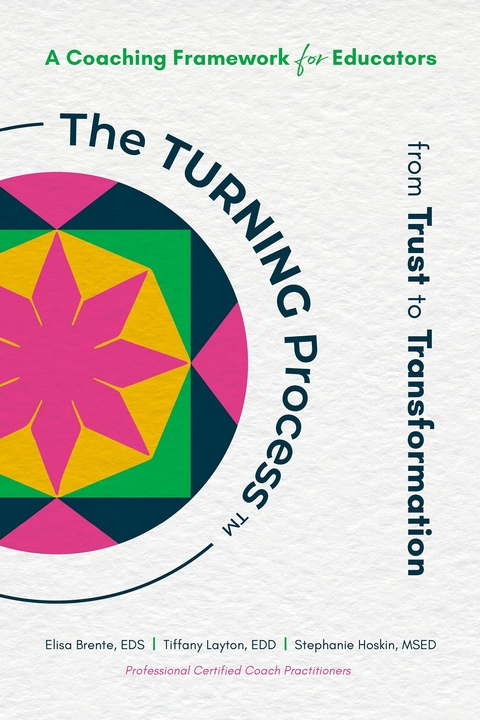
TURNING Process(TM): From Trust to Transformation (eBook)
148 Seiten
Bookbaby (Verlag)
979-8-3178-0799-3 (ISBN)
Dr. Tiffany Layton, PCC, is an accomplished educator and certified leadership coach with extensive experience in transforming high-needs K-12 schools across the U.S. and abroad. Her career spans a wide range of roles-including teacher, reading specialist, instructional coach, principal, curriculum director, and professional development specialist-each grounded in her deep commitment to student success and sustainable school improvement. Tiffany holds a bachelor's degree in early childhood education from Northeastern Oklahoma State University, a master's degree in educational leadership from Pittsburg State University, and a doctorate in learning and organizational change from Baylor University. She is also a Professional Certified Coach through the International Coaching Federation. Recognized for her expertise in evidence-based coaching and personalized professional learning, Tiffany is known for building strong relationships, leading through change, and cultivating positive school cultures. Her published research highlights the transformative impact of coaching in education and reflects her mission to empower all learners-students and educators alike. Beyond her professional life, Tiffany enjoys spending time with her husband and their three children on their working cattle ranch in northeastern Oklahoma. Her personal passions include horses, rodeoing, reading, animals, and traveling.
The TURNING Process(TM): From Trust to Transformation presents a powerful and practical framework for anyone dedicated to fostering significant professional growth in education. Authored by the trio of lifelong educators behind Kaleidoscope Coaching, this book is born from their personal quest to move beyond superficial support and achieve a profound, lasting impact in schools. They recognized a crucial difference between simply advising or mentoring and truly empowering individuals to unlock their full potential. At the heart of this transformative guide lies the TURNING Process , a meticulously crafted seven-stage model. This cyclical and iterative framework is not a rigid prescription but a dynamic roadmap designed to foster continuous development. Each stage Trust, Unlock, Reflect, Refine, Reshape, Reorient, Notice, Identify, Navigate, and Grow builds upon the last, creating a seamless journey from foundational connection to sustained excellence. The TURNING Process is deeply rooted in transformational coaching theory, a philosophy that champions the inherent capacity of individuals for growth and self-direction. It's also meticulously aligned with the International Coaching Federation's (ICF) Core Competencies, ensuring that its methodologies are globally recognized and evidence-based. This means readers are not just learning a new technique; they're embracing a comprehensive approach that prioritizes the educator's agency and expertise. Through the pages of this book, readers will discover how to cultivate the essential trust that forms the bedrock of any successful coaching relationship. They'll master the art of skillful questioning, a powerful tool for unlocking hidden potential and prompting profound self-discovery. The authors provide practical strategies to guide educators through deep reflection on their current practices, leading to precise refinement of strategies, a reshaping of mindsets, and a reorientation of actions. Coaches will learn how to help educators notice both progress and challenges, identify specific areas for improvement, and navigate obstacles with resilience. Ultimately, the TURNING Process culminates in sustained growth, empowering educators to become self-directed learners committed to continuous improvement. The TURNING Process : From Trust to Transformation goes beyond simply offering solutions; it inspires coaches to foster genuine empowerment and sustainable change from within. By embracing this framework, instructional coaches, school leaders, and all educators can cultivate improved instructional skills, boost self-efficacy, and contribute to a more positive and productive learning environment for students. This book is an essential resource for anyone ready to transform their approach to professional development and truly make a difference in the lives of educators and the students they serve.
Chapter 2
Trust:
The Invisible Bridge
Trust opens up new and unimagined possibilities.
— Robert C. Solomon
Trust is required for transformational coaching partnerships. It is the invisible bridge of connection that allows coaches and educators to work together in a safe space for exploration, vulnerability, and meaningful change. This chapter explores the essential element of trust, drawing on Charles Feltman’s (2009) research-based framework, and provides practical strategies for building and maintaining this crucial foundation.
The Pillars of Trust:
A Foundation for Transformation
Trust in coaching is defined as the foundation that allows for deep, meaningful change in educators’ lives. It goes beyond mere comfort and creates a space where clients feel emotionally, mentally, and relationally safe. When trust is established, it enables clients to:
- express vulnerability without fear;
- share doubts, anxieties, and inner conflicts without judgment; and
- explore limiting beliefs and long-held narratives without castigation.
Charles Feltman describes trust as choosing to risk making something you value vulnerable to another person’s actions (2009). In his book The Thin Book of Trust, he provides a research-based framework for understanding trust in professional relationships. Feltman identifies four key areas that contribute to trust: sincerity, reliability, competence, and care. These pillars, working in concert, create the conditions for deep and lasting client growth.
- Sincerity is about genuine presence and authenticity. It’s more than just showing up; it’s about being fully present with your client. This involves openness and active listening without interruption, putting away distractions like phones, and making appropriate eye contact. It is about responding authentically and empathetically to their experiences, demonstrating that you truly hear and understand them.
- Reliability means consistently honoring commitments, maintaining clear boundaries, and providing a dependable structure for the coaching relationship. Practically, this might involve starting and ending sessions on time, sending session summaries within 24 hours, consistently arriving on time for virtual meetings, and following through on agreed-upon actions. It’s about being a predictable and trustworthy partner on the client’s journey.
- Competence encompasses the skills, knowledge, and techniques necessary to guide clients effectively. It’s not just about certifications; it’s about staying up to date with the latest research and best practices in coaching. It also includes the wisdom to recognize the limits of your expertise and knowing when to refer a client to another professional whose skills better align with their needs.
- Care demonstrates genuine interest in the client’s well-being and success; it is a demonstration of benevolence. Showing care can be as simple as remembering details about a client’s life, checking in with them after a particularly challenging session, or offering encouragement and support even when they’re struggling. It is demonstrating that you value them as individuals and are genuinely invested in their success.
Vulnerability is essential for trust and growth. It’s when we reveal our fears, doubts, and hidden dreams that we open ourselves to the possibility of change. Coaches play a crucial role in fostering a safe space for this vulnerability to emerge. It is important to acknowledge that trust is not a static state. It can be fragile and can be damaged by misunderstandings, unmet expectations, or perceived breaches of confidentiality. Coaches must be mindful of these challenges and be prepared to address them openly and honestly if they arise.
Content Connections: Trust
- How do the four pillars of trust align with your trusting relationships?
Building a Bridge
of Mutual Trust and Respect
In the coaching relationship, vulnerability means a willingness on the educator’s part to step outside of their comfort zone, to acknowledge areas where they struggle, and to be open to feedback and new perspectives. It’s about having the courage to say “I don’t know” or “I need help” without fear of judgment. For the coach, vulnerability means being authentic and transparent, creating a space where the educator feels safe to be themselves, flaws and all.
Vulnerability is essential for transformative coaching because it is the gateway to self-discovery. It’s in those moments of acknowledging our weaknesses and uncertainties that we create the opportunity for real growth. When coaches are willing to be vulnerable, they can:
- Explore limiting beliefs and challenge their validity.
- Receive feedback openly and use it to improve our practice.
- Take risks and experiment with innovative approaches.
- Develop greater self-awareness and emotional intelligence.
Sincerity is the foundation of genuine connection. When a coach is truly present and authentic, the educator feels seen and understood, which fosters trust. Several coaching techniques effectively demonstrate this crucial sincerity, strengthening the coaching bond. For instance, the coaching move of active listening without interruption demonstrates sincerity and builds rapport.
- Active Listening (with Empathy): Go beyond just hearing the words; focus on understanding the emotions and unspoken messages. Respond with empathy and validation. Example: “It sounds like you’re feeling really overwhelmed with this new curriculum. That’s completely understandable.”
- Non-Judgmental Stance: Emphasize that the coaching space is a safe zone free from judgment. Avoid giving advice or offering solutions prematurely. Focus on understanding the educator’s perspective.
- Confidentiality: Clearly communicate the boundaries of confidentiality. What information will be kept private, and under what circumstances might it need to be shared (e.g., legal or ethical obligations)?
- Respectful Communication: Use respectful and supportive language. Avoid making assumptions or giving unsolicited advice. Focus on asking questions and empowering the educators to find their own solutions.
- Building Rapport: Invest time in building rapport and establishing a genuine connection. Share some of your own experiences (appropriately) to show that you’re also human and have faced challenges.
- Acknowledging Courage: Acknowledge and appreciate the educator’s willingness to be vulnerable. This reinforces that their openness is valued and creates a positive feedback loop. Example: “I really appreciate your willingness to share this with me. It takes courage to be this open, and I know that this will help you grow.”
Imagine that a teacher, Ms. Rodriguez, hesitates to try a new teaching strategy. She worries that it might not work and that her colleagues will judge her. She takes a risk and admits to her coach, “I’m nervous about trying this. I’m afraid I’ll mess it up.” The coach’s response is crucial. The coach actively listens, validates her feelings (“That’s completely understandable, trying new things can be scary.”) and emphasizes that the coaching space is judgment-free. This creates an environment where Ms. Rodriguez feels safe to take risks and explore new possibilities.
Ms. Rodriguez’s vulnerability, her willingness to express her fear, is only possible if the coach has established trust, particularly through sincerity (genuine presence and empathy) and care (demonstrating a genuine interest in Ms. Rodriguez’s well-being). Without these elements, Ms. Rodriguez would likely remain silent, hindering her own growth and the potential impact of the coaching.
Building trust is a dynamic process that requires careful attention to each of the four pillars. The following scenario illustrates how a coach can apply these principles in a challenging situation, working with a veteran teacher resistant to change.
Coaching Moves: Bridging the Trust Gap
Sarah, a district coach, was assigned to work with Mr. Thompson, a veteran high-school English teacher known for his traditional methods and skepticism toward new initiatives. Sarah knew building trust with Mr. Thompson would be her biggest challenge.
Mr. Thompson slumped into the chair, arms crossed. “So, they’re making us do this coaching thing now,” he said, his voice laced with cynicism. “Honestly, I don’t see the point.”
Sarah knew this was a critical moment. She needed to acknowledge his skepticism without dismissing it. “I hear your skepticism, Mr. Thompson,” she replied calmly, making eye contact and leaning forward slightly. “Change can be difficult, especially when you’ve been teaching successfully for as long as you have. It sounds like you’ve seen a lot of initiatives come and go. I’m genuinely...
| Erscheint lt. Verlag | 1.9.2025 |
|---|---|
| Sprache | englisch |
| Themenwelt | Sozialwissenschaften ► Pädagogik |
| ISBN-13 | 979-8-3178-0799-3 / 9798317807993 |
| Informationen gemäß Produktsicherheitsverordnung (GPSR) | |
| Haben Sie eine Frage zum Produkt? |
 EPUB (Ohne DRM)
Größe: 2,0 MB
Digital Rights Management: ohne DRM
Dieses eBook enthält kein DRM oder Kopierschutz. Eine Weitergabe an Dritte ist jedoch rechtlich nicht zulässig, weil Sie beim Kauf nur die Rechte an der persönlichen Nutzung erwerben.
Dateiformat: EPUB (Electronic Publication)
EPUB ist ein offener Standard für eBooks und eignet sich besonders zur Darstellung von Belletristik und Sachbüchern. Der Fließtext wird dynamisch an die Display- und Schriftgröße angepasst. Auch für mobile Lesegeräte ist EPUB daher gut geeignet.
Systemvoraussetzungen:
PC/Mac: Mit einem PC oder Mac können Sie dieses eBook lesen. Sie benötigen dafür die kostenlose Software Adobe Digital Editions.
eReader: Dieses eBook kann mit (fast) allen eBook-Readern gelesen werden. Mit dem amazon-Kindle ist es aber nicht kompatibel.
Smartphone/Tablet: Egal ob Apple oder Android, dieses eBook können Sie lesen. Sie benötigen dafür eine kostenlose App.
Geräteliste und zusätzliche Hinweise
Buying eBooks from abroad
For tax law reasons we can sell eBooks just within Germany and Switzerland. Regrettably we cannot fulfill eBook-orders from other countries.
aus dem Bereich


