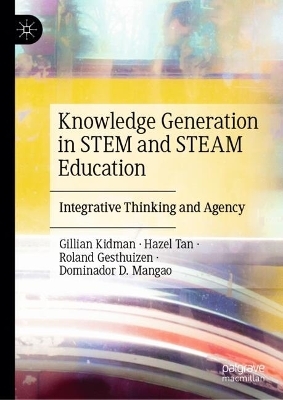
Knowledge Generation in STEM and STEAM Education
Springer International Publishing (Verlag)
978-3-032-03246-1 (ISBN)
This book examines how integrative practices are conceived, described, and taught within the context of STEA+M education. STEA+M education is far more than a disciplinary expansion of STEM education; it is a paradigmatic shift in educational purpose and practice, offering a framework for rethinking how knowledge is produced, whose voices are legitimised, and what purposes education serves. The authors argue that teachers must not only understand the knowledge and skills of a specialist discipline but also understand how to integrate and synthesise knowledge in a cross-disciplinary fashion between several disciplines simultaneously. For teachers to effectively integrate multiple educational domains, they must engage students in integrative STEA+M thinking practices such as inquiry-based learning, student agency, and neo-twenty-first century skills. This must occur not only within, but also across, disciplines in an integrated manner, whether this involves multi-, inter-, or trans-disciplinary approaches. This skill is defined as integrative inquiry literacy.
Gillian Kidman is from Monash University, Australia. She specialises in science, mathematics, geography education, and integrative STEM/STEAM education.
Hazel Tan is from Monash University, Australia. She specialises in secondary mathematics and integrative STEM/STEAM education.
Roland Gesthuizen is a senior teacher with the Department of Education Victoria. He specialises in digital pedagogy and computational thinking.
Dominador Dizon Mangao is from the Philippine Normal University, Philippines. He is a specialist in Science Education.
Part A: Foundations of Integrative Thinking in STEA+M Education.- Chapter 1 Neuroeducation in STEM: Bridging Cognitive Science and Pedagogy for Effective Learning.- Chapter 2 Disciplinary Thinking in STEM: Balancing Epistemologies for Integrated Education.- Chapter 3 The Plexus Model of STEA+M Education: Fostering Agency, Innovation, and Societal Engagement.- Chapter 4 Interdisciplinary Thinking in STEA+M: Cognitive Integration, Makerspaces, and Knowledge Creation.- Part B: Expanding the Boundaries of STEA+M Education.- Chapter 5 21st Century Skills and STEM Education: A Review of Literature.- Chapter 6 STEA+M Thinking Systems as Neo-21st Century Skills.- Chapter 7 STEA+M Education and Hidden Curriculum Contexts.- Part C: Implementing Integrative STEA+M Pedagogies and Professional Development.- Chapter 8 Integrating Design Thinking in STEA+M Education: The PaDL Framework for Planning and Learning.- Chapter 9 Interdisciplinary STEM Curriculum Integration: Exploring Teacher-Developed Curriculum Goals .- Chapter 10 Interdisciplinary Integration for Future-Making Education in STEAM.
| Erscheinungsdatum | 02.11.2025 |
|---|---|
| Zusatzinfo | XXXII, 372 p. 22 illus., 13 illus. in color. |
| Verlagsort | Cham |
| Sprache | englisch |
| Maße | 148 x 210 mm |
| Themenwelt | Sozialwissenschaften ► Pädagogik ► Schulpädagogik / Grundschule |
| Schlagworte | inquiry approach • integrative literacy inquiry • Knowledge Integration • STEAM education • Teaching and learning |
| ISBN-10 | 3-032-03246-6 / 3032032466 |
| ISBN-13 | 978-3-032-03246-1 / 9783032032461 |
| Zustand | Neuware |
| Informationen gemäß Produktsicherheitsverordnung (GPSR) | |
| Haben Sie eine Frage zum Produkt? |
aus dem Bereich