


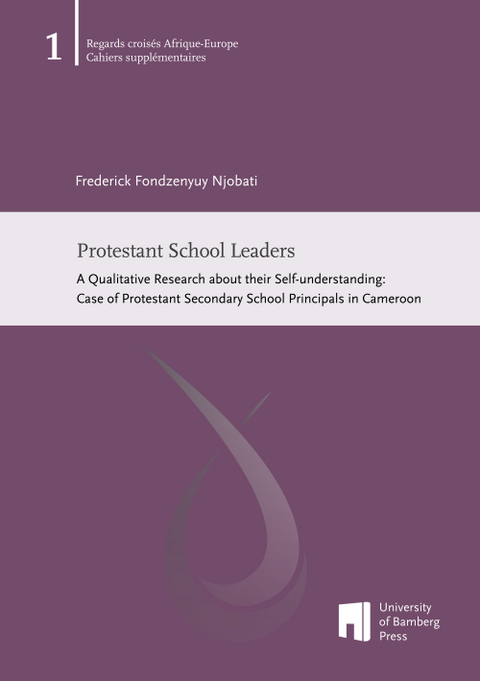
Protestant School Leaders : A Qualitative Research about their Self-understanding
Case of Protestant Secondary School Principals in Cameroon
Seiten
2025
University of Bamberg Press (Verlag)
978-3-98989-058-9 (ISBN)
University of Bamberg Press (Verlag)
978-3-98989-058-9 (ISBN)
The study is concerned with the self-understanding of Protestant secondary school principals about their school leadership in the context of Cameroon where education is rooted in missionary and colonial times. The debate at international level on whether or not none-state schools are widening inequality gaps and whether school leadership is contributing to enlightenment or to fundamentalism matter in researching about the Protestant school profile and leadership. The study therefore seeks to answer the research question, “What are the perceptions of secondary school principals of Protestant schools about their school leadership?”
The research was conceptualized as exploratory and hypothesis-generating within the qualitative approach. It used semi-structured interviews to collect data from 26 theoretically sampled secondary school principals. The data was analyzed by qualitative content analysis using the grounded theory in an iterative deductive-inductive way. Through the generalization process of abduction and by a deep analysis of the empirical data, the criteria which constitute the categories of quality first emerged. Thereafter, six ideal types of leading understanding were generated and consists of (1) call for superiority leadership, (2) state-conformational leadership, (3) ecclesiastical leadership, (4) community-participatory leadership, (5) vocation to serve leadership and (6) diaconal leadership. Further analysis revealed a multi-dimensional self-understanding by principals on the Protestant ethos of schools and their leadership function. Thus, not all the six ideal leadership types are contributing to quality education. On the one hand, there are fundamentalist leaders focusing on normative aspects of discipline while on the other hand, there are leaders promoting democratic values or working in a diaconal way, promoting social justice. Furthermore, principals show little awareness of belonging to the church as a global institution.
The research was conceptualized as exploratory and hypothesis-generating within the qualitative approach. It used semi-structured interviews to collect data from 26 theoretically sampled secondary school principals. The data was analyzed by qualitative content analysis using the grounded theory in an iterative deductive-inductive way. Through the generalization process of abduction and by a deep analysis of the empirical data, the criteria which constitute the categories of quality first emerged. Thereafter, six ideal types of leading understanding were generated and consists of (1) call for superiority leadership, (2) state-conformational leadership, (3) ecclesiastical leadership, (4) community-participatory leadership, (5) vocation to serve leadership and (6) diaconal leadership. Further analysis revealed a multi-dimensional self-understanding by principals on the Protestant ethos of schools and their leadership function. Thus, not all the six ideal leadership types are contributing to quality education. On the one hand, there are fundamentalist leaders focusing on normative aspects of discipline while on the other hand, there are leaders promoting democratic values or working in a diaconal way, promoting social justice. Furthermore, principals show little awareness of belonging to the church as a global institution.
| Erscheinungsdatum | 10.07.2025 |
|---|---|
| Reihe/Serie | Regards croisés Afrique-Europe. Cahiers supplementaires ; 1 |
| Verlagsort | Bamberg |
| Sprache | englisch |
| Maße | 148 x 210 mm |
| Gewicht | 475 g |
| Themenwelt | Sozialwissenschaften ► Pädagogik ► Bildungstheorie |
| Sozialwissenschaften ► Pädagogik ► Erwachsenenbildung | |
| Schlagworte | Kamerun • Leadership • Qualitative research • Schulleiter • Secondary School • Sekundarstufe • Selbstverständnis • Sub-Saharan Africa |
| ISBN-10 | 3-98989-058-1 / 3989890581 |
| ISBN-13 | 978-3-98989-058-9 / 9783989890589 |
| Zustand | Neuware |
| Informationen gemäß Produktsicherheitsverordnung (GPSR) | |
| Haben Sie eine Frage zum Produkt? |
Mehr entdecken
aus dem Bereich



aus dem Bereich
Analysen und Beispiele aus Wissenschaft und Praxis
Buch (2025)
Kallmeyer (Verlag)
CHF 49,90
Buch | Softcover (2024)
Carl Link (Verlag)
CHF 68,60


