


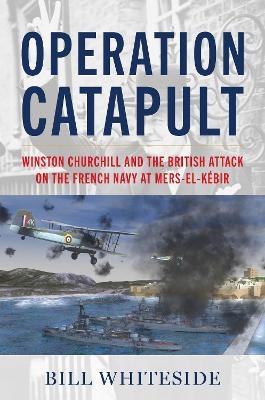
Operation Catapult
Winston Churchill and the British Attack on the French Navy at Mers-el-Kebir
Seiten
2026
Naval Institute Press (Verlag)
978-1-68247-969-8 (ISBN)
Naval Institute Press (Verlag)
978-1-68247-969-8 (ISBN)
- Noch nicht erschienen (ca. April 2026)
- Versandkostenfrei
- Auch auf Rechnung
- Artikel merken
In July 1940, just weeks after France signed an armistice with Germany, Winston Churchill made one of World War II’s most shocking and controversial decisions: he ordered the Royal Navy to open fire on the French fleet at Mers-el-Kébir, killing more than 1,200 of Britain’s recent allies. The Associated Press called it “the strangest of all naval actions in the world’s history.” Churchill feared that Hitler would seize the powerful French fleet and turn it against Britain, so when French commanders refused British demands to move their ships to Allied ports, he gave the order to strike. The bombardment stunned the world, strained relations between Britain and France, and resonated through Churchill’s speech to Parliament, which, according to one observer, “echoed like no other ever heard in its ancient halls.”
The fallout reached far beyond the Algerian coast. In Alexandria, British and French admirals negotiated a fragile truce, but trust between the two navies was shattered. Many Royal Navy officers were tormented by the attack, forced to fire on men they had fought beside only weeks earlier. Even Churchill, who deeply admired France, was anguished by his decision. Through the intertwined stories of French admiral Jean Louis Xavier François Darlan and British vice admiral Sir James Somerville—leaders tested by loyalty, duty, and the chaos of war—this dramatic episode reveals the tension, sacrifice, and unflinching resolve that defined Churchill’s wartime leadership.
The fallout reached far beyond the Algerian coast. In Alexandria, British and French admirals negotiated a fragile truce, but trust between the two navies was shattered. Many Royal Navy officers were tormented by the attack, forced to fire on men they had fought beside only weeks earlier. Even Churchill, who deeply admired France, was anguished by his decision. Through the intertwined stories of French admiral Jean Louis Xavier François Darlan and British vice admiral Sir James Somerville—leaders tested by loyalty, duty, and the chaos of war—this dramatic episode reveals the tension, sacrifice, and unflinching resolve that defined Churchill’s wartime leadership.
Bill Whiteside, a member of the International Churchill Society, is a writer and researcher focused on Winston Churchill and the Royal Navy. He holds a BS in management from the University of Notre Dame and lives in Lancaster, Pennsylvania.
| Erscheint lt. Verlag | 30.4.2026 |
|---|---|
| Zusatzinfo | 6 Maps, 10 B-W Photos |
| Verlagsort | Annopolis |
| Sprache | englisch |
| Maße | 152 x 228 mm |
| Themenwelt | Geschichte ► Allgemeine Geschichte ► 1918 bis 1945 |
| Geisteswissenschaften ► Geschichte ► Regional- / Ländergeschichte | |
| Geschichte ► Teilgebiete der Geschichte ► Militärgeschichte | |
| Sozialwissenschaften ► Politik / Verwaltung | |
| ISBN-10 | 1-68247-969-2 / 1682479692 |
| ISBN-13 | 978-1-68247-969-8 / 9781682479698 |
| Zustand | Neuware |
| Informationen gemäß Produktsicherheitsverordnung (GPSR) | |
| Haben Sie eine Frage zum Produkt? |
Mehr entdecken
aus dem Bereich



aus dem Bereich
Deutschland 1933 bis 1945
Buch | Hardcover (2025)
S. Fischer (Verlag)
CHF 47,60
ein Psychologe erlebt das Konzentrationslager
Buch | Hardcover (2024)
Kösel (Verlag)
CHF 30,80


