


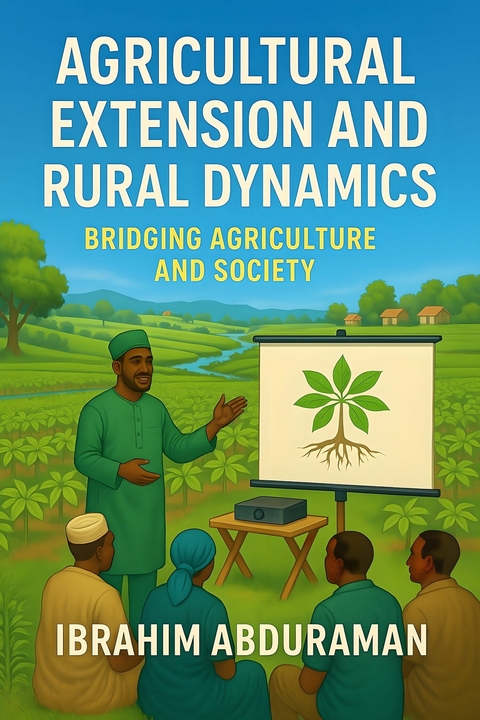
Agricultural Extension and Rural Dynamics (eBook)
293 Seiten
Publishdrive (Verlag)
978-0-00-096117-4 (ISBN)
Agricultural Extension and Rural Dynamics: Bridging Agriculture and Society is a transformative guide that illuminates the critical nexus between agricultural innovation, rural sociology, and sustainable development. Tailored to the vibrant and diverse Nigerian context, this textbook equips students, extension agents, researchers, and policymakers with the knowledge and tools to empower rural farmers, bridge the gap between scientific advancements and indigenous practices, and foster resilient agricultural systems. Spanning 27 insightful chapters, the book delves into the multifaceted world of agricultural extension, from its foundational objectives to cutting-edge ICT-based delivery methods. It explores how extension services can catalyze mass adoption of improved farming practices by addressing socio-cultural barriers, leveraging local leadership, and harnessing communication strategies like the S-M-C-R model. Readers will discover the power of participatory approaches-such as farmer field schools, result demonstrations, and agricultural festivals-in fostering farmer engagement and innovation adoption. The textbook emphasizes the integration of rural sociology, highlighting how social norms, tribal diversity, and group dynamics shape agricultural outcomes in Nigeria. It offers practical strategies for navigating challenges like low literacy, gender inequities, and climate variability, while promoting inclusivity for women, youth, and marginalized groups. From designing culturally sensitive teaching materials to planning robust extension programs, the book provides actionable insights grounded in principles like sustainability, client-orientation, and stakeholder collaboration.
Key highlights include:
1. Bridging Knowledge Gaps: Strategies to align scientific research with farmers' indigenous knowledge, ensuring relevance and adoption. 2. Innovative Communication: The role of audio-visual aids, ICT tools, and mass media in reaching diverse rural audiences. 3. Community Empowerment: The pivotal roles of local leaders, paraprofessionals, and social institutions in driving extension success. 4. Program Planning and Evaluation: Tools for designing, executing, and assessing impactful extension initiatives using Bloom's Taxonomy and operational models. 5. Socio-Cultural Sensitivity: Tailored approaches to address Nigeria's ethnic, religious, and social diversity in extension work.
With its blend of theory, case studies, and practical applications, Agricultural Extension and Rural Dynamics is more than a textbook-it's a roadmap for transforming Nigeria's rural landscapes. It inspires readers to cultivate not just crops, but thriving communities, by bridging agriculture and society for a sustainable future.
CHAPTER ONE
INTRODUCTION
1.1 Introduction
Agriculture remains the backbone of many economies, particularly in developing countries like Nigeria, where it supports livelihoods, ensures food security, and drives economic development. However, the gap between scientific advancements in agriculture and their practical application in rural settings poses a significant challenge to achieving sustainable agricultural growth. Agricultural extension and rural sociology are two interrelated disciplines that address this challenge by facilitating the transfer of knowledge and technologies to farmers while understanding the social, cultural, and economic contexts that shape their lives. Together, these fields provide a holistic framework for empowering rural communities, enhancing agricultural productivity, and fostering sustainable development in an era of global challenges such as climate change, population growth, and market volatility.
Agricultural extension is a dynamic process that goes beyond the mere dissemination of technical information. It involves educating farmers, building their capacity to adopt innovations, and enabling them to navigate complex agricultural and environmental challenges. Extension services act as a conduit between research institutions, policymakers, and rural farmers, ensuring that scientific discoveries are translated into practical solutions that improve yields, incomes, and resilience. In Nigeria, where smallholder farmers dominate the agricultural landscape, extension plays a critical role in addressing issues such as low productivity, limited access to markets, and vulnerability to climate variability (Olorunfemi, Oladele & Fapojuwo, 2020). By employing participatory approaches, extension programs empower farmers to take ownership of their development, fostering self-reliance and sustainable practices.
Rural sociology complements agricultural extension by providing a deep understanding of the social structures, cultural norms, and community dynamics that influence farmers’ behaviours and decision-making processes. Rural communities are not homogenous; they are shaped by diverse tribal affiliations, kinship systems, and socio-cultural values that affect how innovations are perceived and adopted. For instance, in Nigeria, the social organization of ethnic groups such as the Hausa, Igbo, Yoruba, and Fulani influences marriage patterns, inheritance systems, and community leadership, all of which impact the effectiveness of extension interventions (Adebayo & Idowu, 2019). Rural sociology examines these factors, offering insights into how extension programs can be tailored to align with local values and social systems, thereby increasing their acceptance and impact.
The integration of agricultural extension and rural sociology is particularly relevant in the 21st century, as global agriculture faces unprecedented challenges. Climate change threatens crop yields and livelihoods, while technological advancements, such as precision agriculture and digital extension tools, offer new opportunities for innovation. At the same time, socio-economic issues such as poverty, gender inequality, and rural-urban migration require extension services to adopt a broader, more inclusive approach that addresses not only technical but also social and economic barriers. This textbook aims to provide a comprehensive exploration of these interconnected disciplines, equipping students, extension professionals, and policymakers with the knowledge and skills to design and implement effective extension programs. It covers foundational concepts such as the principles of extension, communication strategies, and innovation adoption, as well as advanced topics like programme planning, leadership, and the sociological underpinnings of rural development. By bridging the gap between theory and practice, this book seeks to empower readers to contribute meaningfully to agricultural transformation and rural development, particularly in the Nigerian context.
1.2 Definition of Agricultural Extension
Agricultural extension is a multifaceted and dynamic process that encompasses the transfer of knowledge, technologies, and skills from agricultural research systems to farmers and other stakeholders in the agricultural value chain. It is defined as an educational and advisory system designed to empower farmers by providing them with the tools, information, and support needed to improve their productivity, sustainability, and livelihoods (Ragasa & Mazunda, 2018). The Food and Agriculture Organization (FAO) describes agricultural extension as a broad set of activities, including training, advisory services, technology dissemination, and capacity building, aimed at enhancing farmers’ decision-making capabilities and addressing agricultural challenges (FAO, 2019). This definition highlights the dual role of extension as both an educational process and a practical mechanism for agricultural development.
At its core, agricultural extension is about enabling farmers to make informed choices by providing access to relevant, timely, and context-specific information. It involves not only the dissemination of technical knowledge—such as improved seed varieties, pest management techniques, or soil fertility practices—but also the fostering of behavioural changes, skill development, and problem-solving abilities. Extension services are inherently client-oriented, focusing on the needs, aspirations, and constraints of farmers in their local environments. This requires extension agents to engage with farmers where they live and work, using participatory methods to ensure that interventions are culturally appropriate and practically feasible (Davis & Sulaiman, 2016). For example, in Nigeria, extension programs must account for the diverse agro-ecological zones and socio-cultural contexts of rural communities, from the savannahs of the north to the rainforests of the south.
Agricultural extension is also characterized by its two-way communication process, which distinguishes it from traditional top-down approaches to knowledge transfer. Extension agents not only deliver information to farmers but also collect feedback on their challenges, needs, and experiences, which is relayed back to researchers and policymakers. This iterative process ensures that agricultural innovations are refined to meet the specific needs of farmers, enhancing their relevance and adoption rates (Olorunfemi et al., 2020). For instance, feedback from farmers about the suitability of a new crop variety can inform research institutions to develop more resilient or locally adapted strains.
In the context of rural sociology, agricultural extension must navigate the complex social systems that shape rural life. Factors such as social norms, gender roles, and community leadership structures influence how farmers perceive and adopt new technologies. For example, in some Nigerian communities, traditional gender norms may limit women’s access to extension services, necessitating targeted interventions to ensure inclusivity (FAO, 2019). Extension also involves building trust and fostering collaboration with local leaders, farmers’ associations, and community groups to enhance the effectiveness of programs.
Moreover, modern agricultural extension has evolved to incorporate new tools and approaches, such as Information and Communication Technologies (ICTs) like mobile apps, GIS, and drones, which enable real-time information sharing and precision agriculture (FAO, 2019). These innovations have expanded the scope of extension, making it possible to reach larger and more diverse audiences. In summary, agricultural extension is a participatory, educational, and communicative process that empowers farmers by bridging the gap between scientific knowledge and practical application, fostering sustainable agricultural development, and improving rural livelihoods in diverse socio-cultural contexts.
1.3 History of Agricultural Extension
The history of agricultural extension reflects a global evolution of efforts to disseminate agricultural knowledge, improve farming practices, and address food security and rural development challenges. From its origins in 19th-century Europe and North America to its adaptation in developing countries like Nigeria, agricultural extension has undergone significant transformations in response to changing agricultural, social, and technological contexts. This section traces the key milestones in the development of agricultural extension, with a focus on its global evolution and its specific trajectory in Nigeria.
1.3.1 Early Beginnings in Europe and North America (19th Century)
The roots of agricultural extension can be traced to the 19th century, when rapid industrialization and population growth in Europe and North America created an urgent need to improve agricultural productivity. In the United Kingdom, the establishment of agricultural societies, such as the Royal Agricultural Society of England in 1838, marked the beginning of organized efforts to share farming knowledge. These societies promoted improved farming techniques through publications, agricultural shows, and demonstrations, laying the groundwork for modern extension systems (Jones & Garforth, 2017). In Ireland, the “itinerant instructors” of the 1840s provided hands-on training to farmers, a precursor to modern extension agents.
In the United States, the formalization of agricultural extension began with the Morrill Act of 1862, which established land-grant universities tasked with providing practical education in agriculture and related fields. These institutions became hubs for agricultural research and outreach, disseminating knowledge to rural communities. The term “extension” emerged in the U.S. to describe the...
| Erscheint lt. Verlag | 23.6.2025 |
|---|---|
| Sprache | englisch |
| Themenwelt | Sozialwissenschaften ► Pädagogik |
| ISBN-10 | 0-00-096117-5 / 0000961175 |
| ISBN-13 | 978-0-00-096117-4 / 9780000961174 |
| Informationen gemäß Produktsicherheitsverordnung (GPSR) | |
| Haben Sie eine Frage zum Produkt? |
 EPUB (Adobe DRM)
Größe: 9,6 MB
Kopierschutz: Adobe-DRM
Adobe-DRM ist ein Kopierschutz, der das eBook vor Mißbrauch schützen soll. Dabei wird das eBook bereits beim Download auf Ihre persönliche Adobe-ID autorisiert. Lesen können Sie das eBook dann nur auf den Geräten, welche ebenfalls auf Ihre Adobe-ID registriert sind.
Details zum Adobe-DRM
Dateiformat: EPUB (Electronic Publication)
EPUB ist ein offener Standard für eBooks und eignet sich besonders zur Darstellung von Belletristik und Sachbüchern. Der Fließtext wird dynamisch an die Display- und Schriftgröße angepasst. Auch für mobile Lesegeräte ist EPUB daher gut geeignet.
Systemvoraussetzungen:
PC/Mac: Mit einem PC oder Mac können Sie dieses eBook lesen. Sie benötigen eine
eReader: Dieses eBook kann mit (fast) allen eBook-Readern gelesen werden. Mit dem amazon-Kindle ist es aber nicht kompatibel.
Smartphone/Tablet: Egal ob Apple oder Android, dieses eBook können Sie lesen. Sie benötigen eine
Geräteliste und zusätzliche Hinweise
Buying eBooks from abroad
For tax law reasons we can sell eBooks just within Germany and Switzerland. Regrettably we cannot fulfill eBook-orders from other countries.
aus dem Bereich


