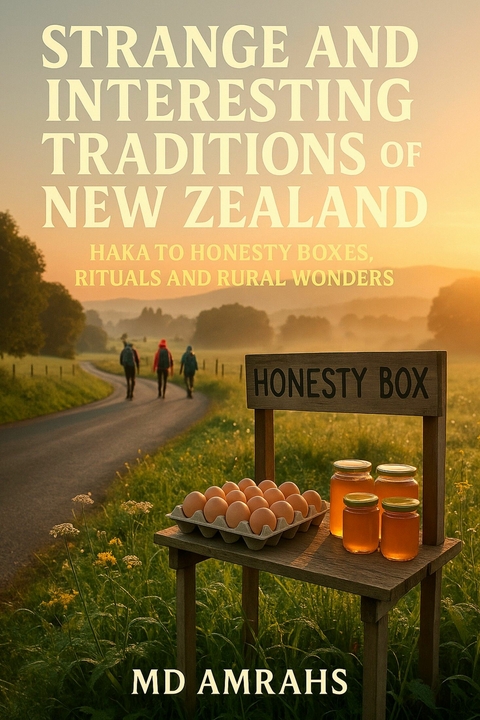
Strange and Interesting Traditions of New Zealand (eBook)
155 Seiten
Publishdrive (Verlag)
978-0-00-095863-1 (ISBN)
This book captures the heart of New Zealand's culture through twenty-one everyday traditions that reflect trust, community, and connection to land. From the sizzling Election Day sausage to honesty boxes on rural roadsides, these customs reveal how small acts shape national identity. Each chapter highlights a tradition's origin, its Māori and settler roots, and how it lives on today-from the powerful haka and Christmas parades with summer flair to whitebait fritters cooked in family kitchens. Written in clear, friendly language, the book is suitable for all ages, offering readers a welcoming glimpse into Kiwi life. Whether you're a visitor, a lifelong resident, or simply curious about New Zealand's spirit, the stories will inspire appreciation for the moments that bring people together. You'll find cultural insights, historical context, and gentle humor, all celebrating the beauty of shared rituals in homes, towns, and fields across the country.
1. Haka (Traditional War Dance) Performed by Māori
The haka carries the beating heart of Aotearoa, New Zealand, alive in every stomping foot and every guttural chant. Born among the Māori tribes centuries ago, warriors performed the haka to prepare themselves for battle, to honor their ancestors, and to unite their people under a shared purpose. When they first glimpsed approaching enemies, they would gather on the edge of their pā, or fortified village, faces painted, eyes wide, muscles tense, and voices rising in a thunderous call that shook the very air. That moment, charged with fierce intent and deep respect for one’s heritage, formed the cornerstone of this powerful tradition. It served not only as a warning to foes but also as an affirmation of collective strength and identity, binding each performer to the line of chiefs, hunters, and explorers who came before them.
The origins of the haka lie in Māori cosmology and social structure, where oral histories trace the dance back to the god Tāne, who is said to have carved the first human from clay. Māori chanted the first rituals in his honor, celebrating life, the forest, and the bonds that unite humankind. Although warriors most often performed the haka in preparation for combat, families and communities also used the dance to welcome distinguished guests, commemorate important occasions, and mark milestones such as births, marriages, and farewells. Each gesture and vocal intonation carried meaning: a sudden thrust of the hips could recall the swift movement of a taniwha, a mythical water creature. At the same time, extended tongues challenged opponents without spilling a drop of blood. At its core, the haka expresses emotions that range from pure triumph and defiance to profound mourning and solemn respect.
When visitors arrive in New Zealand today, they often witness haka at marae, the communal meeting grounds where tribes gather for events large and small. A troupe of men lines up, their bodies painted with intricate swirling patterns called tā moko, each design specific to the wearer’s waka (ancestral canoe) and iwi (tribe). On a signal, they burst forward in unison, feet stamping like the thunder of Tūmatauenga, the god of war. Voices echo through valleys and across beaches, the rolling cadence rising and falling like the surf itself. Tourists feel the vibrations beneath their feet and look on in awe as the performers lock eyes with them, welcoming them into a shared space of dignity and empathy. After the final shout, the group bows, heads lowered, and offers the hongi, pressing noses together in an exchange of breath, declaring that the visitors and hosts now share life force.
The haka’s transition from war cry to global phenomenon began in the early 20th century, when New Zealand’s national rugby team, known as the All Blacks, incorporated it into their pre-match rituals. Initially, critics questioned whether a dance rooted in warfare was suitable for a civilized sport. Still, when crowds saw the way the haka galvanized the team, fueling an almost mystical connection between players and spectators, it became an instant symbol of unity. Opponents learned to stand respectfully as the haka thundered on the field, a ritual that now marks every international fixture. Beyond rugby, sporting teams at every level—from school leagues to professional clubs—utilize the haka to foster unity, sharpen focus, and instill pride. The collective breath, held for a split second before release, becomes a moment of complete presence, a chance to shed personal fears and embrace the strength of a group moving as one.
While the All Blacks remain the most famous exponent of haka, countless other groups perform it in ways that reflect their own experiences. Women’s teams devised haka with powerful yet graceful movements, combining high kicks with fierce facial expressions. Secondary schools teach haka in culture classes, shaping young people’s sense of belonging and teaching them that heritage flows through their veins as they grow. Even companies sometimes ask Māori artists to lead a haka at annual conferences, breaking down hierarchies to foster collaboration and empathy. In this modern context, the haka retains its authenticity because every performance includes a clear link to the words and actions that can be traced back to tribal narratives. Each tribe still sings a haka specific to its history, ensuring that no two experiences ever appear precisely the same.
Geographically, haka resonates from the snow-draped peaks of the Southern Alps to the windswept beaches of Muriwai. In Northland, where the land meets the misty Pacific, local iwi stage a haka at dawn, the sight of their silhouettes against the red horizon becoming emblematic of resilience. Farther south, on the volcanic soils of Rotorua, lakes shimmer with steam from geothermal springs, creating an otherworldly backdrop for evening performances. Visitors flock to cultural shows that weave haka with poi dances—women twirling balls of flax on cords—to illustrate the harmony between warrior spirit and feminine grace. In small towns throughout the country, marae invite the public to participate in wānanga, educational workshops, where people learn the language of haka through movement and song. Such experiences have transformed haka from a spectacle into a living classroom.
The popularity of haka extends beyond New Zealand’s shores, as expatriate Māori communities spread throughout the globe. In cities like London, Los Angeles, and Sydney, Māori associations host annual gatherings where they challenge local rugby clubs to haka showdowns. These events bring friends of New Zealand—often referred to as Pākehā—into closer contact with Māori culture, leading to a deeper understanding and lasting friendships. Some universities now offer degrees in indigenous performing arts, with visiting Māori experts teaching haka technique and history. As students practice choreography in lecture halls once dominated by classical ballet, they witness haka’s ability to transport them across time and continent, forging empathy between cultures that might otherwise remain distant.
Beyond its cultural prominence, haka contributes to New Zealand’s tourism industry in surprising ways. Travel writers routinely cite it as a reason to visit, and tour operators package haka workshops alongside jet boat rides and wine tours. Small bed-and-breakfast hosts sometimes open each morning with a simple group version of haka, bringing guests closer to the land’s beating heart. Adventure athletes, from surfers to climbers, perform haka before tackling challenging routes, believing that the dance unlocks mental resilience needed for extreme conditions. Even cruise ships that dock in Auckland arrange for a farewell haka on the wharf, leaving sailors and passengers alike with a final taste of the country’s indomitable spirit. As more people seek authentic cultural encounters rather than generic attractions, haka remains a centerpiece in New Zealand’s travel brochure.
Lesser-known facts surrounding the haka often surprise those who assume it exists in only one form. The haka called Tūtūrehu, for example, stands apart because it immerses performers in shimmering cloaks of feathers, moving slowly and deliberately to mimic forest spirits. In contrast, the Kapa o Pango, created in 2005 for the All Blacks, introduces a throat-slitting gesture that spurs lively debate about appropriation and respect. Some elders view the move as too graphic, while others defend it as an evolution that keeps the haka relevant to younger generations. Meanwhile, the Haka Taparahi, performed without weapons, highlights the dancer’s voice and posture. At festivals like Te Matatini, the national kapa haka competition, dozens of haka variations unfold back to back, each one a testament to innovation grounded in centuries of tradition.
The unique characteristics of the haka lie not only in its visual power but also in its verbal richness. Each haka contains a series of verses that recount tribal victories, ancestral migrations, or natural wonders. When performers chant lines about Nga Pōhutukawa, the crimson blossom that crowns coastal cliffs, they invoke the beauty of their land just as vividly as they summon their fighting spirit. Some haka reference the moa, a giant bird that once roamed New Zealand’s forests, using its extinct status as a warning to preserve cultural memory. Others call upon Tāwhirimātea, the god of weather, to summon wind and rain in their favor. Through these stories, whakapapa—genealogy—flows into the present moment, reminding everyone that they stand on ground consecrated by countless footsteps before their own.
Scholars have traced parallels between the haka and other indigenous war dances worldwide; yet, the haka’s seamless blending of vocal and physical elements remains unrivaled. Anthropologists note that the haka’s rapid switch between high-pitched calls and deep, rhythmic stomps engages both the mind and body, forging a state of collective flow. Psychologists studying performance stress have found that groups who practice haka report lower anxiety levels before competitions and feel more cohesive afterward. These findings suggest that haka operates as an embodied meditation, enabling participants to channel adrenaline into communal energy rather than letting it fracture their focus. That modern research aligns with Māori wisdom underscores the haka’s timeless effectiveness as both a ritual and a therapy.
As New Zealand moves into the future, the haka continues to evolve without losing its foundational spirit. Te reo Māori, the indigenous language, enjoys a renaissance, and haka lyrics have expanded to include contemporary themes such as environmental protection and social...
| Erscheint lt. Verlag | 4.7.2025 |
|---|---|
| Sprache | englisch |
| Themenwelt | Sozialwissenschaften ► Politik / Verwaltung |
| ISBN-10 | 0-00-095863-8 / 0000958638 |
| ISBN-13 | 978-0-00-095863-1 / 9780000958631 |
| Informationen gemäß Produktsicherheitsverordnung (GPSR) | |
| Haben Sie eine Frage zum Produkt? |
 EPUB (Adobe DRM)
Größe: 761 KB
Kopierschutz: Adobe-DRM
Adobe-DRM ist ein Kopierschutz, der das eBook vor Mißbrauch schützen soll. Dabei wird das eBook bereits beim Download auf Ihre persönliche Adobe-ID autorisiert. Lesen können Sie das eBook dann nur auf den Geräten, welche ebenfalls auf Ihre Adobe-ID registriert sind.
Details zum Adobe-DRM
Dateiformat: EPUB (Electronic Publication)
EPUB ist ein offener Standard für eBooks und eignet sich besonders zur Darstellung von Belletristik und Sachbüchern. Der Fließtext wird dynamisch an die Display- und Schriftgröße angepasst. Auch für mobile Lesegeräte ist EPUB daher gut geeignet.
Systemvoraussetzungen:
PC/Mac: Mit einem PC oder Mac können Sie dieses eBook lesen. Sie benötigen eine
eReader: Dieses eBook kann mit (fast) allen eBook-Readern gelesen werden. Mit dem amazon-Kindle ist es aber nicht kompatibel.
Smartphone/Tablet: Egal ob Apple oder Android, dieses eBook können Sie lesen. Sie benötigen eine
Geräteliste und zusätzliche Hinweise
Buying eBooks from abroad
For tax law reasons we can sell eBooks just within Germany and Switzerland. Regrettably we cannot fulfill eBook-orders from other countries.
aus dem Bereich